




PTC is a complex signaling and communications technology that will provide critical safety redundancies to the commuter rail industry.
Commuter rail makes significant, substantial PTC progress: APTA
Ninety-six percent of 16,722 wayside (on track equipment) installations have been completed.
November 13, 2018
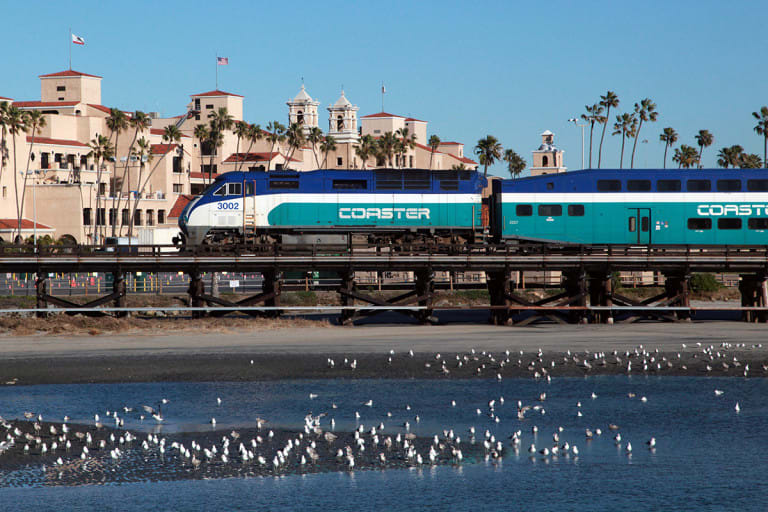
The NCTD expect to have full interoperable operations on all trains on the San Diego portion of the Los Angeles-San Diego-San Luis Obispo corridor by Dec. 31, 2018. Photo: NCTD
3 min to read
The NCTD expect to have full interoperable operations on all trains on the San Diego portion of the Los Angeles-San Diego-San Luis Obispo corridor by Dec. 31, 2018. Photo: NCTD
The American Public Transportation Association (APTA) announced that the commuter rail industry has made significant progress in installing Positive Train Control (PTC) in the third quarter ending September 30.
The commuter rail industry has made substantial PTC progress, and as of Sept. 30, 2018:
100% of spectrum has been acquired.
96% of 16,722 wayside (on track equipment) installations have been completed.
94% of 13,400 pieces of onboard equipment have been installed on locomotives and cab cars, etc.
89% of back office control systems are ready for operation.
85% of 13,543 employees have been trained in PTC.
68% of 28 railroads are in PTC operation, in Revenue Service Demonstration (RSD), or are awaiting FRA approval to begin testing.
“Safety isn’t merely a part of our industry’s culture; it’s at the heart of all rail transportation in every technological, logistical, and operational decision we make,” said APTA President and CEO Paul P. Skoutelas. “The significant progress that has been made by the commuter rail industry to install PTC is a demonstration of the industry’s commitment to safety. Commuter railroads are continuing to work tirelessly to meet the Congressional deadline for PTC installation.”
“SEPTA’s PTC implementation efforts have been driven by an early and steadfast commitment from our Board, proactive planning and decision making and some good circumstances. I am proud of how our team has responded to the complexities of installing, testing and implementing a new safety system,” said Southeastern Pennsylvania Transportation Authority GM Jeffrey D. Knueppel. “No two commuter railroads are the same. Each has different operating environments, equipment, host-tenant relationships and ridership — so no two PTC experiences are going to be the same. What we all have in common, though, is a commitment to safety and implementing PTC on our systems.”
Implementing and financing PTC has been, and remains, a huge challenge at Metra, but we are excited to be starting to see the results of our labor,” said Metra CEO/Executive Director Jim Derwinski. “We recently celebrated the completion of the PTC milestones for this year, including finishing the installation of all equipment and starting a Revenue Service Demonstration on one line, and we are on track to full implementation by 2020.”
“Safety is NCTD's top priority. The implementation of PTC has been challenging and we appreciate the efforts of our elected officials, employees and contractors that have contributed to its potential completion,” said Matthew O. Tucker, executive director for North County Transit District. “We expect to have full interoperable operations on all trains on the San Diego portion of the Los Angeles-San Diego-San Luis Obispo corridor by Dec. 31, 2018. PTC will make the rail system safer as we move forward to implement plans to double passenger and freight train operations by 2030.”
More Rail

New York MTA Advances Final Contract for Second Avenue Subway Expansion
Contract Four is the largest in the Second Avenue Subway Phase 2 project and includes construction of station infrastructure, tracks, and signals for the subway expansion, MTA officials said. Work on Contract Four will begin in 2027.
Read More →
San Diego MTS Breaks Monthly Trolley Ridership Record
Agency officials said July’s ridership indicates MTS’s continued recovery from the pandemic.
Read More →
Report Examines NJ TRANSIT Reliability, Funding Challenges
The Garden State Initiative analysis examines the roles of Amtrak infrastructure, fleet management, and agency operations while recommending a more performance-based approach to improving reliability.
Read More →
Stadler, CapMetro Sign Long-Term Rail Fleet Support Agreement
Beginning in 2027, Stadler will provide on-site technical expertise, spare parts support, training, and obsolescence management to help extend the reliability and longevity of CapMetro’s GTW fleet.
Read More →
Biz Briefs: Alstom Lands Canadian Contract, LYT to Supply California TSP, and More
In METRO's latest installment, we take a look at recent news from Complete Coach Works, Beep, FlixBus, and more partnerships making headlines across the transportation sector.
Read More →
CATS Gold Line Marks 5 Years of Service, 2.8M Passenger Trips
With a six-mile expansion planned, the Charlotte streetcar is positioned to connect more neighborhoods and major transit hubs across the region.
Read More →
Why Simulating Pedestrian Movement Has Become Essential for Modern Rail Stations
Pedestrian microsimulation is helping rail planners identify bottlenecks, test station designs, and prepare complex transit hubs for growing passenger volumes.
Read More →
Amtrak Begins Major Construction at New York’s Sunnyside Yard
The new maintenance facility will support Amtrak’s Airo trainsets while improving maintenance efficiency and turnaround times in New York.
Read More →
Chicago Leaders Unveil Plans for O’Hare Airport Express Train
The privately developed project would offer a 15-minute trip between downtown and O’Hare’s Terminal 2, with trains operating every 15 minutes on a dedicated track. The service would use battery-electric trains and three existing freight rail rights-of-way.
Read More →
OCTA Maps Out 30-Year Strategy to Protect Coastal Rail Corridor
The draft feasibility report identifies strategies to protect the coastal rail line for decades as the agency continues near-term stabilization and sand placement efforts.
Read More →