



Commuter rail making significant progress on PTC, study finds
Implementation is expected to cost the commuter rail industry more than $3.5 billion in capital expenditure, which includes over $16 million in spectrum acquisition, as well as $100 million annually in additional maintenance costs.

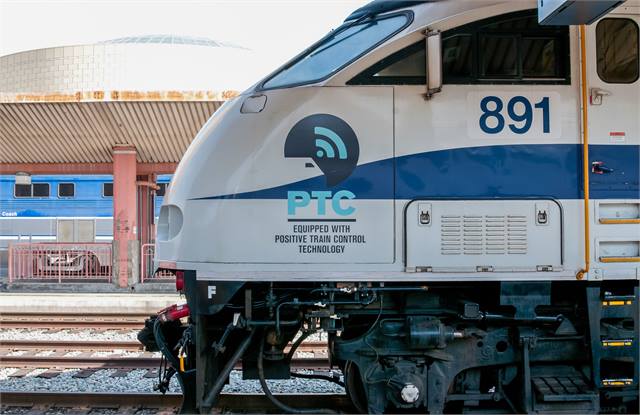
According to updated analyses done by the American Public Transportation Association (APTA), the commuter rail industry is making significant progress on implementing positive train control (PTC) and is on schedule to meet the congressional deadlines.
According to APTA's analyses, some of the results include:
22% of the 3,150 route miles are either in service or in full PTC demonstration awaiting Federal Railroad Administration (FRA) approvals.
27% of the 3,400 locomotives and cab cars are installed with PTC hardware.
40% of the 35 back office control systems are ready for operation.
70% of spectrum has been acquired and 50% of the 1,000 radio towers have been erected.
22% of the 13,000 employees have been trained in PTC.
19% of commuter rail agencies are expected to be 100% PTC equipped by the end of 2016.
"The commuter rail industry has made great strides in implementing positive train control (PTC)," said APTA Acting President/CEO Richard A. White. "This progress on this complex safety technology demonstrates our ongoing commitment to our number one priority of safety."
The delivery of PTC is highly complex, requiring the development of safety critical software; installations on 3,150 miles of track; 3,400 locomotives; 1,000 radio towers; and training more than 13,000 employees, according to APTA.
"The installation of PTC is a heavy lift for the commuter rail industry. From a technical standpoint, PTC was not a mature technology when Congress mandated it in the Rail Safety Improvement Act of 2008," said White. "A number of challenges had to be addressed, not just from the technology aspect, but in costs, scarce qualified resources, and adequate access to track and locomotives for installation and testing."
Douglas Rahden
The APTA analyses was based on surveying APTA members and assessing the quarterly reports submitted to the FRA. It also showed that given the priority of PTC, there remains significant investment backlog for State of Good Repair (SOGR) and expansion projects, including upgrades and replacement to track, bridges, rolling stock, and facilities.
PTC implementation is expected to cost the commuter rail industry more than $3.5 billion in capital expenditure, which includes over $16 million in spectrum acquisition, as well as $100 million annually in additional maintenance costs. As of October 2016, spending by the commuter railroads is estimated to be more than $1.5 billion.
Funding remains a critical concern for the commuter rail agencies, all of which are publicly funded. Currently, $75 million has been awarded to commuter rail agencies through federal grants designated specifically for PTC implementation. Additionally, $199 million was authorized by Congress but has yet to be appropriated. Finally, a $967 million loan from the U.S. Department of Transportation was made available to one commuter rail agency for PTC implementation.
"It is urgent that Congress appropriate additional dollars so that the commuter rail industry has the resources to continue their aggressive actions to meet this congressional deadline," said White.
More Rail
Amtrak, CN Reach Agreements to Strengthen Passenger Rail Service, Safety
The agreement resolves a more than decade-long proceeding before the Surface Transportation Board concerning the terms and conditions for Amtrak services, such as the City of New Orleans, Illini/Saluki, and Wolverine.
Read More →
New York MTA Advances Final Contract for Second Avenue Subway Expansion
Contract Four is the largest in the Second Avenue Subway Phase 2 project and includes construction of station infrastructure, tracks, and signals for the subway expansion, MTA officials said. Work on Contract Four will begin in 2027.
Read More →
San Diego MTS Breaks Monthly Trolley Ridership Record
Agency officials said July’s ridership indicates MTS’s continued recovery from the pandemic.
Read More →
Report Examines NJ TRANSIT Reliability, Funding Challenges
The Garden State Initiative analysis examines the roles of Amtrak infrastructure, fleet management, and agency operations while recommending a more performance-based approach to improving reliability.
Read More →
Stadler, CapMetro Sign Long-Term Rail Fleet Support Agreement
Beginning in 2027, Stadler will provide on-site technical expertise, spare parts support, training, and obsolescence management to help extend the reliability and longevity of CapMetro’s GTW fleet.
Read More →
Biz Briefs: Alstom Lands Canadian Contract, LYT to Supply California TSP, and More
In METRO's latest installment, we take a look at recent news from Complete Coach Works, Beep, FlixBus, and more partnerships making headlines across the transportation sector.
Read More →
CATS Gold Line Marks 5 Years of Service, 2.8M Passenger Trips
With a six-mile expansion planned, the Charlotte streetcar is positioned to connect more neighborhoods and major transit hubs across the region.
Read More →
Why Simulating Pedestrian Movement Has Become Essential for Modern Rail Stations
Pedestrian microsimulation is helping rail planners identify bottlenecks, test station designs, and prepare complex transit hubs for growing passenger volumes.
Read More →
Amtrak Begins Major Construction at New York’s Sunnyside Yard
The new maintenance facility will support Amtrak’s Airo trainsets while improving maintenance efficiency and turnaround times in New York.
Read More →
Chicago Leaders Unveil Plans for O’Hare Airport Express Train
The privately developed project would offer a 15-minute trip between downtown and O’Hare’s Terminal 2, with trains operating every 15 minutes on a dedicated track. The service would use battery-electric trains and three existing freight rail rights-of-way.
Read More →