




RELATED: Cities to spend $141B on smart city projects in 2019
Continental launches smart city mobility, transportation hub
Deployed tech enables future smart cities to boost safety, decrease congestion, reduce pollution and enable autonomous driving.
January 6, 2020

4 min to read
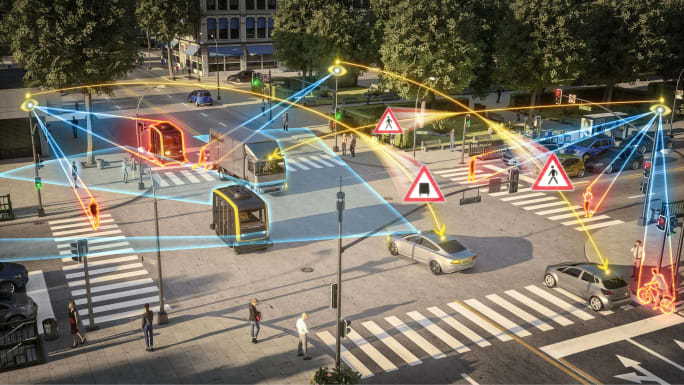
Continental’s Smart City Mobility and Transportation Hubs will have the potential to significantly increase the intersection’s safety, improve traffic flow and reduce pollution. © Continental AG
The technology company Continental today announced a big step toward creating safer, smarter cities with the debut of its smart city mobility and transportation hub in Auburn Hills, Mich. At the center of this Smart City Mobility and Transportation Hub are two "intelligent" intersections equipped with Continental sensors and intelligent software integrated into the infrastructure.
Ultimately, this technology will have the potential to improve traffic flow, add convenience, reduce pollution and, most importantly, significantly increase the intersection’s safety by communicating hidden dangers to approaching connected vehicles and pedestrians. Furthermore, Continental’s Wrong-Way Driver detection system, which warns at-risk drivers in the vicinity of a driver heading the wrong way, has also been installed.
In its current phase, the Smart City Mobility and Transportation Hub is collecting important non-personally identifiable information, like location and movement patterns, about pedestrians, vehicles and other intersection-related activity to create an environment model needed for infrastructure-to-everything (I2X) communication. The environment model provides information about traffic participants (i.e., vehicles and vulnerable road users), traffic infrastructure, static objects, and the overall road situation to connected vehicles.
The Smart City Mobility and Transportation Hub infrastructure is equipped with Continental’s short- and long-range radars. These radar sensors have been deployed on a number of vehicle platforms over the years, and enable functions like adaptive cruise control, blind spot detection, forward collision warning, lane change assist and more. Continental now looks to apply the economies of scale together with its software functions know-how from automotive to the infrastructure.
Data analysis
In addition to the Continental radar sensors, the Auburn Hills Smart City Mobility and Transportation Hub also has a roadside unit and electronic control unit to process data and run the environment model and functions.
This combination can offer a number of benefits, like counting the number of vehicles entering and exiting a specific zone to communicate the number of available parking spaces to interested vehicles.
By connecting to a traffic light controller, traffic flow can be better optimized, reducing not only congestion, but also emissions from idling vehicles.
The solution makes it possible to warn an approaching vehicle about occluded hazards such as pedestrians.
With additional analysis and artificial intelligence, intention prediction of pedestrians becomes possible, helping to alert drivers to pedestrians planning to cross even when the vehicle has the right of way.
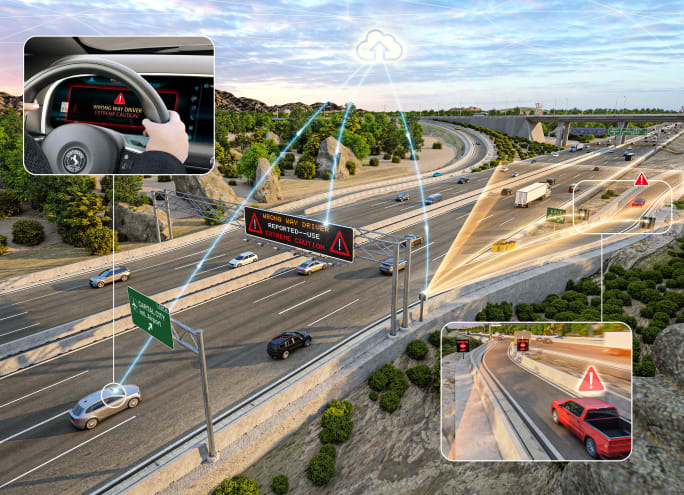
Continental’s Wrong-Way Driver detection system warns at-risk drivers in the vicinity of a driver heading the wrong way. © Continental AG
Wrong-Way Driver detection system
An additional feature added to the Auburn Hills Smart City Mobility and Transportation Hub is Continental’s Wrong-Way Driver (WWD) detection system, which warns at-risk drivers in the vicinity of a driver heading the wrong way. Designed for deployment on freeways and highways, crashes involving a wrong-way driver are often catastrophic. In fact, in the U.S. on average there are approximately 295 crashes producing 389 fatalities each year, trending upwards over the last 5 years. Continental’s WWD detection system will be showcased at CES 2020.
Continental’s WWD detection system technology uses a combination of Continental sensors, connected-vehicle systems and a heatmapping algorithm. The self-learning system automatically defines the roadways and directions of travel, then sends an alert via push notification to a mobile device or connected vehicle informing at-risk vehicles of the wrong-way driver’s location, speed and direction of travel.
This technology is packaged into a fixed-mount I2X roadside unit with low power requirements, making it suitable for solar power. The WWD detection system would be installed on existing poles and gantries near the beginning of highway exit ramps, not only detecting and alerting of wrong-way drivers just entering the highway, but also those who may have entered several miles before.
While this information and alert can be sent to authorities and at-risk drivers via I2V, V2X or SMS, it could potentially be integrated into widely used navigation apps, increasing penetration and effectiveness.
In addition to Auburn Hills, Continental operates a Smart City Mobility and Transportation Hub in Changsha, China, as well as Intelligent Intersections in Walnut Creek, Calif., and Columbus, Ohio, and plans to expand to other cities in the near future.
More New Mobility

From Hardware to Digital Partner: Luminator Charts Its Next Chapter
CEO Magnus Friberg discusses Luminator’s shift toward becoming a digital partner, the growing importance of software and interoperability, and how AI can help agencies improve operations and passenger experience.
Read More →
Biz Briefs: Alstom Lands Canadian Contract, LYT to Supply California TSP, and More
In METRO's latest installment, we take a look at recent news from Complete Coach Works, Beep, FlixBus, and more partnerships making headlines across the transportation sector.
Read More →
CharterUP’s Armir Harris on Technology, AI, and the Future of Group Mobility
In a recent episode of METROspectives, CharterUP Founder/CEO Armir Harris discussed the company’s evolution from an online charter bus marketplace into a technology platform supporting public- and private-sector mobility and much more.
Read More →
Jacksonville’s NAVI Project Charts a New Course for Autonomous Public Transportation
Through its NAVI program, JTA is showing how autonomous vehicles, intelligent infrastructure, and coordinated operations can work together to deliver everyday public transportation.
Read More →
Biz Briefs: Luminator Marks Milestone and More
From manufacturers and suppliers to transit agencies and motorcoach operators, these updates offer a snapshot of the projects, partnerships and business moves driving the industry forward.
Read More →
New Tricks for Old Bureaucracies: Joshua Schank on Making Transit Innovation Stick
Former LA Metro Chief Innovation Officer Joshua Schank discusses why good ideas aren't enough, how transit agencies can overcome resistance to change, and why today's challenges demand more innovation.
Read More →
How DART's GoPass Is Redefining Regional Mobility
Serving 14 transit agencies, GoPass simplifies multimodal travel by allowing riders to plan, pay for, and manage an entire trip through one app.
Read More →
Biz Briefs: OCTA Taps Clean Energy for Hydrogen Station, Stadler to Supply Via Rail Vehicles, and More
From manufacturers and suppliers to transit agencies and motorcoach operators, these updates offer a snapshot of the projects, partnerships and business moves driving the industry forward.
Read More →CharterUP Expands Into New Mobility and Autonomous Transportation
Vice President of New Mobility Stephen Joos discusses how CharterUP is leveraging its nationwide transportation network, technology platform, and autonomous vehicle partnerships to expand into workforce mobility, campus shuttles, and transit solutions.
Read More →
METRO Magazine Announces 2026 Innovative Solutions Awards Winners
Projects Recognized for Advancing Mobility Through Technology, Accessibility, Workforce Innovation, and Operational Excellence
Read More →