



Cities to spend $141 billion on smart city projects in 2019, study says
Global survey of 100 cities reveals roadmap to smart city best practices and the keys to unlocking ROI and managing investmen.

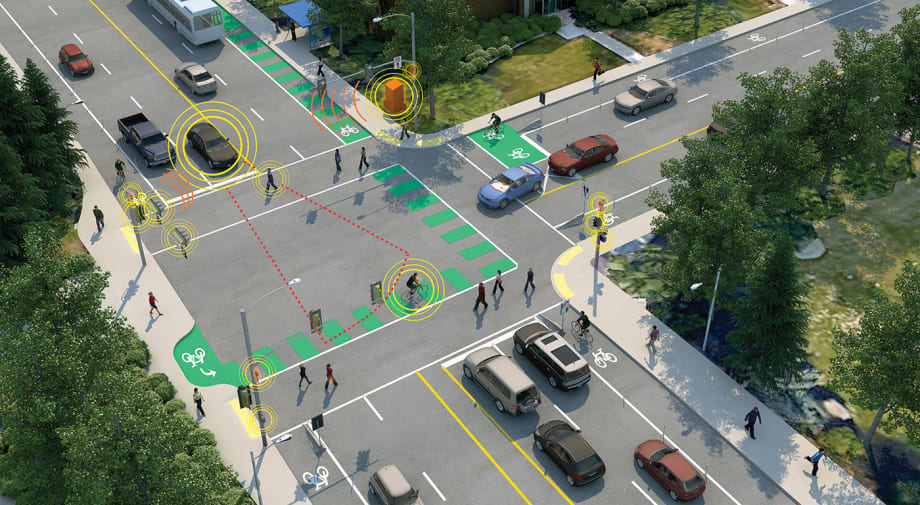
Rendering courtesy Stantec
Rendering courtesy Stantec
A new study shows how cities can go beyond current smart solutions to become “hyperconnected” hubs generating economic, social, and environmental benefits by linking key elements of their urban landscape — including transportation, public health, energy, water, security, and sustainability.
ESI ThoughtLab announced the key findings from its Building a Hyperconnected City program, a year-long global study co-sponsored by Stantec and other industry partners. The survey included 100 metro centers using technology to improve, connect, and secure areas of their urban ecosystem.
Cities surveyed reported that they will spend $141 billion on smart city projects in 2019, which amounts to an average investment of $1.4 billion per city. That investment is projected to rise an average of 14 percent over the next year, the larger portion of which will come from more advanced cities, who will increase their investments by 21 percent.
Central to Building a Hyperconnected City is a roadmap on how to manage urban digital innovation, maximize return on investment (ROI) in new technologies, and ensure benefits reach the business community and citizens. The roadmap compiles practices followed by cities more advanced in project deployment and ROI, which can be adopted by cities at all stages of hyperconnectedness:
Start with an evidence-based business case and continuously monitor performance in order to calculate ROI.
Calculate the full benefits of investment including social, business, economic, and environmental payoffs.
Organize resources effectively within a centralized department and draw on both internal and external staff to operate hyperconnected city programs.
Create a structure such as an innovation hub to capitalize on technological advancements and prioritize cybersecurity.
Use the industry ecosystem effectively by partnering with business and academic communities but keep crucial development and implementation tasks in-house.
Generate more value from data by working with business and other partners, making it accessible to citizens and stakeholders, and guiding data management with well-planned policies.
Ensure citizen engagement by enabling input and two-way communication and prioritize reaching out to disadvantaged populations.
Cities reported that becoming more connected yields benefits across the urban ecosystem. For example, the research revealed that using technology to interlink different areas of public transit programs increases passenger satisfaction by 38 percent, on-time arrival by 33 percent, and transit ridership by 29 percent. Digital public transit payment systems, used by 72 percent of cities surveyed, are particularly effective, with advanced cities recognizing a 6.5 percent ROI.
More advanced cities also reported a higher average ROI from projects at 5.0 percent, versus 1.8 percent for cities cutting their teeth in digital innovation. This indicates a multiplier effect when it comes to smart city investments — the more connected a city becomes, the greater the benefits of those investments.
Challenges. Cities also reported a number of challenges in efforts to become hyperconnected:
Chief among them was uncertainty among citizens and other stakeholders wary of new technologies in the urban environment. The study found that cities like Barcelona and Stockholm alleviate this through effective communication and outreach to build citizen trust and engagement.
Funding for smart initiatives is yet another hurdle, but there are many possible solutions, both public and private, that cities around the world have adopted.
“Good citizen engagement is critical to building healthy, happy, resilient cities,” said Nancy MacDonald, Stantec’s Smart Cities Lead. “Making the case for smart projects and educating the public is the first step. If people in the community feel engaged and see the change as positive, projects will be much more successful. The smartest cities put people first.”
More Technology

From Hardware to Digital Partner: Luminator Charts Its Next Chapter
CEO Magnus Friberg discusses Luminator’s shift toward becoming a digital partner, the growing importance of software and interoperability, and how AI can help agencies improve operations and passenger experience.
Read More →
Beyond the Checklist: A Structured Approach to Transit Maintenance
Reliability-Centered Maintenance helps transit agencies move beyond routine checklists to focus limited resources on the assets and failures that have the greatest impact on safety, reliability, and service.
Read More →
NJ TRANSIT Advances Bus Technology Upgrades Across Statewide Fleet
More than 1,500 buses now feature upgraded technology designed to improve arrival predictions and provide free Wi-Fi, with deployment expected to reach nearly 2,000 buses by the end of 2026.
Read More →

Building a Flexible Path to Transit Electrification
John Hroncich discusses BAE Systems’ modular and scalable approach, lessons learned from decades of real-world operations, and how agencies can identify electrification strategies that fit their fleets.
Read More →
Biz Briefs: Alstom Lands Canadian Contract, LYT to Supply California TSP, and More
In METRO's latest installment, we take a look at recent news from Complete Coach Works, Beep, FlixBus, and more partnerships making headlines across the transportation sector.
Read More →
From Legacy Silos to Conversational Intelligence
What if transit leaders could ask any operational question and get a trusted answer in seconds? Conversational AI is transforming how agencies use their data.
Read More →
USDOT Announces Rail Vehicle Replacement Grants, Chattanooga AV Shuttle Funding
More than $191 million in federal funding will help three transit agencies replace aging rail vehicles and support a new autonomous shuttle service in Chattanooga.
Read More →
Bus Tech Talk: Keeping Transit Technicians Ahead of the Technology Curve
LA Metro’s Obed Mejia discusses technician training, evolving maintenance technology, fleet replacement, and strategies for getting the most out of today’s transit fleets.
Read More →
Biz Briefs: RIPTA Unveils New Frontrunners, Clevland RTA Adds New Siemens, and More
In METRO's latest installment, we take a look at recent news from Siemens, Prevost, Dodge, and more partnerships making headlines across the transportation sector.
Read More →
Why Simulating Pedestrian Movement Has Become Essential for Modern Rail Stations
Pedestrian microsimulation is helping rail planners identify bottlenecks, test station designs, and prepare complex transit hubs for growing passenger volumes.
Read More →