



CTA O’Hare accident caused by fatigue, misplaced track braking system
A fully implemented Transmission Based Train Control system would have prevented this accident by applying the train’s brakes and stopping the train before the train passed the red stop signal, according to the NTSB report.

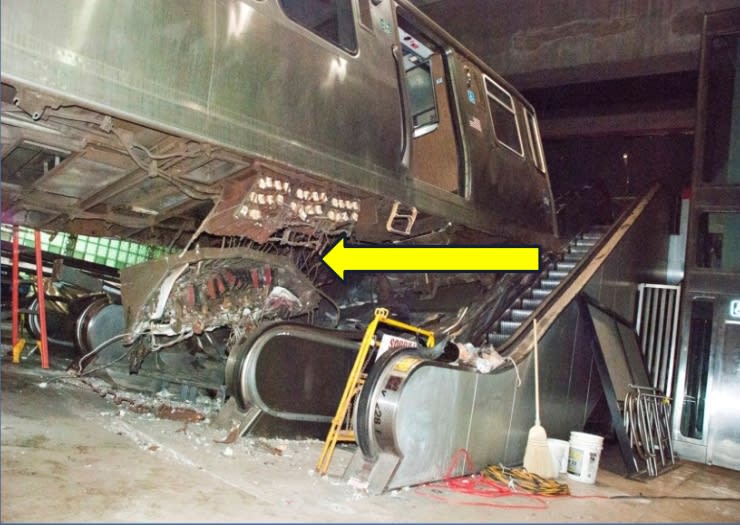
This NTSB photo of the Chicago Transit Authority train identifies the railcar's fault logger, which collects data only after an event.
Photo: NTSB
This NTSB photo of the Chicago Transit Authority train identifies the railcar's fault logger, which collects data only after an event.
Photo: NTSB
The National Transportation Safety Board determined that operator fatigue caused the 2014 Chicago Transit Authority (CTA) accident at O’Hare station. Additionally, CTA did not effectively manage the operator’s work schedule to mitigate the risk of fatigue.
RELATED:Chicago train operator asleep before crash, NTSB reports
In the March 24, 2014, accident, at about 2:49 a.m. (CST), CTA train No. 141 collided with the bumping post at the end of the track. The train’s lead car rode over the bumping post and struck an escalator located at the end of the track, injuring 33 passengers and causing damage of more than $11 million. No one was on the escalator at the time of the accident.
The operator had worked 12 consecutive days. During the accident trip, she fell asleep before the train entered the O’Hare station. She awakened when the train hit a safety feature called a track trip seconds before the train struck the bumping post.
“Managing operator fatigue is obviously crucial,” said NTSB Chairman Christopher A. Hart. “Transit agencies need to reduce the risk of fatigue in their scheduling practices, which CTA did not adequately do; and transit operators need to report to work rested, which this transit operator did not do.”
Prior to the accident, CTA did not require fatigue awareness training for administrative managers whose responsibilities included scheduling regular and extra board employees. Additionally, there were no limits to the number of double shifts an operator could work, although operators were required to take off at least eight hours after working a double shift.
After the accident, CTA revised its work/rest policy. To ensure safer fatigue management in mass transit nationwide, the NTSB recommended that the Federal Transit Administration, which provides federal oversight for rail transit safety, develop a work scheduling program for rail transit agencies that reduces the risk of fatigue. The NTSB also recommended that the FTA establish hours of service regulations for mass transit operators, among other actions.
“We have seen again and again that local agencies take remedial action after an accident,” said Hart. “In mass transit, the FTA’s national oversight role allows it to ensure that the lessons learned through an accident in one city do not have to be re-learned through another accident in another city.”
The investigation also revealed a variety of design flaws in the placement of the station’s safety features, none of which applied the train’s brakes in time to stop it. Furthermore, the track that the accident train was traveling on at O’Hare station had a 25-mile-per-hour speed restriction, but the bumping post that the train struck was only designed to stop trains traveling at 15 miles per hour.
“In this accident, multiple redundant systems were intended to provide protection, but they were implemented in such a way that they never reduced the train’s speed,” said Hart. “But Transmission Based Train Control, a form of positive train control used in mass transit, would have prevented the accident.”
To view the full report, including the probable cause and all seven recommendations, click on the following link: http://www.ntsb.gov/news/events/Pages/2015_CTA_BMG.aspx
7 SAFETY RECOMMENDATIONS
As a result of this investigation, the NTSB makes 6 new safety recommendations to the Federal Transit Administration and 1 new safety recommendation to the Chicago Transit Authority.
To the Federal Transit Administration:
1. Develop a work scheduling program for rail transit agencies that incorporates fatigue science — such as validated biomathematical models of fatigue — and provides for the management of personnel fatigue risks, and implement the program through the state safety oversight program.
2. Establish (through the state safety oversight program) scientifically based hours-of-service regulations that set limits on hours of service, provide predictable work and rest schedules, and consider circadian rhythms and human sleep and rest requirements.
3. Identify the necessary training and certification needs for work schedulers in the rail transit industry and require the transit agencies — through the state safety oversight program — to provide additional training or certification for their work schedulers.
4. Require (through the state safety oversight program)
rail transit employees who develop work schedules to complete initial and recurrent training based on current fatigue science to identify and mitigate work schedule risks that contribute to operator fatigue.
5. Require rail transit agencies to implement transmission-based train control systems that prevent train collisions.
6. Require that new or rehabilitated rail transit vehicles be equipped with event recorders meeting Institute of Electrical and Electronics Engineers Standard 1482.1 for rail transit vehicle event recorders.
To the Chicago Transit Authority:
7. Install a transmission-based train control system on all passenger train routes.
More Security and Safety

Transit Agencies Highlight Safety Gains at National Summit
Leaders from 15 major transit systems shared crime-reduction results and safety initiatives while discussing the role of continued federal support.
Read More →
DART Launches Major Security, Fare Enforcement Initiative
The 90-day demonstration will deploy coordinated security teams at five light rail stations while testing controlled access and gathering data to guide future investments.
Read More →
RTD Launches NextRide App to Consolidate Trip Planning, Fares, Security Reporting
The app expands on RTD’s existing NextRide web application and allows customers to view real-time vehicle locations and service alerts, purchase and store digital fares, and access customer support.
Read More →

TAPTCO Updates OSHA Compliance Training for Transit Maintenance Operations
The revamped program addresses 26 OSHA standards for maintenance facilities, with TAPTCO pointing to training, documentation, and everyday shop hazards as continuing challenges for transit operations.
Read More →
How VaporVision Adds Value to Transit Door Systems
Wabtec engineers explain how the system improves doorway detection, strengthens diagnostics and gives transit agencies and OEMs greater operating flexibility.
Read More →
FRA Announces $5.3B in Rail Investments, Including $2B for Amtrak
Funding will support grade-crossing improvements, infrastructure upgrades, and new Amtrak equipment in 23 states.
Read More →
Chicago, Maryland Expand Non-Law-Enforcement Safety, Rider Support
The CTA and MTA are launching new programs aimed at de-escalation, crisis response, rider assistance, and greater transparency.
Read More →
LA Metro, City of West Hollywood, and Partners Advance Smarter Bus Lane Enforcement
The award-winning partnership combines AI-powered detection with human oversight to improve bus reliability, accessibility, and enforcement efficiency.
Read More →
LA Metro Reports 57% Decline in Homelessness on Transit System Since 2024
The agency's latest homelessness count offers new data on how care-based services and cross-sector partnerships can complement traditional transit security strategies.
Read More →
FTA Launches 'Transit Moves America' Dashboard to Highlight Agency Safety and Performance
The online dashboard transforms National Transit Database information into a public-facing resource that allows users to compare transit agencies on key operational and safety metrics.
Read More →