



D.C.'s certification, travel training improve paratransit service
The programmatic change at Metro helped the agency save more than $25 million in Fiscal Year 2011, as well as receive the 2012 Innovation Award from APTA.

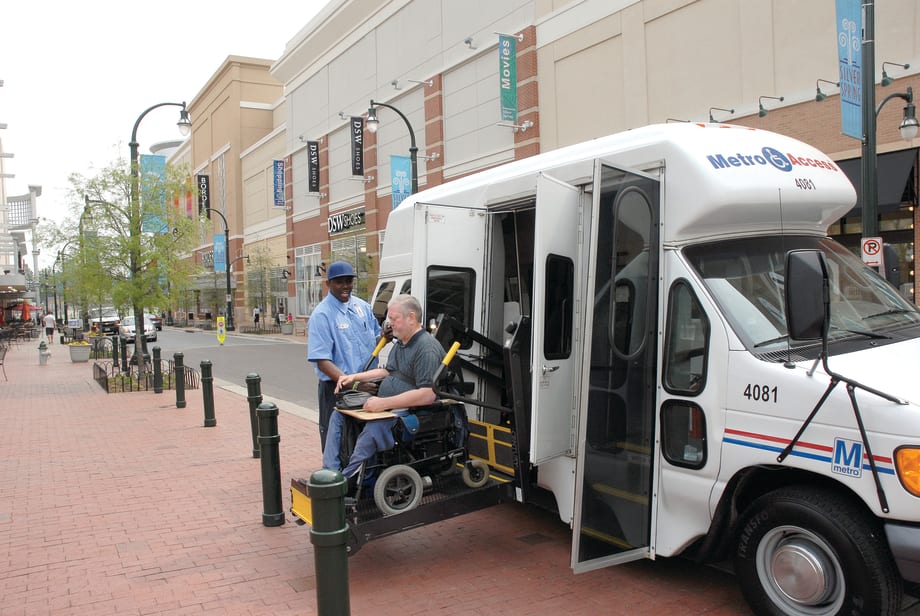
Following a decision to take its Access Services paratransit system in house in 2005, the Washington Metropolitan Area Transit Authority (Metro) was faced with rising demand and costs it knew had to be addressed.
“One of the concerns we had at the time was it seemed that almost 100 percent of the people who applied [for paratransit services] were found to be eligible. It didn’t look like there was much real screening going on, and we were concerned about that,” said Christian T. Kent, assistant GM, Access Services.
Metro’s initial step in 2005 was to switch from using its contractors’ offices throughout the regions in D.C., Virginia and Maryland it serves to certify paratransit customers to rehabilitation hospitals, who the agency felt had better clinical expertise to make eligibility requirements.
“Over four years, we frankly made our paratransit service run very well,” explained Kent. “We made it very attractive to the customer, and it just seemed like the ridership was going through the roof. It was increasing as high as 22 percent from one year to the next.”
Over the four-year period after making the switch to certifying customers through rehabilitation hospitals, Kent explained that Metro’s paratransit budget doubled from $52 million in 2005 to $104 million in 2009.
“What we noticed about our eligibility process was that while those rehab hospitals may have been expert in understanding disability, we didn’t see a lot of discussion with the customer about the possibility of them using bus and rail services,” said Kent. “We made the decision, then, to take the next step, which was to end those contracts with the rehab hospitals. We built a facility at our headquarters building, and now, the assessments are done here.”
By streamlining its eligibility process and fine-tuning its travel training program, Metro has enabled customers with disabilities to travel more independently, improved the rider’s experience, and saved the transit agency and its stakeholders millions of dollars.
Aside from instituting a new certification process, Metro adopted a new business model for connecting customers with the service that best meets their needs, promoted discounted and free fixed-route service for qualified riders with disabilities, and provided extensive training on how to use the bus and rail services as a more convenient and affordable alternative to Access.
“When they finish our process, most don’t leave empty handed,” said Kent. “They are either going to be eligible for paratransit services, get a half-price fare card, or participate in travel training and become avid fixed-route users.”
The programmatic change at Metro helped the agency save more than $25 million in Fiscal Year 2011, as well as receive the 2012 Innovation Award from APTA.
“There aren’t many service-oriented businesses where you get more compliments than complaints,” said Kent. “Here, we’ve practically lost count of the number of times customers have called in commendations, thanking Frank Roth, [director, eligibility certification and outreach], and his staff for the way they were treated, the information they got and how it’s been able to improve their quality of life.”
More Paratransit

Biz Briefs: RIPTA Unveils New Frontrunners, Clevland RTA Adds New Siemens, and More
In METRO's latest installment, we take a look at recent news from Siemens, Prevost, Dodge, and more partnerships making headlines across the transportation sector.
Read More →
King County Metro Makes ADA Paratransit Easier to Navigate
METRO's Innovative Solutions Award winner replaces complex service-area descriptions with an accessible, interactive map that puts paratransit information directly in customers’ hands.
Read More →
Jacksonville’s NAVI Project Charts a New Course for Autonomous Public Transportation
Through its NAVI program, JTA is showing how autonomous vehicles, intelligent infrastructure, and coordinated operations can work together to deliver everyday public transportation.
Read More →
Driving Smarter Paratransit
John Hanlon shares how AlphaRoute is leveraging AI-powered technology to help paratransit providers optimize operations, support frontline staff, and enhance the rider experience.
Read More →
METRO Magazine Announces 2026 Innovative Solutions Awards Winners
Projects Recognized for Advancing Mobility Through Technology, Accessibility, Workforce Innovation, and Operational Excellence
Read More →
Biz Briefs: STV teams with Amtrak, Motorcoach Operators Boost Fleet and Land Contracts, and More
From manufacturers and suppliers to transit agencies and motorcoach operators, these updates offer a snapshot of the projects, partnerships and business moves driving the industry forward.
Read More →
Biz Briefs: Masabi Teams with St. Louis Metro and More
In METRO's latest installment, we take a look at recent news from Transdev, Hitachi, and more partnerships making headlines across the transportation sector.
Read More →
New York MTA Leverages Zoning Program to Advance Station Accessibility
Accessibility enhancements at Nevins St Station will be financed through a development agreement tied to the MTA's Zoning for Accessibility initiative.
Read More →
Reinventing Fleet Maintenance with Real-time Visibility and AI
Transit leaders need to know what needs fixing, where to look, who is responsible, when work is completed, and what it costs without having to chase information across disconnected systems.
Read More →
SamTrans Sets Priorities for Potential Connect Bay Area Revenue
The board-approved framework allocates future funding to maintaining service, rider improvements, equity initiatives, and infrastructure repairs.
Read More →