




RELATED: Virgin Hyperloop One ready for 3rd-party assessment
European countries agree to establish common hyperloop standards
Will focus on vehicle systems, tube infrastructure and components, overall infrastructure, and communications protocols.
March 12, 2020
4 min to read
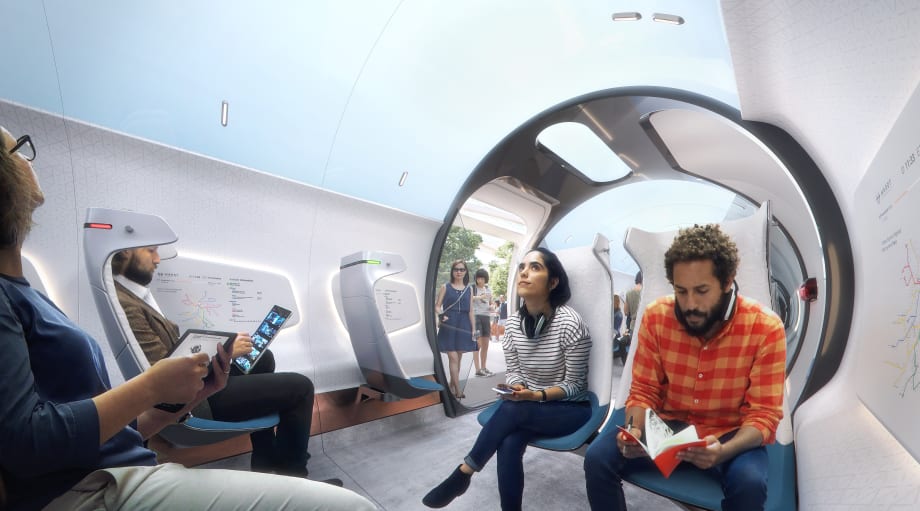
Hardt Hyperlooop vehicle interior rendering. ©Plompmozes
A group of European countries have partnered to create a joint technical committee (JTC) called JTC 20 to define, establish, and standardize the methodology and framework to regulate hyperloop travel systems and ensure interoperability and high safety standards throughout Europe.
The consortium of European and Canadian hyperloop companies responsible for driving the initiative around international standardization comprises Hardt Hyperloop (from the Netherlands), Hyper Poland (from Poland), TransPod (from Canada, with offices in Italy and France), and Zeleros Hyperloop (from Spain).
As the hyperloop industry continues to grow with increased interest and more players entering the market, the consortium expects there will eventually be many disparate approaches to standards and operational principles. The potential impact this may have on interoperability of infrastructure, rolling stock, signalling, and other subsystems is substantial — it will become difficult and costly to transport passengers and freight from one country to another, due to dependency on the particular and unique hyperloop system adopted in each location. By developing common standards, specifications, and approaches, JTC 20 will help to mitigate potential challenges to implementation across the continent.
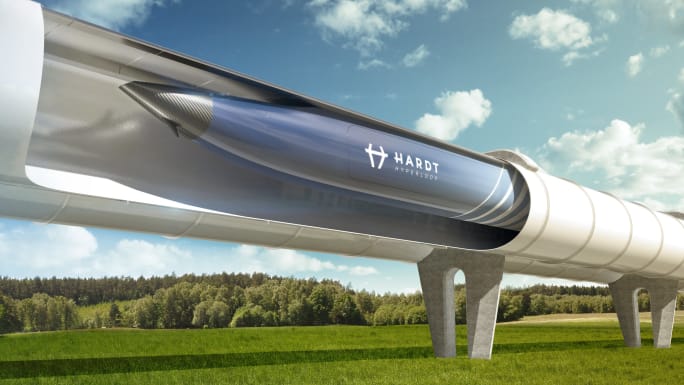
Rendering of Netherlands-based Hardt Hyperloop vehicle. Hardt
The proposal for the creation of the technical committee was a joint effort by the national standardization organizations of Spain (UNE) and the Netherlands (NEN). JTC 20 will comprise working groups focusing on various components of hyperloop systems including vehicle systems, tube infrastructure and components, overall infrastructure, and communications protocols. The consortium of hyperloop companies responsible for initiating the creation of JTC 20, along with members from various national standardization organizations and experts from a variety of industries, will participate in the working groups to lend technical and geo-specific expertise.
Concurrently, a network of hyperloop research centers is already in the planning stages and is slated to begin operation in the next few years, in France, Poland, Spain, and the Netherlands. They will serve as research sites for the testing and validation of the technologies and standards coming out of JTC 20. Following successful validation, the recommendations will be presented in a legislative proposal to be brought to the European Parliament and Council of the European Union.
Testing facility
Europe’s first facility to test hyperloop at high speeds will be built in the Dutch province of Groningen. The new European Hyperloop Center (EHC) will be open to hyperloop developers from all over the world. This will promote cooperation, in order to accelerate the development of a technology that could offer a clean alternative to air travel.
Construction of the EHC will start in 2020 and is expected to be completed in 2022. Tests conducted at the EHC will determine whether the hyperloop is a realistic alternative to short- haul flights. Travel by hyperloop is CO2 neutral and can provide a sustainable solution for the growing global number of passengers and amount of freight.
The EHC will consist of a two-mile test track, making it the first facility in Europe to test this revolutionary transport system at high speeds. The EHC will also host a Learning Center that will focus on European standardisation, safety standards and the passenger travel experience.
Hardt
Hardt Hyperloop, located in The Netherlands, was founded in 2016. In 2017 Hardt won the international hyperloop competition by Elon Musk’s SpaceX. Hardt Hyperloop’s partners include: InnoEnergy, Koolen Industries, Schiphol Airport, the Dutch Railways, Deutsche Bahn and BAM, Tata Steel and IHC.
Hyper Poland
Hyper Poland is developing an innovative approach to hyperloop in three steps in which the first is magrail technology that can be deployed on existing railway infrastructure. The company consists of a multidisciplinary team of experts with experience gained from among others Airbus, Bombardier, Shinkansen. Hyper Poland team was the finalist of the SpaceX Hyperloop Pod Competition (2017) and finalist of Build Earth Live Dubai (2016). The company`s main partners include Microsoft, Railway Research Institute, Transfer Multisort Elektronik, National Center for Research and Development and the Warsaw University of Technology. In 2019, Hyper Poland was classified by Lufthansa Innovation Hub among 150 top mobility startups.
TransPod
Toronto, Canada-based TransPod’s goal is to disrupt and redefine commercial transportation between major cities in developed and emerging markets. The startup was founded in 2015 to build the world’s leading hyperloop system to connect people, cities, and businesses with high-speed transportation that is affordable and environmentally sustainable.
Zeleros
Zeleros (Spain) is developing a scalable hyperloop transport system that minimizes infrastructure costs by integrating the technology in the vehicles. Its partners include technological firms (Altran), operators (Renfe, F. ValenciaPort) and researchers (Universitat Politècnica de València, CIEMAT), and it is backed by Silicon Valley’s Plug&Play Tech Center, EIT Climate-KIC, and Spain’s key transport associations. The founders were doubly awarded by Elon Musk in 2016.
More Rail

New York MTA Advances Final Contract for Second Avenue Subway Expansion
Contract Four is the largest in the Second Avenue Subway Phase 2 project and includes construction of station infrastructure, tracks, and signals for the subway expansion, MTA officials said. Work on Contract Four will begin in 2027.
Read More →
San Diego MTS Breaks Monthly Trolley Ridership Record
Agency officials said July’s ridership indicates MTS’s continued recovery from the pandemic.
Read More →
Report Examines NJ TRANSIT Reliability, Funding Challenges
The Garden State Initiative analysis examines the roles of Amtrak infrastructure, fleet management, and agency operations while recommending a more performance-based approach to improving reliability.
Read More →
Stadler, CapMetro Sign Long-Term Rail Fleet Support Agreement
Beginning in 2027, Stadler will provide on-site technical expertise, spare parts support, training, and obsolescence management to help extend the reliability and longevity of CapMetro’s GTW fleet.
Read More →
Biz Briefs: Alstom Lands Canadian Contract, LYT to Supply California TSP, and More
In METRO's latest installment, we take a look at recent news from Complete Coach Works, Beep, FlixBus, and more partnerships making headlines across the transportation sector.
Read More →
CATS Gold Line Marks 5 Years of Service, 2.8M Passenger Trips
With a six-mile expansion planned, the Charlotte streetcar is positioned to connect more neighborhoods and major transit hubs across the region.
Read More →
Why Simulating Pedestrian Movement Has Become Essential for Modern Rail Stations
Pedestrian microsimulation is helping rail planners identify bottlenecks, test station designs, and prepare complex transit hubs for growing passenger volumes.
Read More →
Amtrak Begins Major Construction at New York’s Sunnyside Yard
The new maintenance facility will support Amtrak’s Airo trainsets while improving maintenance efficiency and turnaround times in New York.
Read More →
Chicago Leaders Unveil Plans for O’Hare Airport Express Train
The privately developed project would offer a 15-minute trip between downtown and O’Hare’s Terminal 2, with trains operating every 15 minutes on a dedicated track. The service would use battery-electric trains and three existing freight rail rights-of-way.
Read More →
OCTA Maps Out 30-Year Strategy to Protect Coastal Rail Corridor
The draft feasibility report identifies strategies to protect the coastal rail line for decades as the agency continues near-term stabilization and sand placement efforts.
Read More →