



Experts Say 'Good Jobs Are No Longer an Afterthought' in Transportation Spending
Highlighted a national trend of city and state leaders harnessing billions in public transportation spending through a new, innovative U.S. Employment Plan – an incentives-based approach to reward manufacturing companies for creating high quality American jobs, hiring and training diverse workers, and investing in U.S. factories.


In conjunction with Tuesday’s telebriefing, the Jobs to Move America coalition released a new interactive online Map (www.jobstomoveamerica.org/map), detailing 34 current and upcoming purchases of buses and trains in 24 states, as well as locations of 28 bus and train factories in 15 states.
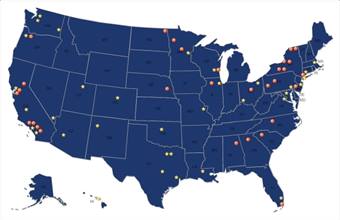
In conjunction with Tuesday’s telebriefing, the Jobs to Move America coalition released a new interactive online Map (www.jobstomoveamerica.org/map), detailing 34 current and upcoming purchases of buses and trains in 24 states, as well as locations of 28 bus and train factories in 15 states.
On a telebriefing convened by the Jobs to Move America coalition this week, experts in economics, sociology, and urban planning highlighted a national trend of city and state leaders harnessing billions in public transportation spending through a new, innovative U.S. Employment Plan – an incentives-based approach to reward manufacturing companies for creating high quality American jobs, hiring and training diverse workers, and investing in U.S. factories.
“Good jobs are no longer an afterthought when we spend billions of public dollars on transit equipment,” said Madeline Janis, Director of Jobs to Move America and National Policy Director of the Los Angeles Alliance for a New Economy (LAANE). “By leveraging our public transit dollars, we can support up to 53,000 good American jobs (i), rather than buying on the cheap, which creates a competitive ‘race to the bottom’ and hurt taxpayers, transit riders and unemployed Americans alike.”
RELATED:Chicago to restart railcar procurement with job-creating approach
In the past, many U.S. transit agencies awarded publicly-funded contracts to the lowest-priced bidder among global manufacturers, without considering long-term U.S. economic impacts. In turn, companies manufacture significant portions of America’s buses and trains overseas, bypassing millions of unemployed Americans and struggling communities. On the briefing call, experts discussed the new approach taken in recent train manufacturing contracts – collectively worth an estimated $4.4 billion – that contained enticements to foster U.S. job growth. Those contracts included Amtrak’s recent procurement, as well as Chicago Mayor Rahm Emanuel and the Chicago Transit Authority’s $2 billion rail car buy and the Maryland Transit Administration’s upcoming $400 million Purple Line purchase.
“This is the beginning of a new era,” said Ed Wytkind, President of the Transportation Trades Dept., AFL-CIO. “The Jobs to Move America Coalition, and the U.S. Employment Plan it supports, has become a game-changer. It gives transit agencies a powerful tool – one that prioritizes jobs and investment here at home and promotes long term economic growth.”
“Good jobs manufacturing buses and trains are a commonsense way to improve the economy and share prosperity more widely,” added George Wentworth, Senior Staff Attorney, National Employment Law Project.
Requests for Proposals (RFPs) including a U.S. Employment Plan require manufacturers to disclose information about their plans to create American jobs and the quality of those jobs –
including wages, benefits, training opportunities, and recruitment of disadvantaged workers such as veterans – in connection with the contract. The transit agencies will evaluate bidding companies’ U.S. jobs plans, and incorporate their commitments into final contracts. The Los Angeles County Metropolitan Transportation Authority adopted similar policies in 2012 on a railcar contract valued at $900 million and a bus contract valued at $300 million.
“Smarter transit purchasing is happening at the local and regional level,” said Jacquelyne Grimshaw, Vice Chair of the Chicago Transit Authority Board and Vice President of the Center for Neighborhood Technology. “As cities transform our approach to transit contracting, we can address this jobs crisis and put our public dollars to their best use.”
“Chicago is leading the way to harness the spending power of taxpayer investments,” said Jorge Ramirez, President of the Chicago Federation of Labor. “Our partnership with CTA and Mayor Emanuel demonstrates how city government can play a strong role in reviving our economy.”
In conjunction with Tuesday’s telebriefing, the Jobs to Move America coalition released a new interactive online Map (www.jobstomoveamerica.org/map), detailing 34 current and upcoming purchases of buses and trains in 24 states, as well as locations of 28 bus and train factories in 15 states. The map includes upcoming transit purchases affecting cities such as Houston, New York, Las Vegas, Cleveland, Seattle, and Baltimore, across the nation.
“This map gives policymakers and others a long-term view of transportation investment as a potential job-creation engine,” said Dr. Manuel Pastor, Director of the University of Southern California Program for Environmental and Regional Equity (PERE). “With billions of public dollars being dedicated to transit spending in every region of the United States, there’s great potential for transit system growth to transform the lives of low-income Americans.”
“There is moral imperative for good jobs, because poverty is real for families in East St Louis and in so many cities,” said Pastor Norma J. Patterson with Good Shepherd of Faith UCC and the Gamaliel Foundation. “We need the jobs building that rail, we need jobs building the station, we need jobs building the train, we need jobs on the train, off the train – we need jobs everywhere.”
More Paratransit

Biz Briefs: RIPTA Unveils New Frontrunners, Clevland RTA Adds New Siemens, and More
In METRO's latest installment, we take a look at recent news from Siemens, Prevost, Dodge, and more partnerships making headlines across the transportation sector.
Read More →
King County Metro Makes ADA Paratransit Easier to Navigate
METRO's Innovative Solutions Award winner replaces complex service-area descriptions with an accessible, interactive map that puts paratransit information directly in customers’ hands.
Read More →
Jacksonville’s NAVI Project Charts a New Course for Autonomous Public Transportation
Through its NAVI program, JTA is showing how autonomous vehicles, intelligent infrastructure, and coordinated operations can work together to deliver everyday public transportation.
Read More →
Driving Smarter Paratransit
John Hanlon shares how AlphaRoute is leveraging AI-powered technology to help paratransit providers optimize operations, support frontline staff, and enhance the rider experience.
Read More →
METRO Magazine Announces 2026 Innovative Solutions Awards Winners
Projects Recognized for Advancing Mobility Through Technology, Accessibility, Workforce Innovation, and Operational Excellence
Read More →
Biz Briefs: STV teams with Amtrak, Motorcoach Operators Boost Fleet and Land Contracts, and More
From manufacturers and suppliers to transit agencies and motorcoach operators, these updates offer a snapshot of the projects, partnerships and business moves driving the industry forward.
Read More →
Biz Briefs: Masabi Teams with St. Louis Metro and More
In METRO's latest installment, we take a look at recent news from Transdev, Hitachi, and more partnerships making headlines across the transportation sector.
Read More →
New York MTA Leverages Zoning Program to Advance Station Accessibility
Accessibility enhancements at Nevins St Station will be financed through a development agreement tied to the MTA's Zoning for Accessibility initiative.
Read More →
Reinventing Fleet Maintenance with Real-time Visibility and AI
Transit leaders need to know what needs fixing, where to look, who is responsible, when work is completed, and what it costs without having to chase information across disconnected systems.
Read More →
SamTrans Sets Priorities for Potential Connect Bay Area Revenue
The board-approved framework allocates future funding to maintaining service, rider improvements, equity initiatives, and infrastructure repairs.
Read More →