



Florida's JTA Opens Autonomous Innovation Center, Unveils Service Name for AV Program
NAVI, which stands for Neighborhood Autonomous Vehicle Innovation, will operate from the AIC, which serves as the command center facility to store, service, monitor, and maintain Jacksonville’s autonomous mobility fleet and is set to launch this summer with NAVI servicing the first phase of the U2C.

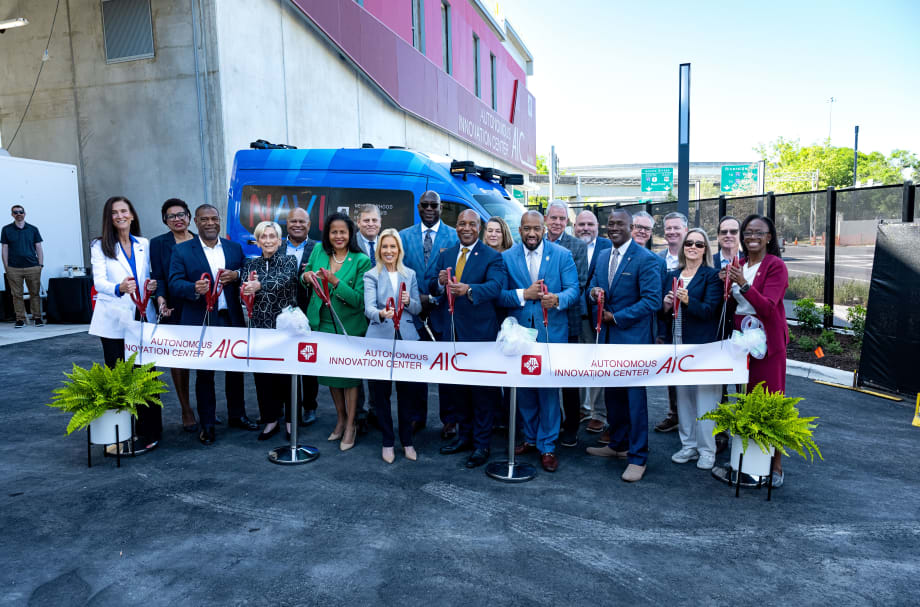
Speakers for the ribbon cutting included: Mayor Donna Deegan, City Council Member Rahman Johnson, Aundra Wallace (Vice Chair - JTA Board of Directors), Nat Ford (CEO, JTA), Joe Moye (Board of Directors Vice Chairman, Beep), and Dave Campbell (Director, Balfour Beatty).
Photo: JTA
Florida’s Jacksonville Transportation Authority (JTA) is one step closer to introducing autonomous vehicles in Northeast Florida with the ribbon cutting of its Autonomous Innovation Center (AIC) and unveiling of the autonomous vehicle (AV) service name, NAVI.
NAVI, which stands for Neighborhood Autonomous Vehicle Innovation, will operate from the AIC, which serves as the command center facility to store, service, monitor, and maintain Jacksonville’s autonomous mobility fleet and is set to launch this summer with NAVI servicing the first phase of the Ultimate Urban Circulator (U2C).
Ribbon Cutting for NAVI
Guests at the ribbon cutting got an up-close look at the AV, which features an outline of the Jacksonville skyline, representing how this new service will connect the urban core with surrounding neighborhoods to play a vital role in downtown revitalization.
The 3.5-mile route connects key parts of Downtown Jacksonville, from the Central Business Core to the Sports & Entertainment District, integrating autonomous vehicles into the mix.
Speakers for the ribbon cutting included: Mayor Donna Deegan, City Council Member Rahman Johnson, Aundra Wallace (Vice Chair - JTA Board of Directors), Nat Ford (CEO, JTA), Joe Moye (Board of Directors Vice Chairman, Beep), and Dave Campbell (Director, Balfour Beatty).
“The JTA’s AV program will be the first-of-its-kind, fully autonomous public transportation system network in the United States,” said JTA CEO Nat Ford. “The opening of the AIC is one of the final milestones before introducing NAVI to our transportation system. This state-of-the-art facility lays a strong foundation for the operation of the AV fleet and supports the vision of a better-connected, vibrant Downtown Jacksonville.”
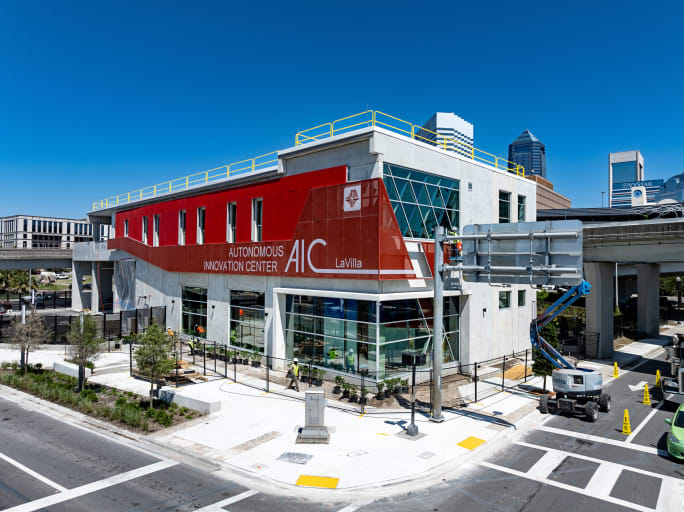
The two-story 18,798-square-foot facility features maintenance bays for vehicle service, covered AV parking with charging stations, as well as an open terrace with a viewing area overlooking vehicles arriving and departing the facility.
Photo: JTA
Revolutionizing the Future
In addition to the AIC’s cutting-edge infrastructure, including maintenance bays, charging stations, and an elevated observation deck — it is equipped with a full-scale command center, featuring a massive display that brings the unified Bay Street Innovation Corridor (BSIC) service interface to life.
From live monitoring of national operations to simulations that demonstrate the system’s reliability, scalability, and real-time responsiveness, the AIC showcases what it takes to manage a modern autonomous transit system.
The two-story 18,798-square-foot facility features maintenance bays for vehicle service, covered AV parking with charging stations, as well as an open terrace with a viewing area overlooking vehicles arriving and departing the facility.
The facility will also ultimately contain 129 rooftop solar panels with 100% of the electrical power demand for the building offset with its microgrid.
It was built by the Balfour Beatty Vision 2 Reality (V2R) team, alongside project partners Beep, Superior Construction Company Southeast, WGI Inc., Urban SDK, Miller Electric, and Grayline.
More Technology

From Hardware to Digital Partner: Luminator Charts Its Next Chapter
CEO Magnus Friberg discusses Luminator’s shift toward becoming a digital partner, the growing importance of software and interoperability, and how AI can help agencies improve operations and passenger experience.
Read More →
Beyond the Checklist: A Structured Approach to Transit Maintenance
Reliability-Centered Maintenance helps transit agencies move beyond routine checklists to focus limited resources on the assets and failures that have the greatest impact on safety, reliability, and service.
Read More →
NJ TRANSIT Advances Bus Technology Upgrades Across Statewide Fleet
More than 1,500 buses now feature upgraded technology designed to improve arrival predictions and provide free Wi-Fi, with deployment expected to reach nearly 2,000 buses by the end of 2026.
Read More →

Building a Flexible Path to Transit Electrification
John Hroncich discusses BAE Systems’ modular and scalable approach, lessons learned from decades of real-world operations, and how agencies can identify electrification strategies that fit their fleets.
Read More →
Biz Briefs: Alstom Lands Canadian Contract, LYT to Supply California TSP, and More
In METRO's latest installment, we take a look at recent news from Complete Coach Works, Beep, FlixBus, and more partnerships making headlines across the transportation sector.
Read More →
From Legacy Silos to Conversational Intelligence
What if transit leaders could ask any operational question and get a trusted answer in seconds? Conversational AI is transforming how agencies use their data.
Read More →
USDOT Announces Rail Vehicle Replacement Grants, Chattanooga AV Shuttle Funding
More than $191 million in federal funding will help three transit agencies replace aging rail vehicles and support a new autonomous shuttle service in Chattanooga.
Read More →
Bus Tech Talk: Keeping Transit Technicians Ahead of the Technology Curve
LA Metro’s Obed Mejia discusses technician training, evolving maintenance technology, fleet replacement, and strategies for getting the most out of today’s transit fleets.
Read More →
Biz Briefs: RIPTA Unveils New Frontrunners, Clevland RTA Adds New Siemens, and More
In METRO's latest installment, we take a look at recent news from Siemens, Prevost, Dodge, and more partnerships making headlines across the transportation sector.
Read More →
Why Simulating Pedestrian Movement Has Become Essential for Modern Rail Stations
Pedestrian microsimulation is helping rail planners identify bottlenecks, test station designs, and prepare complex transit hubs for growing passenger volumes.
Read More →