




RELATED: Helsinki launching self-driving vehicle into regular service
Helsinki launches autonomous vehicle into scheduled service
The City of Helsinki has announced a plan to become carbon neutral by 2035.
May 14, 2018
3 min to read
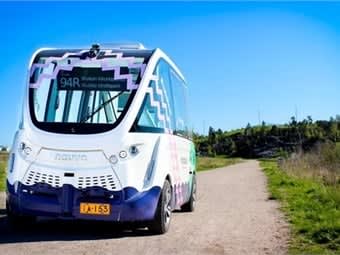
NAVYA's self-driving electric minibus of Helsinki bus line 94R. Photo: Milla Aman/Oscar Nissin
A self-driving electric minibus supplied by NAVYA to the city of Helsinki accepted the first passengers on board on May 14, 2018, launching scheduled service in regular traffic on roads. The RobobusLine project for commercially viable automated bus operation in the Finnish city is projected to start in three years’ time.
The Helsinki RobobusLine’s minibus will operate for six months over the summer and fall of 2018. It runs 3 to 6 times an hour between 9 AM and 3 PM on weekdays, carrying passengers from a stop of a regular Helsinki bus line to a sports park.
The Helsinki RobobusLine complements the network of Helsinki’s metropolitan public transit authority Helsinki Region Transport (HSL), and is incorporated into the region's trip planner.
The top speed on the route is 18 km/h (5 mph), slightly below the minibus’s maximum speed of 25 km/h. Initially there will be an operator on board.
“One of the main goals of the project is to provide an innovation platform for enterprises to produce a consortium who can develop automated bus operation into a commercially viable option for Helsinki Region Transport in the last-mile service – taking riders from a public transit station to stops near their homes and offices,” says the Helsinki RobobusLine project leader Eetu Rutanen of Metropolia University of Applied Sciences, which operates the bus and conducts the project with support from the City of Helsinki and the European Union.
Typically, the last-mile routes cannot be operated viably with conventional buses, but could become commercially feasible with driverless buses.
“We study user behavior, for example, how likely people are to opt for public transit rather than drive when there is a public transit option available for the last mile,” Rutanen explains. Lengthy distances to public transit stations are often the reason for opting for a private car.
The Helsinki RobobusLine project is one of the smart mobility projects in Helsinki designed to reduce carbon dioxide emissions from transportation with electric vehicles and increased use of sustainable public transportation. The City of Helsinki has announced a plan to become carbon neutral by 2035. Helsinki Region Transport plans to give up fossil fuels by 2021.
The launch of Helsinki RobobusLine marks a shift from an experimental phase to regular operation with self-driving minibuses. RobobusLine is the first long-range project in Finland to operate an automated electric minibus on a fixed route.
The Robobus vehicle from NAVYA of France represents the latest generation of automated electric minibuses. Its guidance and detection systems combine data from Lidar sensors, cameras, GPS RTK, IMU and odometry, which are merged and interpreted by deep learning programs.
The Helsinki RobobusLine project is supported by the EU-funded mySMARTLife project, in which Helsinki develops smart commercial-scale solutions with other European cities to cut urban carbon dioxide emissions, focusing on transportation and housing.
More Technology
Almaviva Looks to Open Architecture to Advance Transit Technology
Eric Reese discusses how interoperability, open architecture, and modular design can help transit agencies control costs, reduce vendor lock-in, and upgrade technology without starting over.
Read More →
Driving Smarter Paratransit
John Hanlon shares how AlphaRoute is leveraging AI-powered technology to help paratransit providers optimize operations, support frontline staff, and enhance the rider experience.
Read More →
From Hardware to Digital Partner: Luminator Charts Its Next Chapter
CEO Magnus Friberg discusses Luminator’s shift toward becoming a digital partner, the growing importance of software and interoperability, and how AI can help agencies improve operations and passenger experience.
Read More →

Beyond the Checklist: A Structured Approach to Transit Maintenance
Reliability-Centered Maintenance helps transit agencies move beyond routine checklists to focus limited resources on the assets and failures that have the greatest impact on safety, reliability, and service.
Read More →
NJ TRANSIT Advances Bus Technology Upgrades Across Statewide Fleet
More than 1,500 buses now feature upgraded technology designed to improve arrival predictions and provide free Wi-Fi, with deployment expected to reach nearly 2,000 buses by the end of 2026.
Read More →
Building a Flexible Path to Transit Electrification
John Hroncich discusses BAE Systems’ modular and scalable approach, lessons learned from decades of real-world operations, and how agencies can identify electrification strategies that fit their fleets.
Read More →
Biz Briefs: Alstom Lands Canadian Contract, LYT to Supply California TSP, and More
In METRO's latest installment, we take a look at recent news from Complete Coach Works, Beep, FlixBus, and more partnerships making headlines across the transportation sector.
Read More →
Sponsored•September 8, 2026
From Legacy Silos to Conversational Intelligence
What if transit leaders could ask any operational question and get a trusted answer in seconds? Conversational AI is transforming how agencies use their data.
Read More →
USDOT Announces Rail Vehicle Replacement Grants, Chattanooga AV Shuttle Funding
More than $191 million in federal funding will help three transit agencies replace aging rail vehicles and support a new autonomous shuttle service in Chattanooga.
Read More →
Bus Tech Talk: Keeping Transit Technicians Ahead of the Technology Curve
LA Metro’s Obed Mejia discusses technician training, evolving maintenance technology, fleet replacement, and strategies for getting the most out of today’s transit fleets.
Read More →