



High-speed rail security addressed in new report
Draws upon empirical data from proprietary database of terrorist and serious criminal attacks against public surface transportation and from reviews of selected HSR systems, including onsite observations.

A new report, released by the Mineta Transportation Institute (MTI) addresses high-speed rail (HSR) security by providing analysis of information relating to attacks.
Principal investigator Brian Michael Jenkins and his team offer an analysis of information relating to attacks, attempted attacks and plots against HSR systems. The report is available for free download at http://transweb.sjsu.edu/project/1026.html.
The research report,"Formulating a Strategy for Securing High-Speed Rail in the United States," draws upon empirical data from MTI's proprietary database of terrorist and serious criminal attacks against public surface transportation and from reviews of selected HSR systems, including onsite observations.
It also examines the history of safety accidents and other HSR incidents that resulted in fatalities, injuries, or extensive asset damage to examine the inherent vulnerabilities and strengths of HSR systems and how these might affect the consequences of terrorist attacks.
"We divided this study into three parts," said Jenkins. "First, we examined security principles and measurements. Then, we conducted an empirical examination of 33 attacks against HSR targets, plus a comparison of attacks against HSR targets with those against non-HSR targets. And finally, we examined 73 safety incidents on 12 HSR systems. The purpose of this study is to develop an overall strategy for HSR security and to identify measures that could be applied to HSR systems currently under development in the United States."
MTI expects that the report will provide useful guidance to governmental authorities and to operators of current and future HSR systems. It was co-authored by Chris Kozub, Bruce R. Butterworth, Renee Haider and Jean-Francois Clair.
HSR has seen comparatively few attacks
While terrorist attacks aimed at trains and buses have increased over the past several decades, very few attacks have targeted HSR. To gain possible insights into the consequences of successful terrorist attacks against this travel mode, Jenkins said, this inquiry includes accidents and other HSR incidents that have resulted in injuries, fatalities or extensive asset damage.
"The objective of the research is not to dictate security regimes," he said. "Rather, it is to distill lessons from the history of accidents and terrorist attacks; to review security measures at existing HSR systems; to explore security-regime options; and to suggest principles for an overall security strategy."
The report notes that now is the right time to initiate a discussion, as new HSR systems are being designed and built. This report is intended to inform that discussion by addressing several questions, including:
Does HSR merit more security or different security measures than other passenger rail?
Is it appropriate to consider reducing security for non-HSR passenger rail?
What threats drive security concerns?
What can be learned from HSR security in Europe and Japan?
The report includes 15 figures, including several route maps specific to the incidents, and 11 tables, including HSR attacks by country, HSR bomb attacks by outcome, HSR incidents involving fatalities and more.
More Rail
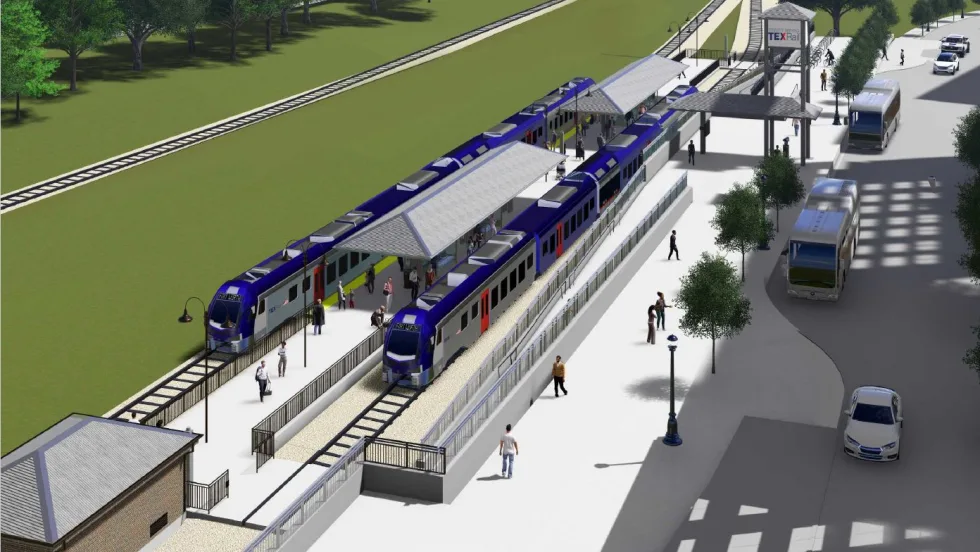
Trinity Metro Breaks Ground on $270M TEXRail Extension
The 2.1-mile extension will connect Fort Worth’s Medical District and Near Southside to downtown, surrounding communities, and Dallas-Fort Worth International Airport.
Read More →
Bringing Austin’s First Light Rail System to Life
Austin Transit Partnership CEO Greg Canally discusses the city's nearly 10-mile light rail project, its collaborative approach to project delivery, the importance of community engagement, and the milestones ahead as construction approaches in 2027.
Read More →
Metra Draft Plan Outlines Costs, Service Improvements for Regional Rail
The Systemwide Network Plan identifies infrastructure needs and potential investments to expand all-day, bidirectional rail service across the Chicago region.
Read More →
Amtrak Completes First Street Tunnel Upgrades, Restores Service
The nine-day construction project included replacing aging track infrastructure and modernizing switch systems near Washington Union Station.
Read More →
FRA Announces $2.3B for Passenger, Freight Rail Projects Nationwide
The CRISI Grant Program funding will support rail infrastructure improvements, safety upgrades, and projects aimed at improving freight and passenger rail service across 45 states and Washington, D.C.
Read More →
Caltrain’s Electrification Drives a New Era of Ridership Growth
The railroad’s shift to electric service has brought more frequent trains, stronger customer satisfaction, and increased ridership, earning it APTA’s Outstanding Public Transportation System award.
Read More →
FTA Advances $164M Broward County Commuter Rail Project
The proposed 10.5-mile commuter rail extension would connect Fort Lauderdale and Aventura, expanding passenger rail options in South Florida.
Read More →
New York MTA Launches Historic $1.9B Signal, Track Modernization Project
Funded in part by congestion pricing revenue, the project will replace nearly century-old signals along the A and C lines in Brooklyn and Queens.
Read More →
LA Metro Breaks Ground on East San Fernando Valley Light Rail Project
The 6.7-mile line will add 11 stations along Van Nuys Boulevard, expand access to jobs and regional transit connections, and support Metro’s broader efforts to improve mobility as rail ridership grows.
Read More →
CSA Group Releases Climate Resilience Standard for Transit, Passenger Rail
Developed with support from the Standards Council of Canada, CSA D700 guides assessing climate-related risks and planning adaptation measures for transit and passenger rail systems.
Read More →