



RELATED: Bill would ban use of fed funds for Chinese rolling stock
House passes bill banning usage of Fed funds for Chinese rolling stock
The authors assert Chinese state-owned and state-supported enterprises have used subsidized “bargain prices” well-below competitive market price to win contracts throughout the U.S.
by Alex Roman, Managing Editor
July 12, 2019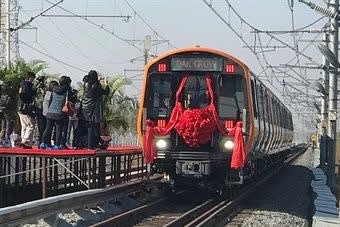
During a October 2017 media event, dignitaries took a ride on one of the four pilot cars to be sent to Boston for testing. Photo: CRRC
2 min to read
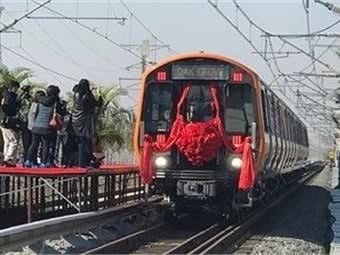
During a October 2017 media event, dignitaries took a ride on one of the four pilot cars to be sent to Boston for testing. Photo: CRRC
The House voted to pass H.R. 2500, the National Defense Authorization Act (NDAA) for Fiscal Year 2020. In the bill’s base text was a provision blocking federal transit dollars for procurement of electric railcars from Chinese State Owned Enterprises (SOEs), and other state-supported companies, originally introduced in the Senate by Sen. John Cornyn (R-TX), and the House by Rep. Harley Rouda (D-CA), as part of the Transit Infrastructure Vehicle Security Act (TIVSA).
“China’s ‘Made in China 2025’ initiative is an unmistakable effort to harm American manufacturers by subsidizing Chinese rail and bus industries,” said Rep. Rouda. “Chinese companies misrepresent themselves as benevolent actors, but let’s be clear: this is an attack on our economy and national security.”
Specifically, the provision prohibits financial assistance to be used in awarding a contract or subcontract to an entity for the procurement of rail rolling stock for use in public transportation if the manufacturer is owned, controlled by, or legally or financially related to corporations under certain conditions identified in the bill that designate the corporation to be a state-sponsored or owned enterprise located in adversarial non-market economies like China.
According to the bill’s authors, the Chinese government continues to use a range of state subsidies and predatory practices to support its market ascension in certain sectors of this country’s economy. Two of these sectors, rail manufacturing and bus manufacturing, are included as part of China’s “Made in China 2025” initiative, a plan targeting global dominance in areas that the Chinese government considers most strategic to its global aims.
The authors also assert that Chinese state-owned and state-supported enterprises have used subsidized “bargain prices” well-below competitive market price to win contracts throughout the U.S., with a number of large, metropolitan areas having recently awarded rail rolling stock procurements to a Chinese state-owned enterprise. They believe there are a number of threats these procurements pose, including impeding economic competitiveness and overtaking the supply chains that support U.S. public transportation agencies. Finally, it is believed that Chinese state-owned and state-supported enterprises have increased security vulnerabilities and create new risks for rolling stock procurements.
More Management

METRO Opens Submissions for 2026 Motorcoach Awards
Nominations are now being accepted for METRO Magazine’s Operator of the Year and Innovative Operator of the Year awards.
Read More →
New York MTA Advances Final Contract for Second Avenue Subway Expansion
Contract Four is the largest in the Second Avenue Subway Phase 2 project and includes construction of station infrastructure, tracks, and signals for the subway expansion, MTA officials said. Work on Contract Four will begin in 2027.
Read More →
Transit Agencies Highlight Safety Gains at National Summit
Leaders from 15 major transit systems shared crime-reduction results and safety initiatives while discussing the role of continued federal support.
Read More →

NITA Names New Leadership, Expands Reduced-Fare Program at First Board Meeting
The new regional transit authority appointed its first board chair and interim executive director while extending reduced fares across CTA, Metra, and Pace for eligible riders.
Read More →
Beyond the Checklist: A Structured Approach to Transit Maintenance
Reliability-Centered Maintenance helps transit agencies move beyond routine checklists to focus limited resources on the assets and failures that have the greatest impact on safety, reliability, and service.
Read More →
APTA 2026 Nominating Committee Selects Leadership Slate, Names Chair and Vice Chair Nominees
Leadership changes will help shape the association’s priorities and its representation of the transportation industry during the 2026–2027 term.
Read More →
DART Launches Major Security, Fare Enforcement Initiative
The 90-day demonstration will deploy coordinated security teams at five light rail stations while testing controlled access and gathering data to guide future investments.
Read More →
Sponsored•September 9, 2026
Advancing Fare Collection Through Technology and Innovation
Learn about delivering 1300 gates at 91 stations while managing fare evasion. Explore the large scale deployment, solution customization and real-world results that affect the region. Prepare for deployment in your region now.
Read More →
Game Day in Motion: Moving Millions During the 2026 World Cup
Between packed transit stations and team motorcoaches, see how agencies and operators across North America tackled the transportation demands of the 2026 FIFA World Cup.
Read More →
Surface Transportation Extension Averts Shutdown, Leaves Transit Funding Gap
The stopgap keeps federal transportation programs moving, but missing advance funding could complicate the transit and rail projects agencies are planning next.
Read More →