



Improperly used train approach warning led to LIRR worker’s death
The accident occurred when a Long Island Rail Road train, on track three in multiple track territory, approached a five-member crew of roadway workers in the Queens Interlocking.

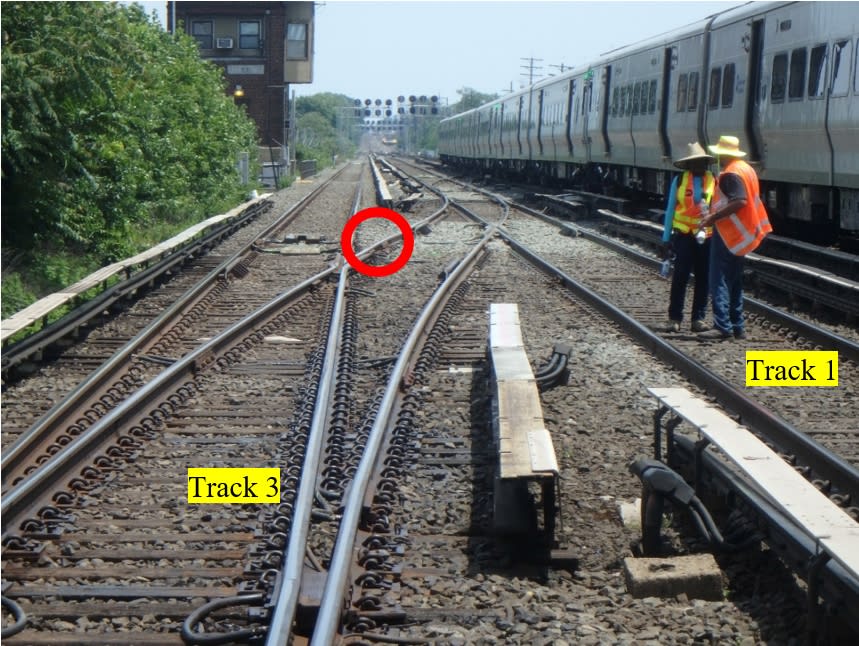
The photo depicts the accident scene on June 11, 2017.The photo was taken at track level from the east end of the Queens Village Station. The point where the roadway worker was struck by the train is marked with the red circle.
NTSB
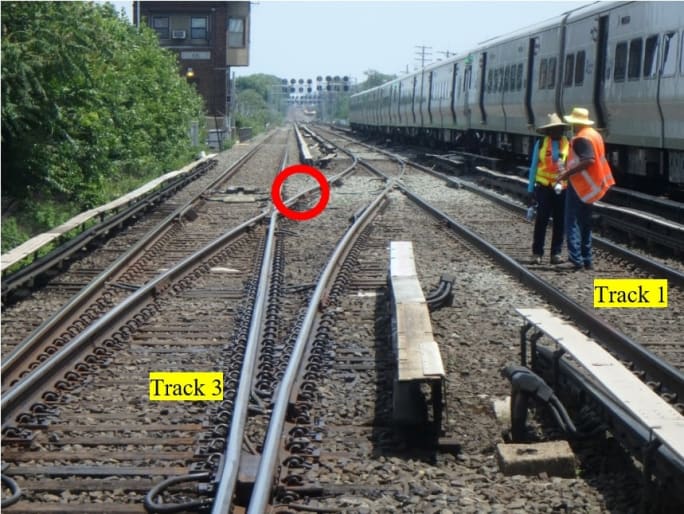
The photo depicts the accident scene on June 11, 2017.The photo was taken at track level from the east end of the Queens Village Station. The point where the roadway worker was struck by the train is marked with the red circle. NTSB
The National Transportation Safety Board issued the final report for its investigation of the June 10, 2017, Queens Village, N.Y., railroad accident in which a railroad roadway worker was struck and killed by a train.
The accident occurred when a Long Island Rail Road train, on track three in multiple track territory, approached a five-member crew of roadway workers in the Queens Interlocking. The foreman and two roadway workers were conducting a walking inspection and making repairs on track one. They were accompanied by the watchman. The fifth roadway worker was clear of the tracks. The watchman noticed the train approaching on track three, sounded a handheld horn, called out to the other workers and raised a paddle as a visual signal to the LIRR’s locomotive engineer to sound the train’s horn. When the engineer sounded the horn, three of the roadway workers remained on track one but the foreman stepped into the path of the traveling train on track three and was struck and killed. The train was traveling about 78 mph when the locomotive engineer applied the emergency brakes just before impact.
The NTSB noted in its report the train approach warning method was particularly dangerous for the crew working on the Queens Village Interlocking. Several factors, such as the multiple tracks at the interlocking, trains operating at high speeds in both directions, and the crew having limited areas to clear trains, combined with the additional train traffic due to the Belmont Stakes, increased the risk of the work crew being struck by a train. The watchmen on duty at the time should have given the workers timely warning of approaching trains and all workers should have cleared to the tracks before the train’s arrival, the NTSB concluded.
Contributing to the accident was the railroad’s and union’s allowance of overtime work schedules without properly considering and mitigating workers’ risk of fatigue. The NTSB noted the watchmen and foreman had consecutive overtime shifts that disrupted their opportunities for restorative sleep during the 48 hours prior to the accident.
The NTSB issued five safety recommendations with two recommendations each issued to the FRA and the Metropolitan Transportation Authority. One recommendation was issued to the International Association of Sheet Metal, Air, Rail, and Transportation Workers. These recommendations address safety issues including roadway worker protection, roadway worker on-track safety briefings, management oversight, FRA oversight and worker fatigue.
The final report is available here.
More Rail

New York MTA Advances Final Contract for Second Avenue Subway Expansion
Contract Four is the largest in the Second Avenue Subway Phase 2 project and includes construction of station infrastructure, tracks, and signals for the subway expansion, MTA officials said. Work on Contract Four will begin in 2027.
Read More →
San Diego MTS Breaks Monthly Trolley Ridership Record
Agency officials said July’s ridership indicates MTS’s continued recovery from the pandemic.
Read More →
Report Examines NJ TRANSIT Reliability, Funding Challenges
The Garden State Initiative analysis examines the roles of Amtrak infrastructure, fleet management, and agency operations while recommending a more performance-based approach to improving reliability.
Read More →
Stadler, CapMetro Sign Long-Term Rail Fleet Support Agreement
Beginning in 2027, Stadler will provide on-site technical expertise, spare parts support, training, and obsolescence management to help extend the reliability and longevity of CapMetro’s GTW fleet.
Read More →
Biz Briefs: Alstom Lands Canadian Contract, LYT to Supply California TSP, and More
In METRO's latest installment, we take a look at recent news from Complete Coach Works, Beep, FlixBus, and more partnerships making headlines across the transportation sector.
Read More →
CATS Gold Line Marks 5 Years of Service, 2.8M Passenger Trips
With a six-mile expansion planned, the Charlotte streetcar is positioned to connect more neighborhoods and major transit hubs across the region.
Read More →
Why Simulating Pedestrian Movement Has Become Essential for Modern Rail Stations
Pedestrian microsimulation is helping rail planners identify bottlenecks, test station designs, and prepare complex transit hubs for growing passenger volumes.
Read More →
Amtrak Begins Major Construction at New York’s Sunnyside Yard
The new maintenance facility will support Amtrak’s Airo trainsets while improving maintenance efficiency and turnaround times in New York.
Read More →
Chicago Leaders Unveil Plans for O’Hare Airport Express Train
The privately developed project would offer a 15-minute trip between downtown and O’Hare’s Terminal 2, with trains operating every 15 minutes on a dedicated track. The service would use battery-electric trains and three existing freight rail rights-of-way.
Read More →
OCTA Maps Out 30-Year Strategy to Protect Coastal Rail Corridor
The draft feasibility report identifies strategies to protect the coastal rail line for decades as the agency continues near-term stabilization and sand placement efforts.
Read More →