



INIT modernizes Portland-Vancouver area electronic fare payment system
Hop Fastpass is a fully integrated open payments e-fare system that can accept regular contactless fare media (Hop cards) and will accept contactless credit or debit card payments.


The new Hop system was recently launched at an event in Portland.
INIT
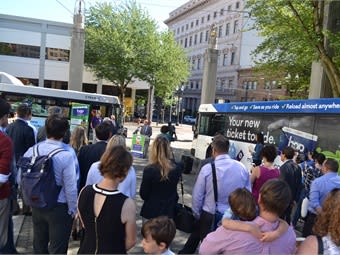
The new Hop system was recently launched at an event in Portland.
INIT
TriMet, C-TRAN, and Portland Streetcar launched Hop Fastpass — an electronic fare collection system implemented by INIT Innovations in Transportation Inc. This regional e-fare system spans multiple agencies allowing transit riders to pay for trips on TriMet and C-TRAN buses, Portland Streetcar, MAX Light Rail, WES Commuter Rail or the C-TRAN Vine BRT system, all which operate within the Portland-Vancouver Metropolitan Area.
Hop Fastpass is a fully integrated e-fare system that can accept regular contactless fare media (Hop cards) and will accept contactless credit or debit card payments.
“The benefits of the Hop system will be far reaching, providing benefits not just for our riders but for the efficiency of our revenue operations as well as those of our fellow transit providers in the greater Portland-Vancouver metro area,” said TriMet GM Neil McFarlane. “Our 15 year partnership with INIT has been and continues to be one that fosters growth, technical advancement, and effective process management.”
Hop Fastpass is one of the first public transit e-fare system in the world to offer equity to passengers in the form of monthly fare capping. Riders have the benefit of earning daily and monthly passes — one ride at a time — without worrying about being charged more than the price of a day or monthly ticket.
Integration with several third parties was required for the system. Using an open API architecture approach, INIT seamlessly integrated with competitors and partners to deliver the project both on time and on budget.
Two of the agencies, TriMet and C-TRAN, already have INIT’s operations control and real-time passenger information systems deployed. Due to the ease of INIT’s modular systems, the INIT e-fare module was much easier and more cost effective to set up. This factor significantly contributed to the overall success of the project.
INIT’s back-end processing software, MOBILEvario, serves as the core intelligence for the account-based, Hop Fastpass system. It manages and processes the multi-agency fare structures in real-time, recognizes and processes revenue sharing, as well as manages accounts and automates reconciliations.
Hop Fastpass can be used on more than 700 buses and rail vehicles and at approximately 400 platform validators. Using the Hop website, Hop app, customer hotline, or the growing retail network, riders can manage funds virtually any time of day or night.
This system benefits the transit providers by reducing boarding times at stops, increasing efficiency and on-time performance, while simplifying fare collections and reducing cash in the system. The structure will benefit residents and visitors alike by providing an easy and worry-free way to enjoy getting around the Portland-Vancouver Metropolitan Area.
More Management

METRO Opens Submissions for 2026 Motorcoach Awards
Nominations are now being accepted for METRO Magazine’s Operator of the Year and Innovative Operator of the Year awards.
Read More →
New York MTA Advances Final Contract for Second Avenue Subway Expansion
Contract Four is the largest in the Second Avenue Subway Phase 2 project and includes construction of station infrastructure, tracks, and signals for the subway expansion, MTA officials said. Work on Contract Four will begin in 2027.
Read More →
Transit Agencies Highlight Safety Gains at National Summit
Leaders from 15 major transit systems shared crime-reduction results and safety initiatives while discussing the role of continued federal support.
Read More →

NITA Names New Leadership, Expands Reduced-Fare Program at First Board Meeting
The new regional transit authority appointed its first board chair and interim executive director while extending reduced fares across CTA, Metra, and Pace for eligible riders.
Read More →
Beyond the Checklist: A Structured Approach to Transit Maintenance
Reliability-Centered Maintenance helps transit agencies move beyond routine checklists to focus limited resources on the assets and failures that have the greatest impact on safety, reliability, and service.
Read More →
APTA 2026 Nominating Committee Selects Leadership Slate, Names Chair and Vice Chair Nominees
Leadership changes will help shape the association’s priorities and its representation of the transportation industry during the 2026–2027 term.
Read More →
DART Launches Major Security, Fare Enforcement Initiative
The 90-day demonstration will deploy coordinated security teams at five light rail stations while testing controlled access and gathering data to guide future investments.
Read More →
Advancing Fare Collection Through Technology and Innovation
Learn about delivering 1300 gates at 91 stations while managing fare evasion. Explore the large scale deployment, solution customization and real-world results that affect the region. Prepare for deployment in your region now.
Read More →
Game Day in Motion: Moving Millions During the 2026 World Cup
Between packed transit stations and team motorcoaches, see how agencies and operators across North America tackled the transportation demands of the 2026 FIFA World Cup.
Read More →
Surface Transportation Extension Averts Shutdown, Leaves Transit Funding Gap
The stopgap keeps federal transportation programs moving, but missing advance funding could complicate the transit and rail projects agencies are planning next.
Read More →