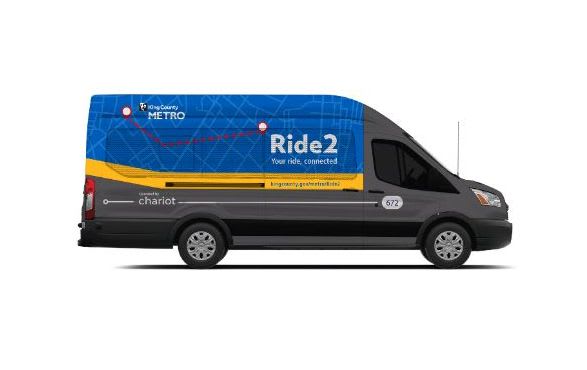
Combined, the two Ride2 services delivered 125 trips per day on average.
King County Metro
2 min to read
Combined, the two Ride2 services delivered 125 trips per day on average.
King County Metro
Seattle’s King County Metro will not renew the on-demand shuttle service Ride2 West Seattle, which was funded by the voter-approved Seattle Transportation Benefit District and served the Alaska Junction and King County Water Taxi dock at Seacrest Park.
At the same time, the agency announced it will also cease Ride2 Eastgate, which serves Eastgate Park & Ride. Both one-year pilot programs will end on Dec. 20.
Ad Loading...
Combined, the two services delivered 125 trips per day on average.
The agency’s Via to Transit, which serves Southeast Seattle and Tukwila, will continue, however. By comparison, it currently serves around 240 trips per day in the Rainier Beach service area alone, and nearly 1,000 rides per day across its five service areas.
The pilots were designed as 12-month research projects to test innovative solutions to immediate transportation needs. West Seattle’s Ride2 launched just before phase one of the “Seattle Squeeze,” in which the viaduct was coming down and City of Seattle sought to provide an alternative to driving downtown via the West Seattle Bridge. Eastgate’s immediate need stemmed from the fact that Eastgate Park & Ride — the county’s largest park-and-ride — was often full early in the morning and is located in an area with limited local bus service and walking and biking infrastructure.
Ride2’s key performance indicators included average wait time and in-vehicle time; however the project team kept an open mind in terms of expected ridership. A total of 7,155 users downloaded the Ride2 app used in both service areas, though less than 15% have used the service in the last 30 days.
The Ride2 pilots provided valuable data on the need for certain on-demand services, but ultimately did not meet the milestones necessary to continue the programs given financial constraints, reported Metro.
Lessons Learned by King County Metro
On-demand shuttle services draw the most riders when deployed in areas where they significantly improve access to jobs compared to traditional bus or other fixed-route service.
On-demand shuttles work best when connecting to very frequent service like light rail and very active bus routes. The service doesn’t work as well to connect to lower frequency bus routes or the Water Taxi, which sails every 30 minutes during peak periods.
On-demand shuttles like Ride2 can be a successful model to feed Metro’s fixed-route system. There is a higher than 90% transfer rate between Ride2s and traditional bus system or water taxi, as was intended.
Riders really liked the convenience of Ride2, and services performed within the targeted wait time of 10 minutes or less, and the targeted in-vehicle time of 15 minutes or less.
Greater efficiencies can be gained from operating on-demand shuttle service in connected areas, like Via to Transit in southeast Seattle and Tukwila, since vehicles can cross between service areas. In contrast, Ride2 has fixed fleets that can only serve one specific service area.

The service is a flexible, reservation-based transit service designed to close the first- and last-mile gaps and connect riders to employment for just $5 per day.
Transit agencies depend on safe, reliable vehicles to deliver consistent service. This eBook examines how next-generation fleet software helps agencies move from reactive processes to proactive operations through automated maintenance, real-time safety insights, and integrated data. Learn how fleets are improving uptime, safety outcomes, and operational efficiency.
In a recent episode of METROspectives, LYT CEO Timothy Menard discusses how artificial intelligence, cloud connectivity, and real-time data are transforming traffic management, boosting bus reliability, and enabling system-wide transit optimization across cities.
The analysis finds that a $4.6 trillion investment across all levels of government over 20 years ($230 billion per year) would be required to build, operate, and maintain a transit network that approaches the level of service within a cohort of 17 global cities with world-class transit systems.
As the transportation landscape continues to evolve in the wake of the pandemic, few manufacturers have faced, or embraced, change as decisively as Forest River Bus.