



L.A. Metro campaign urges rail safety
Ambassadors are positioned at key Blue Line locations in two shifts, Monday through Friday, when accidents are likely to occur, to answer questions and to warn and educate pedestrians and passengers about the dangers of standing too close to the tracks.


Photo courtesy justefrain
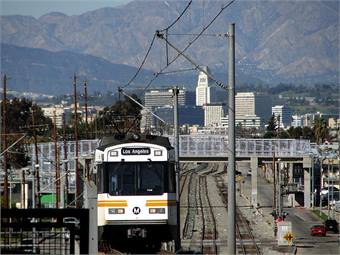
Photo courtesy justefrain
Although there has been a dramatic reduction in Los Angeles County Metropolitan Transportation Authority (Metro) Blue Line accidents this year (three fatalities versus eight during the same period last year) — and other rail lines are experiencing low accident rates similar to previous years — Metro continues to develop methods for keeping vehicles and pedestrians aware of and away from moving rail.
"Significant progress has been made but as long as accidents continue, we will continue our efforts to stop them," said Metro Board Chair Diane DuBois. "During the past year Metro has aggressively pursued a program to stop rail-related accidents and suicides along rail by pursuing the three Es: education, engineering and enforcement."
Metro Safety Ambassadors — many of whom are retired rail and bus operators — are assigned to various spots where accidents have occurred in the past. On the Blue Line, 14 Ambassadors are positioned at seven key locations in two shifts, Monday through Friday, when accidents are likely to occur, to answer questions and to warn and educate pedestrians and passengers about the dangers of standing too close to the tracks and trying to beat on-coming trains.
They also are there to remind patrons and pedestrians of good safety behaviors, such as looking both directions when crossing the tracks since trains come from both directions.
Metro's safety education department has conducted yearly presentations at 160 schools within a 1.5-mile radius of the alignment. It has developed videos and CDs on safe and unsafe behaviors around tracks and trains. Suicide prevention signs have been installed at all stations and at high-speed gated crossings. Additional safety material has been distributed to 250,000 doors near the Blue Line.
And earlier this year, Metro began an innovative partnership with the Didi Hirsch Suicide Prevention Center, which works with referrals from Metro to help stop suicides along the Blue Line.
A variety of engineering efforts also have been instituted. They include:
A closed at-grade crossing on Flower Street.
Four quadrant gates and vehicle detection loops at six intersections.
Flashing "Train" signs as replacements for stagnant "No Left Turn" signs in some places.
Additional flashing lights and bells at several gated crossings.
Swing gates at several high-traffic pedestrian crossings.
Railroad-type barriers at several crossings.
Colored stamped crosswalks and pavement markings.
Electric horns as replacements for mechanical horns on the trains.
Headlights modified on all light-rail trains to flash alternately.
Installation of in-pavement warning lights.
Law enforcement also has been heavily involved in the education process. Motorcycle patrols by Transit Services Bureau have been monitoring high-risk areas where accidents have occurred in the past. Law officers have conducted targeted enforcement at high-risk crossings, issuing dozens of tickets to encourage behavior changes.
RELATED: Watch L.A. Metro's launch of it rail safety ambassador program here.
More Rail

New York MTA Advances Final Contract for Second Avenue Subway Expansion
Contract Four is the largest in the Second Avenue Subway Phase 2 project and includes construction of station infrastructure, tracks, and signals for the subway expansion, MTA officials said. Work on Contract Four will begin in 2027.
Read More →
San Diego MTS Breaks Monthly Trolley Ridership Record
Agency officials said July’s ridership indicates MTS’s continued recovery from the pandemic.
Read More →
Report Examines NJ TRANSIT Reliability, Funding Challenges
The Garden State Initiative analysis examines the roles of Amtrak infrastructure, fleet management, and agency operations while recommending a more performance-based approach to improving reliability.
Read More →
Stadler, CapMetro Sign Long-Term Rail Fleet Support Agreement
Beginning in 2027, Stadler will provide on-site technical expertise, spare parts support, training, and obsolescence management to help extend the reliability and longevity of CapMetro’s GTW fleet.
Read More →
Biz Briefs: Alstom Lands Canadian Contract, LYT to Supply California TSP, and More
In METRO's latest installment, we take a look at recent news from Complete Coach Works, Beep, FlixBus, and more partnerships making headlines across the transportation sector.
Read More →
CATS Gold Line Marks 5 Years of Service, 2.8M Passenger Trips
With a six-mile expansion planned, the Charlotte streetcar is positioned to connect more neighborhoods and major transit hubs across the region.
Read More →
Why Simulating Pedestrian Movement Has Become Essential for Modern Rail Stations
Pedestrian microsimulation is helping rail planners identify bottlenecks, test station designs, and prepare complex transit hubs for growing passenger volumes.
Read More →
Amtrak Begins Major Construction at New York’s Sunnyside Yard
The new maintenance facility will support Amtrak’s Airo trainsets while improving maintenance efficiency and turnaround times in New York.
Read More →
Chicago Leaders Unveil Plans for O’Hare Airport Express Train
The privately developed project would offer a 15-minute trip between downtown and O’Hare’s Terminal 2, with trains operating every 15 minutes on a dedicated track. The service would use battery-electric trains and three existing freight rail rights-of-way.
Read More →
OCTA Maps Out 30-Year Strategy to Protect Coastal Rail Corridor
The draft feasibility report identifies strategies to protect the coastal rail line for decades as the agency continues near-term stabilization and sand placement efforts.
Read More →