



L.A. Metro Sets Date For Regional Connector Launch
The ambitious, complex project, which began in 2013, is unique among rail projects in the U.S.

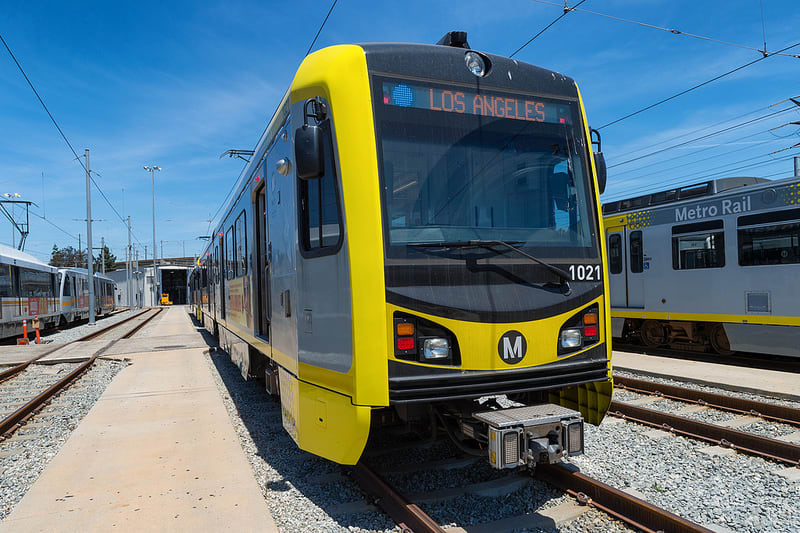
To mark this historic milestone, Metro will provide free rides on the entire Metro transit system including Metro bus and rail lines, as well as Metro Bike Share services, during opening weekend.
Photo: LA Metro
The Los Angeles County Metropolitan Transportation Authority (Metro) will officially open the Regional Connector transit project to the public on June 16.
The ambitious, complex project, which began in 2013, is unique among rail projects in the U.S. The 1.9 miles of new track laid for the project will allow light rail trains to travel between Union Station and the busy 7th Street/Metro Center Station in Downtown’s Financial District. Before the Regional Connector, that’s a journey only Metro’s heavy rail lines could make. Bridging this gap allows Metro to merge the hook-shaped L (Gold) line with the A (Blue) and E (Expo) lines, creating two serpent-like train lines where there were once three.
Inside L.A. Metro’s Passenger Rail Project
The Regional Connector includes three new underground stations:
Little Tokyo/Arts District Station where riders will have easy access to historically rich and vibrant neighborhoods and cultural institutions.
Historic Broadway Station features two nationally registered districts: the Broadway Theater District, with 12 original theaters within seven blocks and Old Spring Street, known as the original Financial District of Downtown Los Angeles.
Grand Avenue Arts/Bunker Hill Station connects riders to downtown's performing arts institutions, museums, fine dining experiences and more.
These new stations will transform the way many riders can experience the Metro system, provide riders a seamless, one-seat journey from as far as Azusa to Long Beach and from East L.A. to Santa Monica with no transfers required.
To mark this historic milestone, Metro will provide free rides on the entire Metro transit system including Metro bus and rail lines, as well as Metro Bike Share services, during opening weekend.
“For the first time since the Blue Line opened in 1990, it will now offer a single-seat ride from Long Beach to Union Station,” said L.A. County Supervisor and Metro Board Member Janice Hahn. “The Regional Connector will mean that jobs and education opportunities, which used to require two to three transfers for residents in my district, will now be just one train ride away.”
Providing a One-Seat Ride
The completion of the Regional Connector project improves connections by bringing together the Metro L (Gold), A (Blue), E (Expo), B (Red) and D (Purple) lines at the 7th Street/Metro Center Station. The new A and E lines will share five downtown Los Angeles stations giving travelers plenty of transfer options along the way. Some customers riding to and through downtown Los Angeles could save up to 20 minutes by eliminating the need to transfer. Metro will launch the Regional Connector with the existing 10-minute peak and 12-minute midday and weekend service frequencies for the A and E lines.
Riders will have the opportunity to visit cultural events and venues in downtown Los Angeles, public parks, and other major attractions. The Regional Connector will offer easier access to medical facilities and jobs, and commerce centers throughout the city.
Many of the key destinations are within walking distance of the new underground stations including the Japanese American National Museum, Million Dollar Theater, the Walt Disney Concert Hall, The Broad and Museum of Contemporary Art, to name a few.
As with previous construction projects, the Regional Connector line was designed and built with the help of community input and local voices. In addition, this project benefited from Metro’s Board approved small business mitigation programs: the Business Interruption Fund and Eat Shop Play which helped support small businesses in the areas along this project during construction.
Funding for the L.A. Metro Project
The Business Interruption Fund provided support for businesses around the Little Tokyo/Arts District and History Broadway stations — $3.3 million was awarded to 56 small “mom and pop” shops and the Eat Shop Play program provided free marketing assistance to 102 businesses along the Regional Connector line.
“People are going to love the newfound connectivity available through the Regional Connector,” said Metro CEO Stephanie Wiggins. “We have built a beautiful, useful, and state-of-the-art rail transit project that everyone in L.A. County will be able to use to get to their favorite destinations. I for one am looking forward to seeing all the families that will use the Regional Connector to get to the beach, rediscover downtown, or go museum hopping with their friends. Thank you to everyone who has worked so hard to get us to opening day.”
Metro contracted with Regional Connector Constructors (RCC), a joint venture between Skanska USA Civil West California District, Inc., and Traylor Brothers, Inc., to design and build the $1.8 billion Regional Connector. Metro’s contractor has been able to achieve one of the best safety records of all Metro construction projects, with more than 7.7 million hours worked without any lost time due to injury or incident.
Metro also implemented a Project Labor Agreement and Construction Careers Policy to encourage construction employment and training opportunities during the Regional Connector project. More than 10% of construction workers hired by Metro’s prime contractors on the Regional Connector project were from economically disadvantaged areas and 20 percent were hired as apprentices to start their careers in construction. PLA/CCP workers included 66% who were Latino, 5% African American, 4% female.
More Rail

New York MTA Advances Final Contract for Second Avenue Subway Expansion
Contract Four is the largest in the Second Avenue Subway Phase 2 project and includes construction of station infrastructure, tracks, and signals for the subway expansion, MTA officials said. Work on Contract Four will begin in 2027.
Read More →
San Diego MTS Breaks Monthly Trolley Ridership Record
Agency officials said July’s ridership indicates MTS’s continued recovery from the pandemic.
Read More →
Report Examines NJ TRANSIT Reliability, Funding Challenges
The Garden State Initiative analysis examines the roles of Amtrak infrastructure, fleet management, and agency operations while recommending a more performance-based approach to improving reliability.
Read More →
Stadler, CapMetro Sign Long-Term Rail Fleet Support Agreement
Beginning in 2027, Stadler will provide on-site technical expertise, spare parts support, training, and obsolescence management to help extend the reliability and longevity of CapMetro’s GTW fleet.
Read More →
Biz Briefs: Alstom Lands Canadian Contract, LYT to Supply California TSP, and More
In METRO's latest installment, we take a look at recent news from Complete Coach Works, Beep, FlixBus, and more partnerships making headlines across the transportation sector.
Read More →
CATS Gold Line Marks 5 Years of Service, 2.8M Passenger Trips
With a six-mile expansion planned, the Charlotte streetcar is positioned to connect more neighborhoods and major transit hubs across the region.
Read More →
Why Simulating Pedestrian Movement Has Become Essential for Modern Rail Stations
Pedestrian microsimulation is helping rail planners identify bottlenecks, test station designs, and prepare complex transit hubs for growing passenger volumes.
Read More →
Amtrak Begins Major Construction at New York’s Sunnyside Yard
The new maintenance facility will support Amtrak’s Airo trainsets while improving maintenance efficiency and turnaround times in New York.
Read More →
Chicago Leaders Unveil Plans for O’Hare Airport Express Train
The privately developed project would offer a 15-minute trip between downtown and O’Hare’s Terminal 2, with trains operating every 15 minutes on a dedicated track. The service would use battery-electric trains and three existing freight rail rights-of-way.
Read More →
OCTA Maps Out 30-Year Strategy to Protect Coastal Rail Corridor
The draft feasibility report identifies strategies to protect the coastal rail line for decades as the agency continues near-term stabilization and sand placement efforts.
Read More →