




RELATED: Design-Build Facilitates Completion of L.A.'s Expo Line Phase 2
Maryland Purple Line EIS receives FTA 'Outstanding Achievement' award
The MTA’s Purple Line is a 16-mile, 21-station light rail line in the northern Washington D.C. suburbs. A circumferential rail transit line linking an existing radial system, the Purple Line will connect key activity centers, four branches of the Washington Metropolitan Area Transit Authority system, and Amtrak’s Northeast Corridor.
December 14, 2015
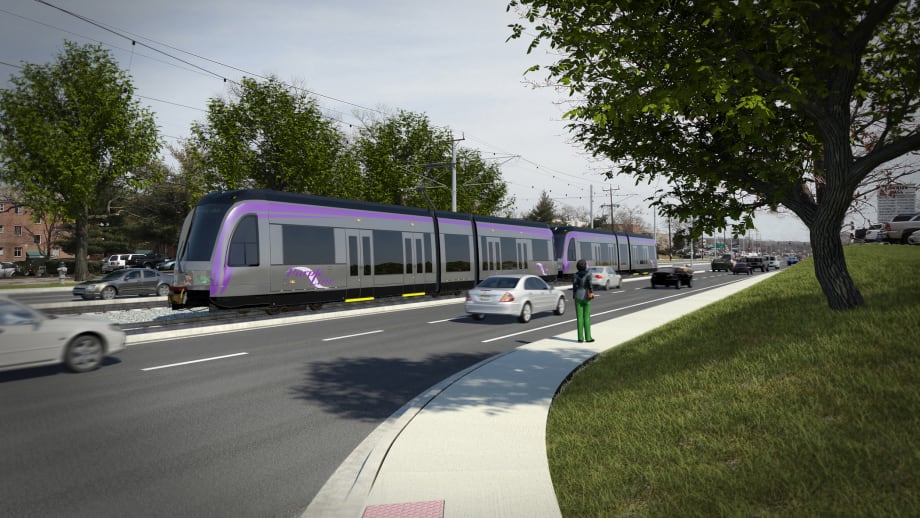
Rendering of Maryland Transit Administration's Purple Line.
2 min to read
Rendering of Maryland Transit Administration's Purple Line.
An environmental impact statement (EIS) prepared for Maryland's proposed Purple Line light rail transit extension has received an Outstanding Achievement Award from the Federal Transit Administration (FTA).
The 2015 Outstanding Achievement Award for Excellence in Environmental Document Preparation in the EIS category recognizes environmental documents that exemplify best practices for a well-managed environmental documentation process, comply with prevailing requirements and expectations, and reduce paperwork.
The award was presented to Maryland Transit Partners, a joint venture of WSP | Parsons Brinckerhoff, AECOM and RK&K that serves as program management consultant to the Maryland Transit Administration (MTA). WSP | Parsons Brinkerhoff has held key roles since the project’s initiation in 2003, particularly for planning, travel forecasting, public involvement, and most recently, the public-private partnership (P3) procurement process.
The MTA’s Purple Line is a 16-mile, 21-station light rail line in the northern Washington D.C. suburbs. A circumferential rail transit line linking an existing radial system, the Purple Line will connect key activity centers, four branches of the Washington Metropolitan Area Transit Authority system, and Amtrak’s Northeast Corridor.
In selecting the Purple Line EIS as winner of the award, the FTA stated: “The Purple Line EIS exemplifies best practices for a well-managed environmental documentation process. FTA is pleased to recognize your efforts in producing this effective and practical environmental document. The review committee was particularly impressed with the presentation of information, including the use of reader-friendly language, graphics and tables, while successfully resolving complicated environmental issues.”
More Rail
Amtrak, CN Reach Agreements to Strengthen Passenger Rail Service, Safety
The agreement resolves a more than decade-long proceeding before the Surface Transportation Board concerning the terms and conditions for Amtrak services, such as the City of New Orleans, Illini/Saluki, and Wolverine.
Read More →
New York MTA Advances Final Contract for Second Avenue Subway Expansion
Contract Four is the largest in the Second Avenue Subway Phase 2 project and includes construction of station infrastructure, tracks, and signals for the subway expansion, MTA officials said. Work on Contract Four will begin in 2027.
Read More →
San Diego MTS Breaks Monthly Trolley Ridership Record
Agency officials said July’s ridership indicates MTS’s continued recovery from the pandemic.
Read More →
Report Examines NJ TRANSIT Reliability, Funding Challenges
The Garden State Initiative analysis examines the roles of Amtrak infrastructure, fleet management, and agency operations while recommending a more performance-based approach to improving reliability.
Read More →
Stadler, CapMetro Sign Long-Term Rail Fleet Support Agreement
Beginning in 2027, Stadler will provide on-site technical expertise, spare parts support, training, and obsolescence management to help extend the reliability and longevity of CapMetro’s GTW fleet.
Read More →
Biz Briefs: Alstom Lands Canadian Contract, LYT to Supply California TSP, and More
In METRO's latest installment, we take a look at recent news from Complete Coach Works, Beep, FlixBus, and more partnerships making headlines across the transportation sector.
Read More →
CATS Gold Line Marks 5 Years of Service, 2.8M Passenger Trips
With a six-mile expansion planned, the Charlotte streetcar is positioned to connect more neighborhoods and major transit hubs across the region.
Read More →
Why Simulating Pedestrian Movement Has Become Essential for Modern Rail Stations
Pedestrian microsimulation is helping rail planners identify bottlenecks, test station designs, and prepare complex transit hubs for growing passenger volumes.
Read More →
Amtrak Begins Major Construction at New York’s Sunnyside Yard
The new maintenance facility will support Amtrak’s Airo trainsets while improving maintenance efficiency and turnaround times in New York.
Read More →
Chicago Leaders Unveil Plans for O’Hare Airport Express Train
The privately developed project would offer a 15-minute trip between downtown and O’Hare’s Terminal 2, with trains operating every 15 minutes on a dedicated track. The service would use battery-electric trains and three existing freight rail rights-of-way.
Read More →