



MCI, New Flyer host IMG at Vehicle Innovation Center
Members are the first private sector transportation operators to visit the VIC which opened last October.


MCI and IMG members gather the Vehicle Innovation Center. From left are Ian Smart, MCI; Patricia Ziska, MCI; Gladys Gillis, The Starline Collection; Chuck Abbott, Gray Line Tennessee; Scott Riccio, Northeast Charter and Tour; Buddy Sload, Krapf Transportation; Brent Maitland, MCI; Dan Martin, Karst Stages; Mike Dixon, Southeastern Stages; Patrick Scully, MCI; Geoffrey Lynch, Hampton Jitney; Brian Parker, Southeastern Stages; Christian Holter, Rochester City Lines; Tom Skinner, Cline Tours; Dan Holter, Rochester City Lines; Frank Leyden, Cline Tours; Robert Lessor, MCI; Greg Gallup, Royal Coach T
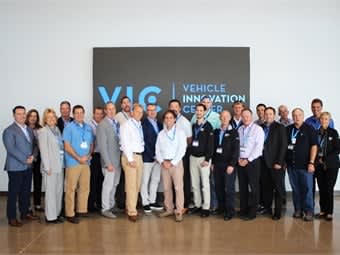
MCI and IMG members gather the Vehicle Innovation Center. From left are Ian Smart, MCI; Patricia Ziska, MCI; Gladys Gillis, The Starline Collection; Chuck Abbott, Gray Line Tennessee; Scott Riccio, Northeast Charter and Tour; Buddy Sload, Krapf Transportation; Brent Maitland, MCI; Dan Martin, Karst Stages; Mike Dixon, Southeastern Stages; Patrick Scully, MCI; Geoffrey Lynch, Hampton Jitney; Brian Parker, Southeastern Stages; Christian Holter, Rochester City Lines; Tom Skinner, Cline Tours; Dan Holter, Rochester City Lines; Frank Leyden, Cline Tours; Robert Lessor, MCI; Greg Gallup, Royal Coach T
Motor Coach Industries (MCI), a U.S. subsidiary of NFI Group Inc., recently hosted members from the International Motorcoach Group (IMG) at its Vehicle Innovation Center (VIC) in Anniston, Ala. Located on New Flyer of America’s manufacturing campus, the VIC features a lab and education center dedicated to exploring developments in propulsion, vehicle connectivity, and Advanced Driver Assistance Systems (ADAS), and design for future buses and coaches.
IMG members are the first private sector transportation operators to visit the VIC which opened last October.
The three-day exploration covered MCI’s deployment of ADAS systems, vehicle connectivity through telematics, and the battery-electric platform coming to MCI models in 2020.
Attendees learned how ADAS, available on MCI J-Series models, provides a step toward autonomous coaches. MCI’s best-in-class ADAS features collision mitigation upgrades to latest-generation Bendix Fusion that integrates a forward-facing camera with vehicle recognition software to detect and stop for stationary objects; the system also offers lane departure warning, traffic sign recognition, and more, along with a new optional 360-Degree Camera featuring reverse sensing and audible warning alert. IMG members also got to test the technologies on MCI coaches at Atlanta Motor Speedway.
David Warren, director, sustainable transportation, at New Flyer, gave a presentation titled “The Essentials of Electric Bus and Coach Technology and Deployment,” offering an in-depth review of lithium-ion batteries, propulsion motors, high-voltage power conversion, and equipment supporting multiple types of industry charging standards.
Attendees also took part in hands-on Learning Lab sessions, including experiencing an electric bus driving simulator that helps drivers hone regenerative braking techniques to increase range and energy efficiency. They also observed how today’s telematics that connect vehicles paves the way for greater efficiency in electric coaches. MCI’s long-range battery-electric J4500e prototype is already setting benchmarks in test-runs with production scheduled to begin in 2020.
IMG is a membership organization comprised of 57 North American coach operators that work together to elevate the standard of service for passengers.
More Technology

From Hardware to Digital Partner: Luminator Charts Its Next Chapter
CEO Magnus Friberg discusses Luminator’s shift toward becoming a digital partner, the growing importance of software and interoperability, and how AI can help agencies improve operations and passenger experience.
Read More →
Beyond the Checklist: A Structured Approach to Transit Maintenance
Reliability-Centered Maintenance helps transit agencies move beyond routine checklists to focus limited resources on the assets and failures that have the greatest impact on safety, reliability, and service.
Read More →
NJ TRANSIT Advances Bus Technology Upgrades Across Statewide Fleet
More than 1,500 buses now feature upgraded technology designed to improve arrival predictions and provide free Wi-Fi, with deployment expected to reach nearly 2,000 buses by the end of 2026.
Read More →

Building a Flexible Path to Transit Electrification
John Hroncich discusses BAE Systems’ modular and scalable approach, lessons learned from decades of real-world operations, and how agencies can identify electrification strategies that fit their fleets.
Read More →
Biz Briefs: Alstom Lands Canadian Contract, LYT to Supply California TSP, and More
In METRO's latest installment, we take a look at recent news from Complete Coach Works, Beep, FlixBus, and more partnerships making headlines across the transportation sector.
Read More →
From Legacy Silos to Conversational Intelligence
What if transit leaders could ask any operational question and get a trusted answer in seconds? Conversational AI is transforming how agencies use their data.
Read More →
USDOT Announces Rail Vehicle Replacement Grants, Chattanooga AV Shuttle Funding
More than $191 million in federal funding will help three transit agencies replace aging rail vehicles and support a new autonomous shuttle service in Chattanooga.
Read More →
Bus Tech Talk: Keeping Transit Technicians Ahead of the Technology Curve
LA Metro’s Obed Mejia discusses technician training, evolving maintenance technology, fleet replacement, and strategies for getting the most out of today’s transit fleets.
Read More →
Biz Briefs: RIPTA Unveils New Frontrunners, Clevland RTA Adds New Siemens, and More
In METRO's latest installment, we take a look at recent news from Siemens, Prevost, Dodge, and more partnerships making headlines across the transportation sector.
Read More →
Why Simulating Pedestrian Movement Has Become Essential for Modern Rail Stations
Pedestrian microsimulation is helping rail planners identify bottlenecks, test station designs, and prepare complex transit hubs for growing passenger volumes.
Read More →