




RELATED: Metra breaks ground on 136-year-old bridge replacement
Metra unveils winterization plans, customer communications
Through the use of GPS technology, the agency's communication specialists can monitor the position and timeliness of all trains in the system in real time and alert passengers in a variety of ways.
December 6, 2017

Metra communications specialists working on the Metra Electric Line desk in the GPS Center on Tuesday, Dec. 5. Photo: Metra
4 min to read
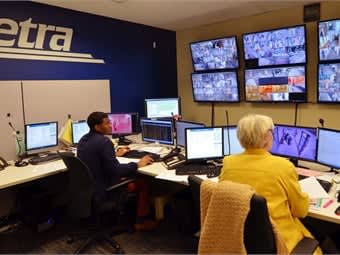
Metra communications specialists working on the Metra Electric Line desk in the GPS Center on Tuesday, Dec. 5. Photo: Metra
Metra recently unveiled its winter weather preparation plans for the system, which included a tour of its GPS Center for reporters to demonstrate how it communicates with customers.
The GPS Center, located in Metra’s headquarters building at 547 W. Jackson, is where platform announcements, website updates, email alerts and most service Tweets originate. Through the use of GPS technology, the agency's communication specialists can monitor the position and timeliness of all trains in the system in real time and alert passengers in a variety of ways about delays, disruptions and other service issues.
“Our GPS Center is the heart of our communication efforts,” said Metra CEO/Executive Director Don Orseno. “Of course, we strive to operate all of our trains on time, but when they run behind due to weather or others reasons, we also strive to communicate those delays in a timely and accurate manner.”
As soon as a train falls six minutes or more behind, Metra staffers will start making announcements on board the delayed train and on the platforms where passengers are waiting. Announcements can be made by typing a message, which is then turned into an automated audio announcement and posted on scrolling signs in most stations and ADA cars, or by speaking directly into a microphone to make a live announcement. Using a separate system, the announcement can also be sent directly to the delayed train.
If a delayed train falls 15 minutes behind schedule (30 minutes on weekends), then we send an alert that warns riders the train is delayed, giving the length of the delay and the reason. The alert is emailed to riders who have signed up to receive them, sent out on Twitter and posted on the Metra website, metrarail.com. Metra's social media team may supplement the GPS tweets with additional information.
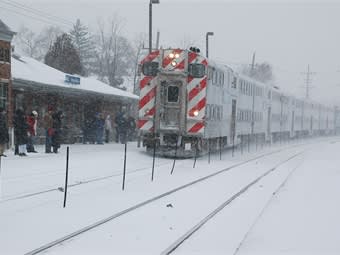
Metra's winterization efforts include stockpiling 63,000 bags (more than 3.1 million pounds) of salt to cover the platforms and other areas under Metra’s responsibility. Photo: Metra
If the agency knows about something that is going to delay more than one train — such as a grade-crossing incident or a switch failure at a critical location — it will issue a “blanket” alert as soon as it is known.
In 2018, Metra will be working on a major upgrade to its GPS technology, which will help communication with customers about delays and disruptions.
Winterization Efforts
Each year, Metra takes the following steps to help mitigate the impact of winter weather on railroad operations:
Inspect and test Metra’s 463 mainline switches .
Test nozzles on 275 hot-air switch heaters.
Inspect and test the remaining 188 mainline switch heaters that use gas flames or electric current.
Inspect snow and ice shields on 73 switches, which cover part of the switch machinery and help concentrate and contain the hot air from the switch heaters.
Inspect and test heaters on all railcars. Metra has about 850 railcars on its diesel lines and 186 Highliner cars on the Metra Electric Line.
Inspect doors on older cars for defects, worn guides and corrosion.
Stockpile 63,000 bags or more than 3.1 million pounds of salt to cover the platforms and other areas under Metra’s responsibility.
Inspect and test 45 snow plows at its disposal, not counting the equipment used by its parking vendor and the numerous municipalities responsible for clearing parking lots and other areas around most of its suburban stations.
Inspect and test Metra’s three cold-air blowers and five hot-air jet blowers to clear its largest and most critical yards.
Unfortunately, no railroad can completely eliminate a common winter switch problem: snow and ice accumulates on the underside of locomotives and train cars, and then falls off the train, into a switch, as the train rumbles over it. The snow and ice can then prevent the movable part of the switch from making contact with the rail. If that contact can’t be made, an electric circuit cannot be completed and, as a failsafe, the signal system will not permit a train to proceed over the switch. In those cases, the switch must be cleared manually and Metra routinely assigns employees to key switching locations during winter storms to keep the switches clear.
Steps before/during a major storm include,
Dispatching Metra signal/switch maintainers to key locations and staffing them 24/7.
Dispatching about 350 workers to shovel and salt platforms and other areas.
Putting crews and equipment in place to keep 24 rail yards clear.
Fueling our locomotives in outlying rail yards overnight.
Leaving our engines on overnight.
Running extra “ice trains” overnight on the Metra Electric Line to prevent ice from accumulating on the overhead power lines.
When extreme weather conditions do not allow for operation of regularly scheduled service, Metra may implement snow schedules, which include about 75 to 80 percent of regularly scheduled trains.
More Rail

New York MTA Advances Final Contract for Second Avenue Subway Expansion
Contract Four is the largest in the Second Avenue Subway Phase 2 project and includes construction of station infrastructure, tracks, and signals for the subway expansion, MTA officials said. Work on Contract Four will begin in 2027.
Read More →
San Diego MTS Breaks Monthly Trolley Ridership Record
Agency officials said July’s ridership indicates MTS’s continued recovery from the pandemic.
Read More →
Report Examines NJ TRANSIT Reliability, Funding Challenges
The Garden State Initiative analysis examines the roles of Amtrak infrastructure, fleet management, and agency operations while recommending a more performance-based approach to improving reliability.
Read More →
Stadler, CapMetro Sign Long-Term Rail Fleet Support Agreement
Beginning in 2027, Stadler will provide on-site technical expertise, spare parts support, training, and obsolescence management to help extend the reliability and longevity of CapMetro’s GTW fleet.
Read More →
Biz Briefs: Alstom Lands Canadian Contract, LYT to Supply California TSP, and More
In METRO's latest installment, we take a look at recent news from Complete Coach Works, Beep, FlixBus, and more partnerships making headlines across the transportation sector.
Read More →
CATS Gold Line Marks 5 Years of Service, 2.8M Passenger Trips
With a six-mile expansion planned, the Charlotte streetcar is positioned to connect more neighborhoods and major transit hubs across the region.
Read More →
Why Simulating Pedestrian Movement Has Become Essential for Modern Rail Stations
Pedestrian microsimulation is helping rail planners identify bottlenecks, test station designs, and prepare complex transit hubs for growing passenger volumes.
Read More →
Amtrak Begins Major Construction at New York’s Sunnyside Yard
The new maintenance facility will support Amtrak’s Airo trainsets while improving maintenance efficiency and turnaround times in New York.
Read More →
Chicago Leaders Unveil Plans for O’Hare Airport Express Train
The privately developed project would offer a 15-minute trip between downtown and O’Hare’s Terminal 2, with trains operating every 15 minutes on a dedicated track. The service would use battery-electric trains and three existing freight rail rights-of-way.
Read More →
OCTA Maps Out 30-Year Strategy to Protect Coastal Rail Corridor
The draft feasibility report identifies strategies to protect the coastal rail line for decades as the agency continues near-term stabilization and sand placement efforts.
Read More →