



Mich. students, charter carriers partner for airport rides
MSA airBus is staffed entirely by students, who handle marketing, finance, scheduling, operations and human resources, and pick up on-the-job skills at the same time.

MSA airBus is able to charge walk-on fares directly to student accounts. Passengers simply swipe their student ID cards and the $11 fare appears on the regular card statement.
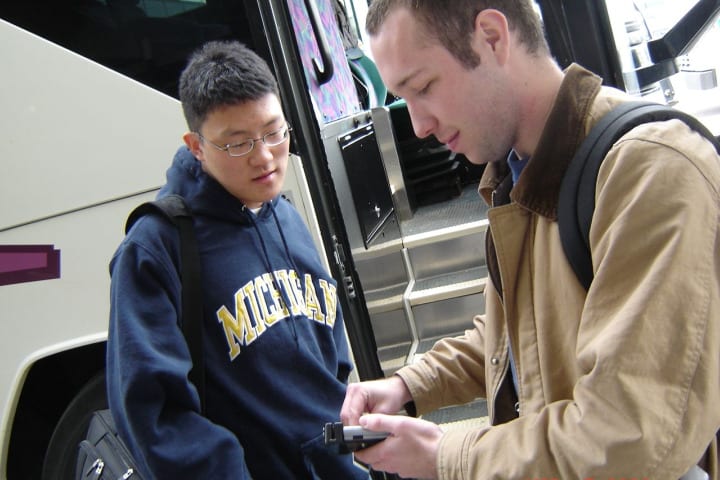
[IMAGE]Michigan-Airbus-full.jpg[/IMAGE]In order to fill the need for transportation between Ann Arbor’s University of Michigan (U-M) and the Detroit-Wayne County Metropolitan Airport, the Michigan Student Assembly (MSA) partnered with private charter carriers to create MSA airbus. The service is available before and after U-M breaks, which amounts to about 20 service days per year.
Although a commuter rail option is being studied, no other low-cost transit options currently exist for students needing to travel the 25 miles between the airport and campus. “We set up MSA airBus as a sort of stop-gap transit option,” says Neil Greenberg, who directs service development.
Schedules are posted online a month before each break. Students purchase tickets for rides to the airport, but can board the return trip for free. Tickets purchased in advance cost $7. Greenberg points out that a taxi ride or van service for the same trip would cost $50 to $70 each way. “Since MSA airBus began in 2002, we’ve saved our customers an estimated $2.8 million in cab fares,” he says.
With the cooperation of U-M Student Financial Operations, MSA airBus is able to charge walk-on fares directly to student accounts. Passengers simply swipe their student ID cards and the $11 fare appears on the regular card statement.
MSA airBus is staffed entirely by students, who handle marketing, finance, scheduling, operations and human resources, and pick up on-the-job skills at the same time.
Until last year, fares covered 100 percent of the service’s costs. Because MSA airBus is part of student government, MSA was able to cover the difference in the 2008-09 school year. Additional marketing efforts — including a Twitter feed — are lined up to help increase ridership and thus cover costs for this coming year, Greenberg says.
MSA airBus is working with the university’s International Student Affairs Commission to add a new service for international students at the beginning of the school year. In addition, airBus will partner with a local restaurant that recently purchased two cutaway buses for late-night rides. “The small buses will run a feeder route in neighborhoods not directly served by MSA airBus, then drop customers off at a regular MSA airBus stop,” Greenberg says.
More Bus

People Movement: Dan Dipert Coaches Adds Third-Generation Leader, Keolis Names New Valley Metro VP/GM, and More
In this edition, we also cover recent appointments and announcements at the Wabtec, SilverRide, HNTB, and more, showcasing the individuals helping to shape the future of transportation.
Read More →
New York MTA Plans Largest Bus Fleet Upgrade in More Than a Decade
The agency is seeking manufacturers for 650 new CNG buses to replace aging vehicles, improve reliability, and advance its broader fleet modernization strategy.
Read More →
Building a Flexible Path to Transit Electrification
John Hroncich discusses BAE Systems’ modular and scalable approach, lessons learned from decades of real-world operations, and how agencies can identify electrification strategies that fit their fleets.
Read More →
Bus Tech Talk: Keeping Transit Technicians Ahead of the Technology Curve
LA Metro’s Obed Mejia discusses technician training, evolving maintenance technology, fleet replacement, and strategies for getting the most out of today’s transit fleets.
Read More →
Biz Briefs: RIPTA Unveils New Frontrunners, Clevland RTA Adds New Siemens, and More
In METRO's latest installment, we take a look at recent news from Siemens, Prevost, Dodge, and more partnerships making headlines across the transportation sector.
Read More →
People Movement: Holly Arnold Joins Transdev and More
In this edition, we also cover recent appointments and announcements at Pace, CamTran, MCI, and more, showcasing the individuals helping to shape the future of transportation.
Read More →
The High Cost of Transit Buses: Industry Leaders Look to Procurement Reform
Transit leaders and policymakers examine how standardized bus designs, streamlined procurement, and predictable funding could help agencies stretch budgets and deliver better service.
Read More →
The Business Voice Behind Public Transportation
As chair of APTA’s Business Members Board of Governors, Ray Melleady explains how more than 850 business members are partnering with transit agencies to advance funding, innovation, and industry-wide collaboration.
Read More →
From Surviving to Thriving: Building Stronger Transportation Organizations
Bus Business Consultants founder Brian Dickson shares lessons on leadership, organizational health, and creating options for long-term success in a changing transportation industry.
Read More →
Finding the ‘Happy Medium’: Optimizing Maintenance Without Sacrificing Reliability
The key to maintenance optimization isn’t doing less work—it’s doing the right work at the right time on the right assets.
Read More →