



Micromobility device users operate without clear, consistent rules: Study
MTI authors concluded that states are the appropriate entity to set comprehensive regulations for personal transportation device riders.


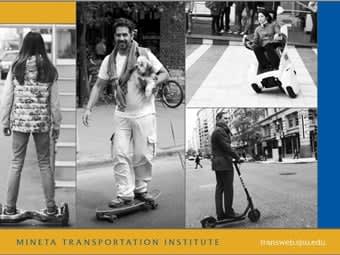
A new MTI report, “How and Where Should I Ride This Thing? Rules of the Road for Personal Transportation Devices,” analyzes existing personal transportation devices (PTD) regulations across the country and proposes state-level rules to balance safety and freedom of movement for all road users, including PTD riders.
“PTDs add a new user group to already contested street and sidewalk space, thus posing thorny regulatory challenges for cities,” said Kevin Fang, who authored the study with Asha Weinstein Agrawal and Ashley M. Hooper. The ever-growing number and types of PTDs have generated excitement about the devices’ potential as sustainable, affordable transportation modes, as well as serious concerns about how to integrate PTDs safely into communities.
After analyzing state, city, and campus rules for PTD riders, the study authors concluded that PTD users operate in a murky regulatory environment, with rules often poorly defined, contradictory, or altogether absent.
PTDs are often subject to regulations for other modes — in contradictory ways. As Agrawal pointed out, “riders face a confusing situation where, for example, Segway-style devices are regulated in radically different ways in different places; Segway riders are considered vehicles operators in Nebraska but pedestrians in Idaho.”
Regulations for a specific device type also vary widely from place to place. Hooper noted that, “depending on where one is riding, electric kick scooters are prohibited on sidewalks, allowed on sidewalks, or required to be on sidewalks.”
Drawing on their analysis of existing rules and expert interviews, the researchers developed model PTD “rules of the road.” Several core principles underpin the proposed rules for PTD riders: protect public safety, permit PTD use as a convenient travel option, be easy to understand and remember, and encompass new device-types as they appear without the need for new regulations.

Regulations for a specific device type also vary widely from place to place.
Photo via Bird
The authors concluded that states are the appropriate entity to set comprehensive regulations for PTD riders, though local jurisdictions should have flexibility to limit certain uses when necessary to protect public safety. “Just as we don’t expect car drivers to remember different driving rules for every community, PTD riders need consistency. However, policymakers also need the flexibility to account for differences in road conditions between and even within cities,” said Fang.
Among other specifics in the proposed state legislation, the authors recommend allowing PTD riders on both streets and sidewalks, subject to strict rules that protect safety and free movement for all travelers.
The final project report contains detailed information on regulations in all the communities analyzed for the project: 50 states and five U.S. territories, 101 cities, and 20 campuses. The report also presents the full text of the model state legislation and explains the reasoning behind each proposed rule.
More New Mobility

From Hardware to Digital Partner: Luminator Charts Its Next Chapter
CEO Magnus Friberg discusses Luminator’s shift toward becoming a digital partner, the growing importance of software and interoperability, and how AI can help agencies improve operations and passenger experience.
Read More →
Biz Briefs: Alstom Lands Canadian Contract, LYT to Supply California TSP, and More
In METRO's latest installment, we take a look at recent news from Complete Coach Works, Beep, FlixBus, and more partnerships making headlines across the transportation sector.
Read More →
CharterUP’s Armir Harris on Technology, AI, and the Future of Group Mobility
In a recent episode of METROspectives, CharterUP Founder/CEO Armir Harris discussed the company’s evolution from an online charter bus marketplace into a technology platform supporting public- and private-sector mobility and much more.
Read More →
Jacksonville’s NAVI Project Charts a New Course for Autonomous Public Transportation
Through its NAVI program, JTA is showing how autonomous vehicles, intelligent infrastructure, and coordinated operations can work together to deliver everyday public transportation.
Read More →
Biz Briefs: Luminator Marks Milestone and More
From manufacturers and suppliers to transit agencies and motorcoach operators, these updates offer a snapshot of the projects, partnerships and business moves driving the industry forward.
Read More →
New Tricks for Old Bureaucracies: Joshua Schank on Making Transit Innovation Stick
Former LA Metro Chief Innovation Officer Joshua Schank discusses why good ideas aren't enough, how transit agencies can overcome resistance to change, and why today's challenges demand more innovation.
Read More →
How DART's GoPass Is Redefining Regional Mobility
Serving 14 transit agencies, GoPass simplifies multimodal travel by allowing riders to plan, pay for, and manage an entire trip through one app.
Read More →
Biz Briefs: OCTA Taps Clean Energy for Hydrogen Station, Stadler to Supply Via Rail Vehicles, and More
From manufacturers and suppliers to transit agencies and motorcoach operators, these updates offer a snapshot of the projects, partnerships and business moves driving the industry forward.
Read More →CharterUP Expands Into New Mobility and Autonomous Transportation
Vice President of New Mobility Stephen Joos discusses how CharterUP is leveraging its nationwide transportation network, technology platform, and autonomous vehicle partnerships to expand into workforce mobility, campus shuttles, and transit solutions.
Read More →
METRO Magazine Announces 2026 Innovative Solutions Awards Winners
Projects Recognized for Advancing Mobility Through Technology, Accessibility, Workforce Innovation, and Operational Excellence
Read More →