




More News: ChargePoint Highlights Trends, Technologies in Charging Industry
Mobility Center Unveils How Communities are Using Technology to Improve Transportation
Transactional data specifications can be used to help dial-a-ride and ADA paratransit services seamlessly connect systems in order to make requesting a trip easier.
September 28, 2024
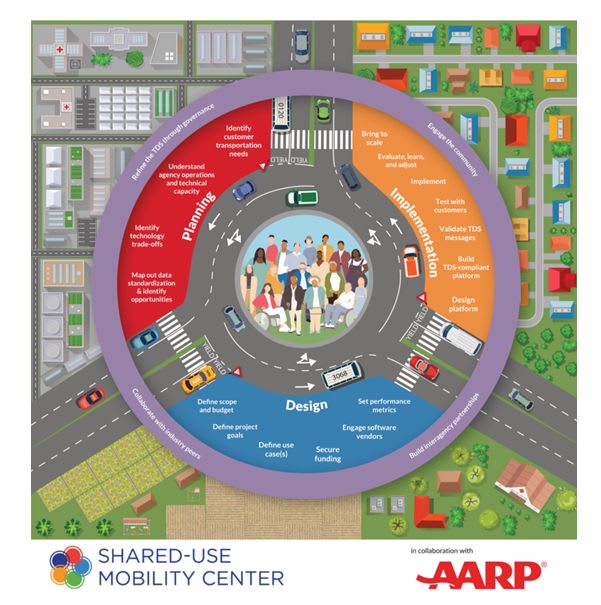
Photo: SUMC in collaboration with AARP
3 min to read
The Shared-Use Mobility Center (SUMC) published a research report on using a new data standard to improve transportation for people with disabilities, older adults, and residents of rural areas.
A roadmap to implement this new data standard was also published at the same time.
The Importance of Demand-Responsive Transportation
Human services transportation normally is implemented through demand-responsive transportation (DRT). These services do not follow fixed routes or schedules and include dial-a-ride, Americans with Disabilities Act (ADA) complementary paratransit, taxis, volunteer-provided transportation, and app-based ride-hailing services.
It is estimated there are 1,000 DTR services currently operating in the U.S.
Many small towns and rural areas rely on a DRT service for public transit as well as most human services transportation providers.
People who cannot drive or access regular public transportation rely on demand-responsive services.
However, these services are often fragmented and there may be multiple providers in any given region. When these services operate separately from each other it can lead to riders finding duplicative services and denials of trip request.
Bringing Services Together
The lack of adequate technology has been a major obstacle to service coordination until recently.
A new transactional data specification (TDS) for DRT report was published in 2020 by the National Academies of Sciences, Engineering, and Medicine’s Transportation Research Board looking at solutions to address this.
Noteworthy case studies included in the report are on projects from North Front Range Metropolitan Planning Organization in Northern Colorado, the Minnesota Department of Transportation TDS Pilot in Southern and Western Minnesota. Projects in Ohio, California, Oregon, and Washington are also summarized in the report.
“Creating an open and interoperable platform was key to the success of Minnesota DOT’s regional multimodal digital trip planner. Using TDS as the basis of our booking integration helped rural dial-a-ride and ADA paratransit services seamlessly connect their scheduling software to trip planning so their riders can easily request a ride 24/7," said Greater Minnesota Shared Mobility Program Coordinator Elliott McFadden. "Our use of the TDS data standard means this solution will work with other software providers and allow us to scale this solution to the rest of the state,”
A Practical Resource
Key takeaways from the demonstration projects are highlighted in the paper. Additional coordination opportunities, such as with providers of non-emergency medical transportation, are also outlined.
TDS can bridge gaps while enhancing service interoperability and access through the methods discussed in the new report.
“The TDS demonstration projects highlight the innovative approaches that rural and urban communities around the country are taking to increase transportation access. We hope these resources offer valuable insights and practical guidance to nonprofit human services transportation providers, transit agencies, state DOTs, metropolitan planning organizations and their stakeholders and that they drive widespread adoption of the TDS”, says Benjamin de la Pena, CEO of the Shared Use Mobility Center.
More Technology

From Hardware to Digital Partner: Luminator Charts Its Next Chapter
CEO Magnus Friberg discusses Luminator’s shift toward becoming a digital partner, the growing importance of software and interoperability, and how AI can help agencies improve operations and passenger experience.
Read More →
Beyond the Checklist: A Structured Approach to Transit Maintenance
Reliability-Centered Maintenance helps transit agencies move beyond routine checklists to focus limited resources on the assets and failures that have the greatest impact on safety, reliability, and service.
Read More →
NJ TRANSIT Advances Bus Technology Upgrades Across Statewide Fleet
More than 1,500 buses now feature upgraded technology designed to improve arrival predictions and provide free Wi-Fi, with deployment expected to reach nearly 2,000 buses by the end of 2026.
Read More →

Building a Flexible Path to Transit Electrification
John Hroncich discusses BAE Systems’ modular and scalable approach, lessons learned from decades of real-world operations, and how agencies can identify electrification strategies that fit their fleets.
Read More →
Biz Briefs: Alstom Lands Canadian Contract, LYT to Supply California TSP, and More
In METRO's latest installment, we take a look at recent news from Complete Coach Works, Beep, FlixBus, and more partnerships making headlines across the transportation sector.
Read More →
Sponsored•September 8, 2026
From Legacy Silos to Conversational Intelligence
What if transit leaders could ask any operational question and get a trusted answer in seconds? Conversational AI is transforming how agencies use their data.
Read More →
USDOT Announces Rail Vehicle Replacement Grants, Chattanooga AV Shuttle Funding
More than $191 million in federal funding will help three transit agencies replace aging rail vehicles and support a new autonomous shuttle service in Chattanooga.
Read More →
Bus Tech Talk: Keeping Transit Technicians Ahead of the Technology Curve
LA Metro’s Obed Mejia discusses technician training, evolving maintenance technology, fleet replacement, and strategies for getting the most out of today’s transit fleets.
Read More →
Biz Briefs: RIPTA Unveils New Frontrunners, Clevland RTA Adds New Siemens, and More
In METRO's latest installment, we take a look at recent news from Siemens, Prevost, Dodge, and more partnerships making headlines across the transportation sector.
Read More →
Why Simulating Pedestrian Movement Has Become Essential for Modern Rail Stations
Pedestrian microsimulation is helping rail planners identify bottlenecks, test station designs, and prepare complex transit hubs for growing passenger volumes.
Read More →