



Stantec in Colorado, STV in North Carolina Top Biz Briefs
Stay informed with these quick takes on the projects and companies driving progress across the transportation landscape.

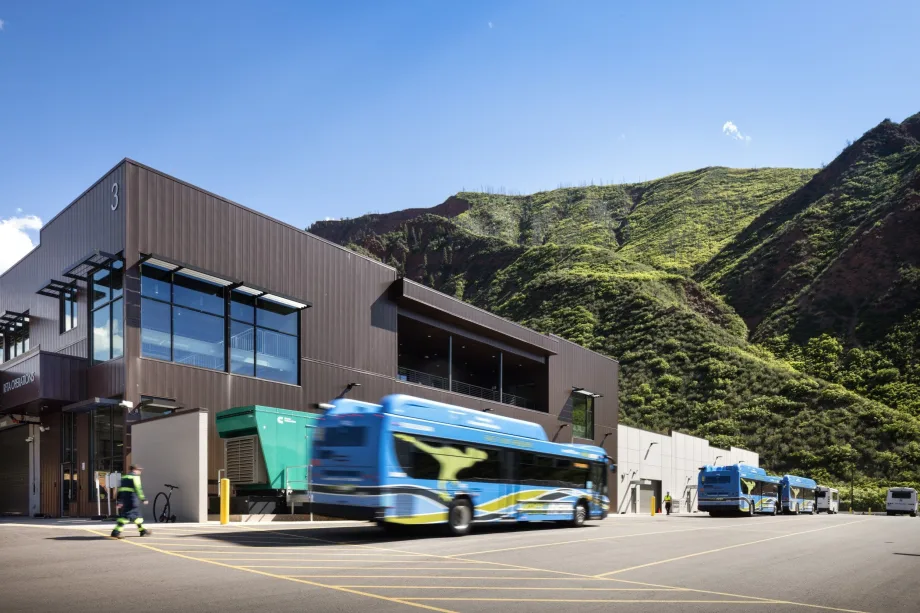
Addressing operational deficiencies, the expanded facility accommodates public transportation needs, including population growth and rising ridership demand, while supporting RFTA’s transition to zero-emission buses.
Saunders-Stantec
- Stantec is playing a significant role in advancing transportation projects in Colorado.
- STV is actively involved in key transportation developments in North Carolina.
- Both firms are contributing to the progress of the transportation sector through their respective projects.
*Summarized by AI
From strategic partnerships to acquisitions and service expansions, the industry continues to evolve at a rapid pace.
In this edition of Biz Briefs, we highlight the latest developments shaping the future of mobility — from manufacturers and technology providers to transit agencies and motorcoach service operators. Stay informed with these quick takes on the projects and companies driving progress across the transportation landscape.
In METRO's latest installment, we take a look at the latest news from Mobileye, Pro-Vision, and more.
Saunders-Stantec Team Completes RFTA Maintenance Facility
The design-build team of Stantec and Saunders Construction recently completed work on the $68 million Glenwood Springs Maintenance Facility (GMF) for the Roaring Fork Transportation Authority (RFTA).
Together, the firms led design-build services, including architecture; industrial architecture; sustainable design; interior design; lighting design; fueling design (diesel, CNG, and hydrogen-ready); mechanical, electrical, and plumbing engineering; and project management/construction (Saunders).
The expanded GMF now provides indoor heated storage for 60 buses and a 9,000-square-foot second-level operations space with a dispatch suite, reception area for visitors, drivers’ room, office space, and locker rooms. It also includes an additional fuel and wash lane to their existing facility.
The design of the facility reflects a thoughtful integration of functionality, sustainability, and user experience through natural lighting and climate-controlled spaces, while blending with the colors of the surrounding mountains, the Stantec-Saunders team said. The facility includes four battery-electric bus charging stations and was designed to accommodate expansion to hydrogen fuel-cell electric buses.
Addressing operational deficiencies, the expanded facility accommodates public transportation needs, including population growth and rising ridership demand, while supporting RFTA’s transition to zero-emission buses. Previously, buses were stored outdoors, resulting in additional operational costs, especially during the winter months, and the operational support spaces were too small to accommodate RFTA’s fleet growth and the increased number of staff.
MBTA Deploys Mobileye Shield+
Boston’s Massachusetts Bay Transportation Authority (MBTA) is enhancing safety across its bus fleet by deploying Mobileye Shield+, an advanced driver assistance system designed to help drivers better detect and respond to vulnerable road users.
The technology is currently installed on 135 MBTA buses. It is expected to expand to more than 330 additional buses after the MBTA was awarded a Fiscal Year 2025 U.S. Department of Transportation Safe Streets and Roads for All (SS4A) grant to support the deployment of advanced collision‑avoidance technology across its bus network.
Mobileye Shield+ provides real‑time visual and audible alerts to help drivers identify pedestrians, cyclists, and other vehicles in areas with obstructed views. This added “second set of eyes” supports operators as they navigate Boston’s dense urban streets and complex traffic patterns. By improving situational awareness, the system helps mitigate potential hazards and reduce the likelihood of collisions and near‑miss incidents, the company said.
MBTA’s growing adoption of this technology reflects its continued investment in scalable, preventative safety initiatives across its fleet. Designed to assist drivers before risks escalate, Mobileye Shield+ enhances awareness in complex driving environments while supporting safer operations for passengers, pedestrians, and cyclists alike.
STV to Manage Construction of Chapel Hill’s $197M BRT Project
STV has been selected by the Town of Chapel Hill, North Carolina, to provide construction management (CM) services for the NS RAPID project, a $197 million, federally supported bus rapid transit (BRT) investment that will reshape mobility along the town’s busiest multimodal corridor.
The 8.2-mile BRT line will connect riders to the University of North Carolina (UNC) at Chapel Hill, Southern Village, UNC medical facilities, and park-and-ride hubs.
The project includes more than five miles of dedicated bus-only lanes, 29 stations with premium amenities, and traffic signal upgrades designed to improve reliability and travel times. NS RAPID will operate as part of Chapel Hill Transit’s fare-free system, ensuring free rides for all users. Service is targeted to begin in 2030.
STV will act as an extension of Chapel Hill Transit staff, overseeing contractor coordination, cost and schedule controls, utility relocation, safety and quality assurance, and federal compliance, the firm said. The project is funded in part through the Federal Transit Administration’s Small Starts program.
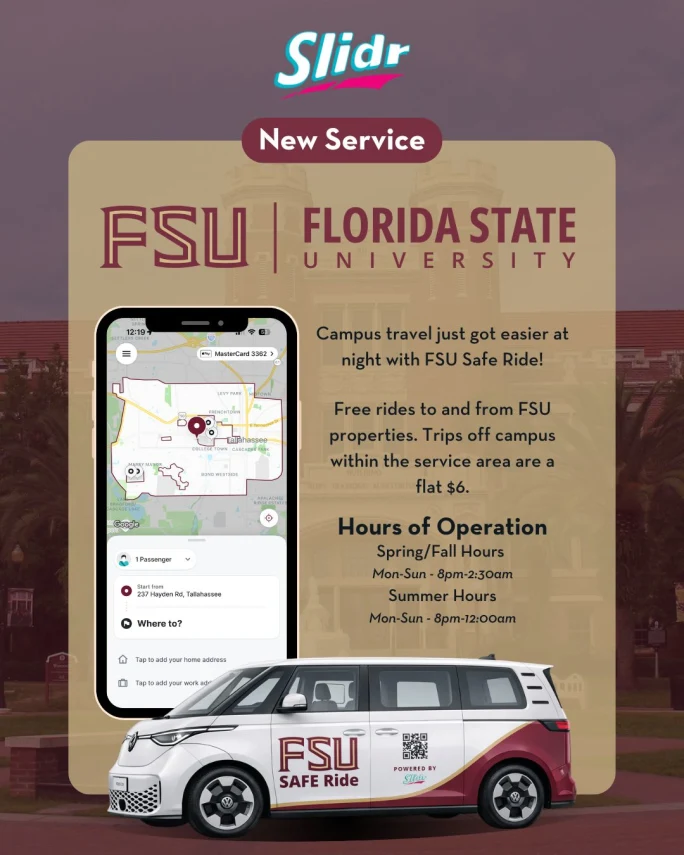
FSU Safe Ride operates with a fleet of all-electric Volkswagen ID. Buzz vehicles and a hybrid ADA-accessible vehicle, making FSU one of the first universities in the country to ru
Slidr
FSU Replaces Lyft Safe Ride Program with Microtransit Service
Florida State University (FSU) replaced its Lyft-based student safe ride program with FSU Safe Ride, a new dedicated electric microtransit service operated by Slidr.
The program gives students a reliable, low-cost way to get around campus and the surrounding community, replacing the unpredictable pricing and availability of third-party rideshare with a service built specifically for FSU.
FSU Safe Ride operates with a fleet of all-electric Volkswagen ID. Buzz vehicles and a hybrid ADA-accessible vehicle, making FSU one of the first universities in the country to run a student transportation program on the ID. Buzz platform.
Rides between any FSU properties are free for students, and rides to anywhere off campus within the service area are a flat $6 with no surge pricing, even during peak weekend hours.
Pro-Vision Attains MECP Certification
Pro-Vision announced that its entire field installation technician team is now certified through the Mobile Electronics Certified Professional (MECP) program, becoming the first fleet video solutions provider to achieve MECP certification for its installation team.
The MECP certification, administered by the Certification Systems Technology Company (CSTC), is the gold standard for mobile electronics installation. It validates a technician’s expertise in vehicle electrical systems, wiring best practices, installation safety, and signal integrity.
MECP-certified installers help ensure high-quality, reliable performance, reducing risks and minimizing issues for fleet customers operating in complex vehicle environments, said Pro-Vision officials.
Fleet video systems are increasingly vital for improving driver safety, reducing liability, and enhancing operational visibility. Proper installation is critical to system performance, uptime, and long-term reliability. By investing in advanced certification for every technician, Pro-Vision said it reinforces its dedication to delivering consistent, high-quality deployments at scale.
Clear-Vu Launches clearNET Transit IoT Platform
Clear-Vu Lighting Inc., a U.S.-based manufacturer of LED tunnel and infrastructure lighting systems, announced the availability of clearNET as a full transit IoT monitoring platform.
Originally deployed as the wireless control and monitoring layer for Clear-Vu's MTLx tunnel lighting system, clearNET is a wireless mesh network built for transit tunnels that continuously monitors every fixture, battery, and integrated sensor, delivering real-time data to agency maintenance and operations teams without new cabling or service disruption.
Each clearNET node monitors the health of fixtures, driver status, battery condition, and power at the individual asset level. Integrated thermal sensors provide continuous heat detection across the tunnel network, replacing manual inspection protocols with automated alerts. Structured data output integrates directly with enterprise asset management (EAM) platforms, enabling condition-based maintenance and risk-informed capital planning.
The platform's 900MHz frequency was selected specifically for tunnel use: it travels reliably around curves and obstructions, spans up to 3,000 feet between nodes, and does not interfere with Communications-Based Train Control (CBTC) systems, officials said.
A single gateway supports up to 2,000 nodes across run lengths exceeding 1.5 miles, with no new data cable required.
Quick Answers
The content focuses on providing quick updates about notable projects and companies that are advancing the transportation sector.
*Summarized by AI
More Technology

ENC Lands MATA Contract and More in Biz Briefs
In this edition of Biz Briefs, we spotlight the latest developments shaping the future of mobility.
Read More →
Strada360’s Steve Lassey on Turning Transit Data Into Better Decisions
From breaking down data silos to preparing for AI, Strada360 CEO Steve Lassey discusses how transit agencies can use technology to improve operations, customer information, and long-term decision-making.
Read More →
Almaviva Looks to Open Architecture to Advance Transit Technology
Eric Reese discusses how interoperability, open architecture, and modular design can help transit agencies control costs, reduce vendor lock-in, and upgrade technology without starting over.
Read More →

Driving Smarter Paratransit
John Hanlon shares how AlphaRoute is leveraging AI-powered technology to help paratransit providers optimize operations, support frontline staff, and enhance the rider experience.
Read More →
From Hardware to Digital Partner: Luminator Charts Its Next Chapter
CEO Magnus Friberg discusses Luminator’s shift toward becoming a digital partner, the growing importance of software and interoperability, and how AI can help agencies improve operations and passenger experience.
Read More →
Beyond the Checklist: A Structured Approach to Transit Maintenance
Reliability-Centered Maintenance helps transit agencies move beyond routine checklists to focus limited resources on the assets and failures that have the greatest impact on safety, reliability, and service.
Read More →
NJ TRANSIT Advances Bus Technology Upgrades Across Statewide Fleet
More than 1,500 buses now feature upgraded technology designed to improve arrival predictions and provide free Wi-Fi, with deployment expected to reach nearly 2,000 buses by the end of 2026.
Read More →
Building a Flexible Path to Transit Electrification
John Hroncich discusses BAE Systems’ modular and scalable approach, lessons learned from decades of real-world operations, and how agencies can identify electrification strategies that fit their fleets.
Read More →
Biz Briefs: Alstom Lands Canadian Contract, LYT to Supply California TSP, and More
In METRO's latest installment, we take a look at recent news from Complete Coach Works, Beep, FlixBus, and more partnerships making headlines across the transportation sector.
Read More →
From Legacy Silos to Conversational Intelligence
What if transit leaders could ask any operational question and get a trusted answer in seconds? Conversational AI is transforming how agencies use their data.
Read More →