



Montreal Unveils first Alstom REM Car
The cars will form a single uninterrupted train for passengers, serving the mobility of Greater Montreal.
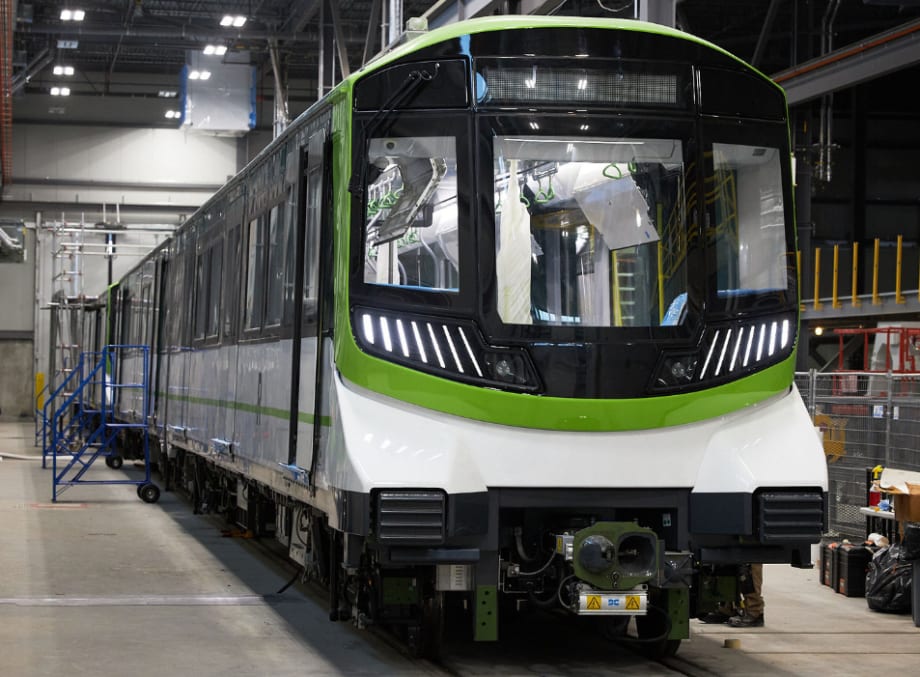
Alstom is supplying REM with not only 212 Metropolis cars, or 106 trains, but also Alstom’s automated and driverless Urbalis 400 communication-based train control solution.
Alstom/C. Feury
The Alstom-led consortium, Groupe des partenaires pour la mobilité des Montréalais (Groupe PMM), participated in the Réseau express métropolitain (REM) project office’s unveiling of the first cars that will carry passengers on the REM in Greater Montreal.
To date, Alstom has delivered four cars to Montreal. The cars for the REM are based on a proven Metropolis platform, already widely in service in the world, including in Sydney, and adapted for Montreal, not only in their design, their capacity, their accessibility, and to the experience they will offer passengers, but also to climatic conditions. The cars will form a single uninterrupted train for passengers, serving the mobility of Greater Montreal. The exterior livery, chosen by the public, was inspired by the Samuel-De Champlain Bridge and was designed to blend into the Montreal environment, offering passengers breath taking views via panoramic windows and large bay windows at either end.
Alstom is supplying REM with not only 212 Metropolis cars, or 106 trains, but also Alstom’s automated and driverless Urbalis 400 communication-based train control (CBTC) solution, an Alstom Iconis control center, as well as platform screen doors and depot equipment for this fully automated light-metro system. Recognized as the supplier of choice for reliable and efficient metros, Alstom has delivered nearly 6,000 Metropolis cars to 25 cities around the world.
Awarded to the Groupe PMM consortium in early 2018, the REM project is the largest transit project in Quebec’s history since the construction of the Montreal metro over 50 years ago. REM will be one of the world’s largest automated transportation networks — approximately 42 miles long with 26 stations — connecting downtown Montreal to the South Shore, the North Shore, the West Island, and the Montréal–Trudeau international Airport.
More Rail

New York MTA Advances Final Contract for Second Avenue Subway Expansion
Contract Four is the largest in the Second Avenue Subway Phase 2 project and includes construction of station infrastructure, tracks, and signals for the subway expansion, MTA officials said. Work on Contract Four will begin in 2027.
Read More →
San Diego MTS Breaks Monthly Trolley Ridership Record
Agency officials said July’s ridership indicates MTS’s continued recovery from the pandemic.
Read More →
Report Examines NJ TRANSIT Reliability, Funding Challenges
The Garden State Initiative analysis examines the roles of Amtrak infrastructure, fleet management, and agency operations while recommending a more performance-based approach to improving reliability.
Read More →
Stadler, CapMetro Sign Long-Term Rail Fleet Support Agreement
Beginning in 2027, Stadler will provide on-site technical expertise, spare parts support, training, and obsolescence management to help extend the reliability and longevity of CapMetro’s GTW fleet.
Read More →
Biz Briefs: Alstom Lands Canadian Contract, LYT to Supply California TSP, and More
In METRO's latest installment, we take a look at recent news from Complete Coach Works, Beep, FlixBus, and more partnerships making headlines across the transportation sector.
Read More →
CATS Gold Line Marks 5 Years of Service, 2.8M Passenger Trips
With a six-mile expansion planned, the Charlotte streetcar is positioned to connect more neighborhoods and major transit hubs across the region.
Read More →
Why Simulating Pedestrian Movement Has Become Essential for Modern Rail Stations
Pedestrian microsimulation is helping rail planners identify bottlenecks, test station designs, and prepare complex transit hubs for growing passenger volumes.
Read More →
Amtrak Begins Major Construction at New York’s Sunnyside Yard
The new maintenance facility will support Amtrak’s Airo trainsets while improving maintenance efficiency and turnaround times in New York.
Read More →
Chicago Leaders Unveil Plans for O’Hare Airport Express Train
The privately developed project would offer a 15-minute trip between downtown and O’Hare’s Terminal 2, with trains operating every 15 minutes on a dedicated track. The service would use battery-electric trains and three existing freight rail rights-of-way.
Read More →
OCTA Maps Out 30-Year Strategy to Protect Coastal Rail Corridor
The draft feasibility report identifies strategies to protect the coastal rail line for decades as the agency continues near-term stabilization and sand placement efforts.
Read More →