MTI Report Finds 51% Support Mileage Fee if Varied by Pollution Levels
The survey also found that the majority of respondents supported lower mileage-fee rates for low-income drivers: almost two-thirds (64%) supported this option.
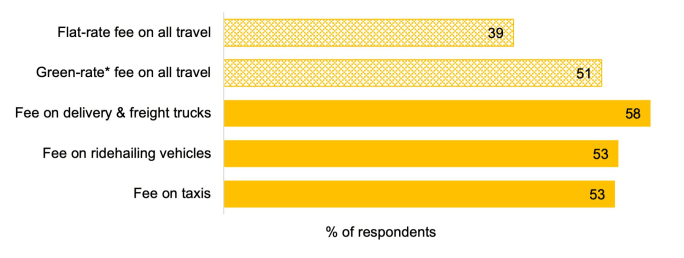
A majority of respondents (51%) supported replacing the federal gas tax with a mileage fee where the rate would vary according to the vehicle’s pollution emissions.
Photo: Canva/METRO
2 min to read
The Mineta Transportation Institute (MTI) released the results from its 15th annual survey in a series that explores public support for raising transportation revenue through higher federal gas taxes or a new mileage fee.
A majority of respondents (51%) supported replacing the federal gas tax with a mileage fee where the rate would vary according to the vehicle’s pollution emissions.
Ad Loading...
“Public support for a mileage fee depends on the details of how the fee is structured,” explained study co-author Asha Weinstein Agrawal, PhD. “More than half of respondents supported not only the pollution-rate mileage fee but also a new ‘Business Road-Use Fee’ that would be charged to delivery and freight trucks (58%) or to taxis and ride-hailing vehicles (53%). By contrast, the least popular mileage fee option was a flat-rate fee on all travel. Support for this option was only 39%.”
“We have also seen support for implementing a mileage fee on all travel increase over time,” said study co-author Hilary Nixon, PhD. “Support for the flat-rate mileage fee grew from just 22% in 2010 to 39% in 2024. Similarly, support for the pollution-rate version grew from 33% in 2010 to 51% in 2024.”
* The rate varies according to how much pollution the vehicle emits.
Photo: MTI
MTI Survey Findings
The survey also found that the majority of respondents supported lower mileage-fee rates for low-income drivers: almost two-thirds (64%) supported this option.
The survey also assessed public knowledge about federal gas taxes and support for the idea of raising the federal gas tax rate by 10 cents per gallon. Key findings include:
Only 2% of respondents knew that the federal gas tax rate has not been raised in more than 20 years.
Almost three-quarters of respondents supported raising the gas tax rate if the revenue would be dedicated to maintaining streets and highways (74% support). In contrast, far fewer respondents supported the same gas tax increase if the revenue were spent for undefined “transportation” purposes.
Support for raising the federal gas tax has risen since 2010.
Ad Loading...
The survey data for this study was collected from a nationally representative sample of 2,522 adults living in the U.S. Respondents completed the online survey in February and March of 2024.
CEO Magnus Friberg discusses Luminator’s shift toward becoming a digital partner, the growing importance of software and interoperability, and how AI can help agencies improve operations and passenger experience.
In METRO's latest installment, we take a look at recent news from Complete Coach Works, Beep, FlixBus, and more partnerships making headlines across the transportation sector.
In a recent episode of METROspectives, CharterUP Founder/CEO Armir Harris discussed the company’s evolution from an online charter bus marketplace into a technology platform supporting public- and private-sector mobility and much more.
Through its NAVI program, JTA is showing how autonomous vehicles, intelligent infrastructure, and coordinated operations can work together to deliver everyday public transportation.
From manufacturers and suppliers to transit agencies and motorcoach operators, these updates offer a snapshot of the projects, partnerships and business moves driving the industry forward.
Former LA Metro Chief Innovation Officer Joshua Schank discusses why good ideas aren't enough, how transit agencies can overcome resistance to change, and why today's challenges demand more innovation.
From manufacturers and suppliers to transit agencies and motorcoach operators, these updates offer a snapshot of the projects, partnerships and business moves driving the industry forward.
Vice President of New Mobility Stephen Joos discusses how CharterUP is leveraging its nationwide transportation network, technology platform, and autonomous vehicle partnerships to expand into workforce mobility, campus shuttles, and transit solutions.