New York City Transit Unveils Security Monitor Screen Bus Pilot
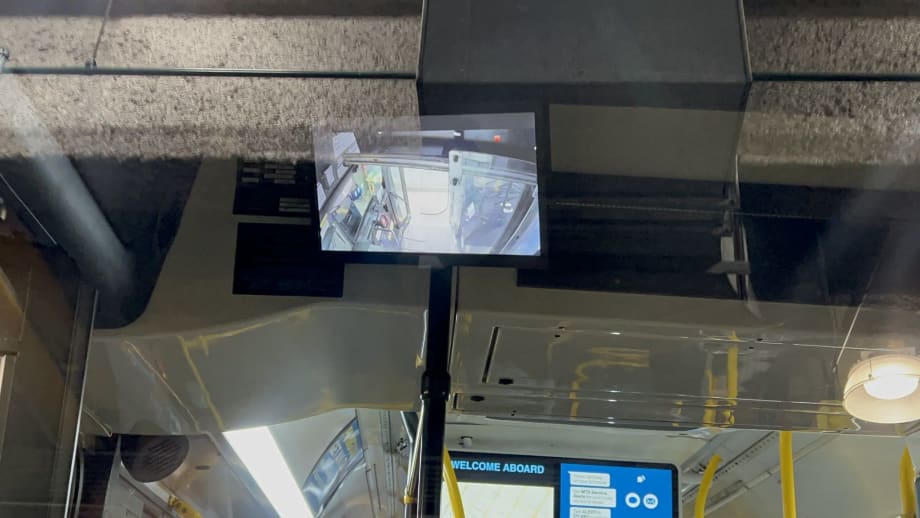
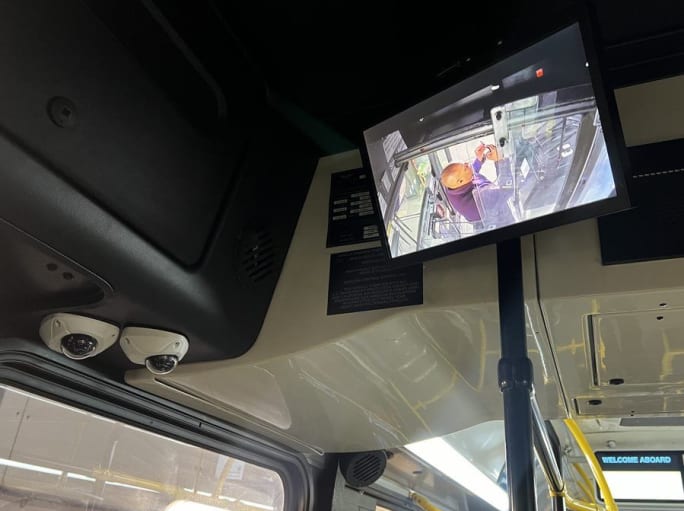
The high-definition LCD screens are installed on board near the entry stairwell and continuously stream live video feeds from existing security camera infrastructure onboard buses.
Security monitor screens offer several advantages for both operators and customers, including enhanced safety.
Photo: MTA
1 min to read
The Metropolitan Transportation Authority’s (MTA) New York City Transit unveiled its security monitor screen pilot, which will include over 100 buses.
The high-definition LCD screens are installed on board near the entry stairwell and continuously stream live video feeds from existing security camera infrastructure onboard buses.
Ad Loading...
The buses will be deployed to routes that have the highest rates of assaults and other misdemeanors that threaten the safety of operators and customers.
Photo: MTA
Benefits of Security Monitors
Security monitor screens offer several advantages for both operators and customers, including enhanced safety. The screens also serve as a deterrent to potential bad actors and provide real-time evidence to law enforcement.
The buses will be deployed to routes that have the highest rates of assaults and other misdemeanors that threaten the safety of operators and customers.
“Installing new technology to keep bus operators and customers safe is paramount to NYCT’s North Star of providing faster, cleaner, and safer service,” said New York City Transit President Richard Davey. “Our bus fleet has robust camera coverage, and these pilot screens will be a force multiplier to the safety benefits these cameras already provide. We’re excited to roll out this pilot and look forward to continuing to innovate and modernize the system to keep customers and operators safe and prioritize fare payment.”
All screens are expected to be installed by the end of this year. The pilot is expected to run through the beginning of 2025.
CEO Magnus Friberg discusses Luminator’s shift toward becoming a digital partner, the growing importance of software and interoperability, and how AI can help agencies improve operations and passenger experience.
Reliability-Centered Maintenance helps transit agencies move beyond routine checklists to focus limited resources on the assets and failures that have the greatest impact on safety, reliability, and service.
More than 1,500 buses now feature upgraded technology designed to improve arrival predictions and provide free Wi-Fi, with deployment expected to reach nearly 2,000 buses by the end of 2026.
John Hroncich discusses BAE Systems’ modular and scalable approach, lessons learned from decades of real-world operations, and how agencies can identify electrification strategies that fit their fleets.
In METRO's latest installment, we take a look at recent news from Complete Coach Works, Beep, FlixBus, and more partnerships making headlines across the transportation sector.
What if transit leaders could ask any operational question and get a trusted answer in seconds? Conversational AI is transforming how agencies use their data.
More than $191 million in federal funding will help three transit agencies replace aging rail vehicles and support a new autonomous shuttle service in Chattanooga.
LA Metro’s Obed Mejia discusses technician training, evolving maintenance technology, fleet replacement, and strategies for getting the most out of today’s transit fleets.
In METRO's latest installment, we take a look at recent news from Siemens, Prevost, Dodge, and more partnerships making headlines across the transportation sector.
Pedestrian microsimulation is helping rail planners identify bottlenecks, test station designs, and prepare complex transit hubs for growing passenger volumes.