



New York Governor Signs Legislation to Fully Fund Transit Improvements
The plan will enable the MTA to make transformative investments, including breaking ground on the new Interborough Express (IBX), rehabilitating the Grand Central Artery, and improving the overall rider experience.

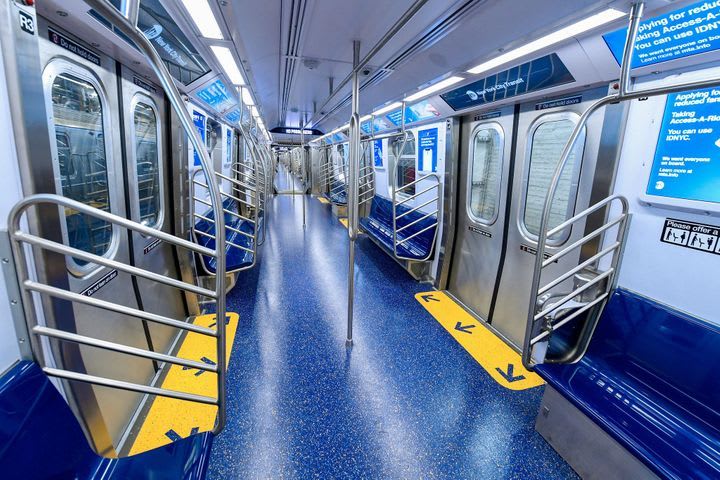
In addition to providing $8 billion in total operating aid for the MTA, the FY 2026 Budget will give a $3 billion State capital appropriation to support the MTA capital plan.
Photo: Marc A. Hermann
New York Gov. Kathy Hochul signed new legislation as part of the FY26 Enacted Budget to fully fund the Metropolitan Transportation Authority’s (MTA) $68.4 billion 2025-29 Capital Plan, representing the most significant investment in the state’s transportation history.
The plan will enable the MTA to make transformative investments, including breaking ground on the new Interborough Express (IBX), rehabilitating the Grand Central Artery, and improving the overall rider experience.
“Public transit is the lifeblood of New York, and our investments in this century-old system will ensure it can thrive for years to come,” Gov. Hochul said in a press release, making the announcement. “For too long, leaders had ignored the needs of straphangers and underfunded public transit. When I took office, we changed that approach — and now, we’re making long-overdue investments to keep this system strong.”
Funding for Projects
The investment will enable the MTA to:
Start construction of the new IBX — a transformative new rapid transit service between Brooklyn and Queens.
Rehabilitate the Grand Central Artery — a four-mile stretch that carries 98 percent of all Metro-North service.
Purchase thousands of new subway and railcars.
Modernize signals to provide faster, more frequent, and more reliable service.
Upgrade maintenance facilities.
Renew electric power systems to enhance reliability.
Repair structurally deficient bridges and tunnels.
Deliver complete ADA-accessibility improvements at more than 65 subway and railroad stations.
Make safety enhancements at stations and across infrastructure systems.
Install modern fare gates at more than 150 stations to prevent fare evasion.
Grow its zero-emissions bus fleet to stay on track for a fully-electric fleet by 2040.
Increase resiliency against flooding and protect the Hudson Line against severe weather.
This will be achieved with a funding plan that also includes cuts to the regional Payroll Mobility Tax (PMT) for roughly 10,000 small businesses and an elimination of the PMT for self-employed individuals earning $150,000 or less. The plan will also eliminate the PMT for all local governments outside New York City.
Notably, the FY 2026 Budget also reallocates up to $1.2 billion from the Penn Station redevelopment project to be put toward priority capital projects such as the Interborough Express, safety initiatives, and efforts to reduce fare evasion.

The MTA’s capital plan will also spend $6 billion each on the Metro-North Railroad and LIRR.
Photo: Marc A. Hermann
Metro-North, LIRR Projects
The MTA’s capital plan will also spend $6 billion on the Metro-North Railroad, including:
Rolling stock: Completing the replacement of 40-year-old railcars with new, fully accessible M9A trains for use on the Harlem and Hudson Lines.
Station platforms and components: Replacing and rehabilitating deteriorating stations and other major components.
Climate and weather protection: Coordinating investments at the most vulnerable locations — including bridges, culverts, retaining walls, and shoreline structures — to reduce service disruptions and equipment damage caused by extreme weather.
Additionally, the MTA’s capital plan will spend $6 billion on the Long Island Railroad (LIRR), which would include:
Rolling stock: Purchasing new railcars to allow MTA to retire 1980s-era M3 cars and provide for more reliable new dual-mode locomotives.
Power system improvements: Replacing or renewing 16 substations, making the system more reliable.
Accessibility: Achieving 98% accessibility by making four more stations accessible, including Bellerose, Douglaston, and Cold Spring Harbor.
Additional Funding Plans
Finally, the MTA capital plan includes $800 million to advance regional investments that help create additional capacity, connect with underserved communities, and respond to changing populations and land-use patterns.
The plan supports projects to reduce conflicts at the nation’s busiest railway junction, electrification, and capacity initiatives on the LIRR and MNR, as well as the evaluation and development of promising improvement and expansion projects.
The funding plan includes a balanced and responsible mix of local, state, federal, and MTA sources and new Payroll Mobility Tax (PMT) revenues from the region’s largest businesses.
In addition to providing $8 billion in total operating aid for the MTA, the FY 2026 Budget will give a $3 billion State capital appropriation to support the MTA capital plan.
The change to the Payroll Mobility Tax (PMT) will cause the largest businesses in the region with payrolls of $10 million or more to pay less than one percent more in PMT.
The FY 2026 Budget also requires the City of New York to provide $3 billion toward the MTA capital plan and requires the MTA to find $3 billion in efficiencies.
More Management

METRO Opens Submissions for 2026 Motorcoach Awards
Nominations are now being accepted for METRO Magazine’s Operator of the Year and Innovative Operator of the Year awards.
Read More →
New York MTA Advances Final Contract for Second Avenue Subway Expansion
Contract Four is the largest in the Second Avenue Subway Phase 2 project and includes construction of station infrastructure, tracks, and signals for the subway expansion, MTA officials said. Work on Contract Four will begin in 2027.
Read More →
Transit Agencies Highlight Safety Gains at National Summit
Leaders from 15 major transit systems shared crime-reduction results and safety initiatives while discussing the role of continued federal support.
Read More →

NITA Names New Leadership, Expands Reduced-Fare Program at First Board Meeting
The new regional transit authority appointed its first board chair and interim executive director while extending reduced fares across CTA, Metra, and Pace for eligible riders.
Read More →
Beyond the Checklist: A Structured Approach to Transit Maintenance
Reliability-Centered Maintenance helps transit agencies move beyond routine checklists to focus limited resources on the assets and failures that have the greatest impact on safety, reliability, and service.
Read More →
APTA 2026 Nominating Committee Selects Leadership Slate, Names Chair and Vice Chair Nominees
Leadership changes will help shape the association’s priorities and its representation of the transportation industry during the 2026–2027 term.
Read More →
DART Launches Major Security, Fare Enforcement Initiative
The 90-day demonstration will deploy coordinated security teams at five light rail stations while testing controlled access and gathering data to guide future investments.
Read More →
Advancing Fare Collection Through Technology and Innovation
Learn about delivering 1300 gates at 91 stations while managing fare evasion. Explore the large scale deployment, solution customization and real-world results that affect the region. Prepare for deployment in your region now.
Read More →
Game Day in Motion: Moving Millions During the 2026 World Cup
Between packed transit stations and team motorcoaches, see how agencies and operators across North America tackled the transportation demands of the 2026 FIFA World Cup.
Read More →
Surface Transportation Extension Averts Shutdown, Leaves Transit Funding Gap
The stopgap keeps federal transportation programs moving, but missing advance funding could complicate the transit and rail projects agencies are planning next.
Read More →