




Safe and Secure: Transit Agencies Push for Community Improvement
New York Seeing Progress on Subway, Transit Public Safety Initiatives
Last October, Governor Kathy Hochul announced that the NYPD and the MTAPD would surge officer presence on platforms
January 30, 2023
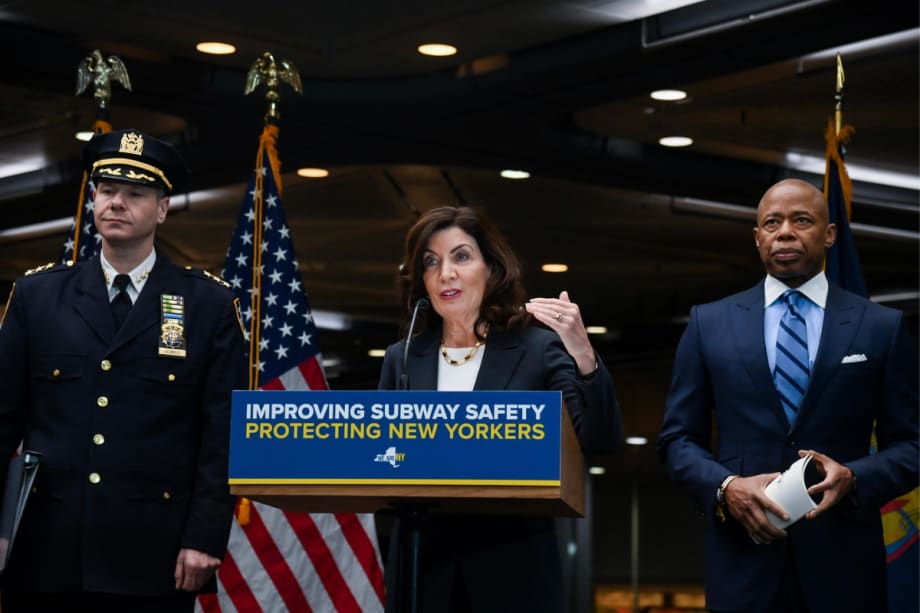
Governor Kathy Hochul, Mayor Eric Adams, MTA Chair/CEO Janno Lieber, and NYPD Chief of Transit Michael Kemper at the Fulton Transit Center where they announce a decrease in subway crimes and increase in customers’ feelings of safety.
Photo:Marc A. Hermann/MTA
3 min to read
Governor Kathy Hochul and Mayor Eric Adams announced new data that shows progress on subway and transit public safety initiatives introduced last year, according to New York Metropolitan Transportation Authority's news release.
Last October, the governor and mayor announced that the NYPD and the MTAPD would surge officer presence on platforms while expanding capacity at the New York State Office of Mental Health to support unhoused individuals who are sheltering in the subway system and those who are suffering from severe mental illness.
Additionally, Governor Hochul announced that teams deployed after October 2022 have helped more than 650 unhoused high-needs New Yorkers connect with critical intervention services.
"My number one priority as Governor is keeping New Yorkers safe, whether on the streets, in their homes, in their schools, or on the subway, and we will do whatever it takes to make our subways safer for riders," Governor Hochul said. "Our Cops, Cameras, and Care initiative has cracked down on subway crime, helped those in need, and continues to attract riders back to the subway system. We have worked closely with the Mayor and the NYPD and we will continue to do whatever is needed to make New Yorkers safe on the subway."
Since the initiatives were announced last October, major crime in the subway system is down 16%, compared to the same time period during the prior year.
Additionally, the crime rate on subways is returning to pre-pandemic levels. In 2019, the rate of crime was 1.5 crimes per million riders.
In 2022, the rate of crime was 2.3 per million riders, so far in 2023, the ridership-adjusted rate is only 1.7 per million riders. Transit murders decreased from four to two. Further, this January has seen the lowest level of transit crime compared to any January since 1993 when this data was first collected. Transit shootings are down 14%, and there has been a notable decrease in robberies, down 30%. Overall arrests have increased by 43.4% since October 2022 and Transit Adjudication Bureau summonses have increased by 84.8%.
Governor Hochul said she is embracing a multifaceted approach to addressing the mental health crisis and its impact on public safety in New York City. This includes efforts to expand the continuum of care, offer incentives to bolster the mental healthcare workforce, and coax healthcare facilities into bringing back in-patient psychiatric beds that were taken offline during the COVID-19 pandemic.
There are now 10 teams of specially trained mental health practitioners - known as Safe Options Support teams -working with emergency shelters, outreach providers, and supportive housing facilitates in New York City to transition the estimated 3,900 individuals living on the street or in the subway system into a stable living environment. These teams have already enrolled 650 individuals into Critical Time Intervention services, an evidence-based practice that helps connect vulnerable individuals to housing and services during difficult times of transition in their lives.
The state is conducting training for law enforcement and first responders on best practices for engaging individuals with serious mental illness who are experiencing homelessness. This training includes fundamental crisis intervention skills and the best practices for engaging the street population experiencing mental health illness.
Governor Hochul also increased the Medicaid fee-for-service rates to bring more inpatient psychiatric beds back online. New York State has provided $27.5 million, which is expected to be matched by the federal government for a total of $55 million to increase these rates, which are retroactive to April 1, 2022.
Additionally, the state's $9 million Community Mental Health Loan Repayment Program is providing loan repayments of up to $120,000 for psychiatrists and up to $30,000 for psychiatric nurse practitioners over a three-year period. This program is projected to serve roughly 180 psychiatrists and 180 psychiatric nurse practitioners.
More Security and Safety

Transit Agencies Highlight Safety Gains at National Summit
Leaders from 15 major transit systems shared crime-reduction results and safety initiatives while discussing the role of continued federal support.
Read More →
DART Launches Major Security, Fare Enforcement Initiative
The 90-day demonstration will deploy coordinated security teams at five light rail stations while testing controlled access and gathering data to guide future investments.
Read More →
RTD Launches NextRide App to Consolidate Trip Planning, Fares, Security Reporting
The app expands on RTD’s existing NextRide web application and allows customers to view real-time vehicle locations and service alerts, purchase and store digital fares, and access customer support.
Read More →

TAPTCO Updates OSHA Compliance Training for Transit Maintenance Operations
The revamped program addresses 26 OSHA standards for maintenance facilities, with TAPTCO pointing to training, documentation, and everyday shop hazards as continuing challenges for transit operations.
Read More →
Sponsored•August 18, 2026
How VaporVision Adds Value to Transit Door Systems
Wabtec engineers explain how the system improves doorway detection, strengthens diagnostics and gives transit agencies and OEMs greater operating flexibility.
Read More →
FRA Announces $5.3B in Rail Investments, Including $2B for Amtrak
Funding will support grade-crossing improvements, infrastructure upgrades, and new Amtrak equipment in 23 states.
Read More →
Chicago, Maryland Expand Non-Law-Enforcement Safety, Rider Support
The CTA and MTA are launching new programs aimed at de-escalation, crisis response, rider assistance, and greater transparency.
Read More →
LA Metro, City of West Hollywood, and Partners Advance Smarter Bus Lane Enforcement
The award-winning partnership combines AI-powered detection with human oversight to improve bus reliability, accessibility, and enforcement efficiency.
Read More →
LA Metro Reports 57% Decline in Homelessness on Transit System Since 2024
The agency's latest homelessness count offers new data on how care-based services and cross-sector partnerships can complement traditional transit security strategies.
Read More →
FTA Launches 'Transit Moves America' Dashboard to Highlight Agency Safety and Performance
The online dashboard transforms National Transit Database information into a public-facing resource that allows users to compare transit agencies on key operational and safety metrics.
Read More →