



NTSB: Driver fatigued in fatal coach overturn
Fatal Texas motorcoach crash in Jan. 2008 was caused by the driver's loss of control of the vehicle after he fell asleep at the wheel. NTSB issued 19 safety recommendations after investigation.

On Wednesday, the National Transportation Safety Board (NTSB) determined that the January 2008 fatal crash of a motorcoach near Victoria, Texas, was caused by the driver's loss of control of the vehicle after he fell asleep at the wheel.
One passenger was fatally injured, 17 passengers sustained major injuries, and the driver and 29 passengers received minor injuries. The NTSB found that passengers were injured by partial ejections from the motorcoach and by striking objects and other passengers inside the motorcoach when it overturned.
On the morning of Jan. 2, 2008, a 2005 Volvo motorcoach operated by Capricorn Bus Lines Inc., under International Charter Services Inc.'s operating authority, was traveling northbound on U.S. Highway 59 near Victoria, Texas. The motorcoach, en route from Monterrey, Mexico, to Houston, was carrying 47 passengers. Approximately five miles south of Victoria, the driver fell asleep, partially ran off the road, and then, after overcorrecting, lost control of the motorcoach which overturned on its right side. Within five minutes, a northbound pickup truck struck the underside of the motorcoach.
Major safety issues identified by this accident investigation focused on driver fatigue; lack of Federal Motor Carrier Safety Administration (FMCSA) oversight of passenger motor carriers in the areas of operating authority, leasing agreements, scope of operating authority violations, safety rating methodology and the New Entrant Safety Assurance Program; and registration and use of non-Federal Motor Vehicle Safety Standards (FMVSS)-compliant, passenger-carrying vehicles in commercial motor carrier operations in the U.S.
"When we looked at the specific chain of events that led to this tragic accident, we also found numerous holes in the federal regulatory environment that allows a non-compliant motorcoach to be registered and operated on U.S. roadways," said NTSB Chairman Deborah A.P. Hersman. "The traveling public should expect that any motorcoach they ride complies with all of the safety criteria imposed on every other commercial passenger vehicle within our borders."
As a result of its investigation, the NTSB issued 19 safety recommendations: one to the U.S. Department of Transportation (DOT), 11 to the FMCSA, two to the National Highway Traffic Safety Administration (NHTSA), and to the U.S. Customs and Border Patrol (CBP); and one each to the Commercial Vehicle Safety Alliance (CVSA), the American Association of Motor Vehicle Administrators (AAMVA), and the International Registration Plan (IRP). The report also reclassifies one previously issued recommendation to the FMCSA and also reiterates two previously issued recommendations to the FMCSA.
Among the recommendations, the NTSB urges NHTSA and FMCSA to work in conjunction with CBP and implement a process to detect motor carriers operating motorcoaches or other passenger-carrying commercial motor vehicles that do not meet U.S. safety standards. Once detected, these non-compliant vehicles should be placed out of service.
In addition, the NTSB urges the FMCSA to deny or revoke operating authority for commercial interstate motor carriers who fail to disclose any prior operating relationship with another motor carrier, prior operations as another motor carrier, or previously holding a different US DOT number.
A synopsis of the accident investigation report can be found on the Board Meetings page of the NTSB's Website, http://www.ntsb.gov/events/Boardmeeting.htm. The complete report will be available on the Website in several weeks.
More Motorcoach

METRO Opens Submissions for 2026 Motorcoach Awards
Nominations are now being accepted for METRO Magazine’s Operator of the Year and Innovative Operator of the Year awards.
Read More →
Biz Briefs: Alstom Lands Canadian Contract, LYT to Supply California TSP, and More
In METRO's latest installment, we take a look at recent news from Complete Coach Works, Beep, FlixBus, and more partnerships making headlines across the transportation sector.
Read More →
Biz Briefs: RIPTA Unveils New Frontrunners, Clevland RTA Adds New Siemens, and More
In METRO's latest installment, we take a look at recent news from Siemens, Prevost, Dodge, and more partnerships making headlines across the transportation sector.
Read More →
People Movement: Holly Arnold Joins Transdev and More
In this edition, we also cover recent appointments and announcements at Pace, CamTran, MCI, and more, showcasing the individuals helping to shape the future of transportation.
Read More →
ABA Report: Motorcoach Travel Generates $161.6B Economic Impact
The 2025 analysis finds motorcoach travel supported nearly 900,000 jobs and generated $28 billion in federal, state, and local taxes.
Read More →
CharterUP’s Armir Harris on Technology, AI, and the Future of Group Mobility
In a recent episode of METROspectives, CharterUP Founder/CEO Armir Harris discussed the company’s evolution from an online charter bus marketplace into a technology platform supporting public- and private-sector mobility and much more.
Read More →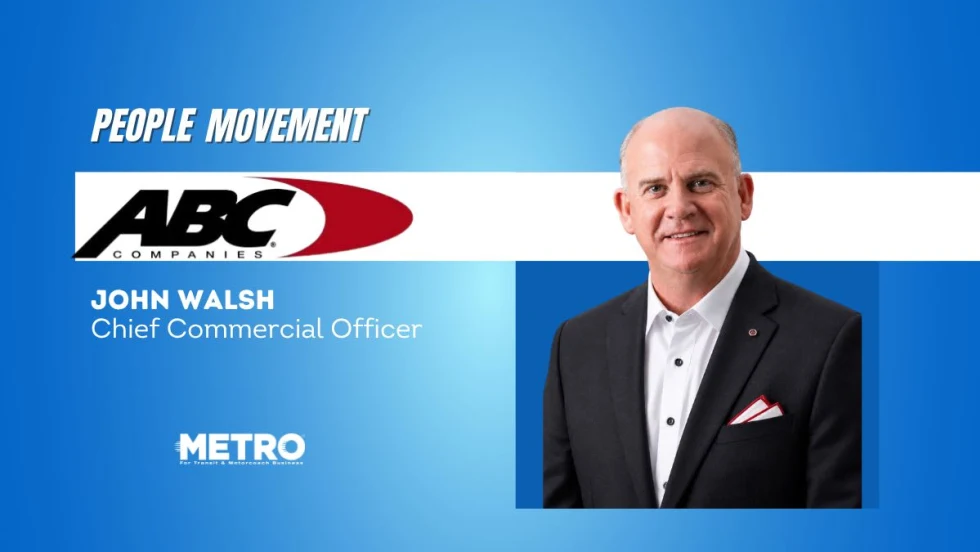
People Movement: ABC Names John Walsh as Chief Commercial Officer
In this edition, METRO also covers recent appointments and announcements at the DART, STV, and more, showcasing the individuals helping to shape the future of transportation.
Read More →
From Surviving to Thriving: Building Stronger Transportation Organizations
Bus Business Consultants founder Brian Dickson shares lessons on leadership, organizational health, and creating options for long-term success in a changing transportation industry.
Read More →
Biz Briefs: Luminator Marks Milestone and More
From manufacturers and suppliers to transit agencies and motorcoach operators, these updates offer a snapshot of the projects, partnerships and business moves driving the industry forward.
Read More →
ABAF Study Reveals Growing Insurance Crisis for Motorcoach Operators
Preliminary findings show 98% of operators faced premium increases over the past five years, while shrinking insurer participation is putting added pressure on businesses and customers.
Read More →