



NTSB Investigating Factors in Greyhound Illinois Crash
During a press conference, the NTSB said the investigation will center around human performance, survival factors, and motor carrier factors, as well as rest area safety, bus occupant protection, potential driver fatigue, and medical fitness.

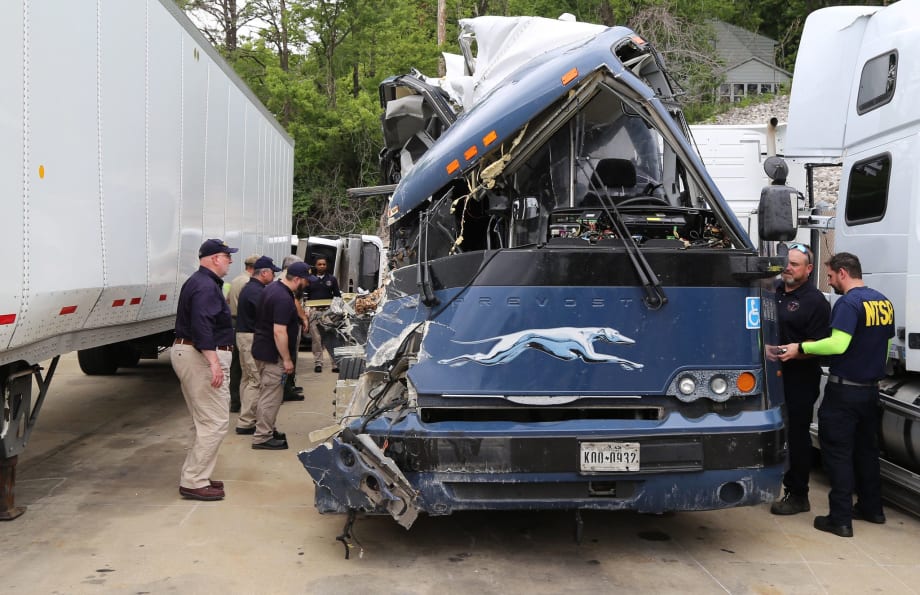
The Greyhound bus was traveling Interstate 70 from Indianapolis to St. Louis with 22 passengers aboard. At about 2 a.m. on July 12, the bus struck the trucks parked along the off-ramp leading to the rest area.
Photo: Peter Knudson/NTSB
The National Transportation Safety Board (NTSB) is investigating what happened last week when a Greyhound bus headed to St. Louis from Indianapolis struck three tractor-trailers parked along an exit ramp leading to a rest stop area near Highland, Ill.
The accident caused three casualties, with others sustaining serious injuries. During a press conference, NTSB Board Member Tom Chapman said the investigation will center around human performance, survival factors, motor carrier factors, highway factors, vehicle factors, and technical reconstruction, as well as rest area safety, bus occupant protection, potential driver fatigue, and medical fitness.
Chapman added that since 2009, Greyhound has voluntarily added seat belts on their coaches and that the model involved in the crash was a 2014, however, it is not clear how many passengers were wearing their seat belts at the time of the accident.
The Investigation
Chapman explained the NTSB is running a safety investigation in parallel with the law enforcement investigation by the Indianola State Police. The Federal Motor Carrier Safety Administration also dispatched investigators to the crash site. He added the final report from the board will be made available within 12 to 24 months and that the board would not speculate on any of the factors of the crash until it’s report is finalized.
The Greyhound bus was traveling Interstate 70 from Indianapolis to St. Louis with 22 passengers aboard. At about 2 a.m. on July 12, the bus struck the trucks parked along the off-ramp leading to the rest area.
The bus contained both forward-facing and inward-facing cameras, with Chapman saying the data will also be downloaded and examined.
“Assuming it can be recovered and will be shared with us, we have a team of experts who specialize in analyzing and collecting that sort of data,” he said.
Chapman added that although the full investigation could take 12 to 24 months, it’s possible the NTSB would hand out safety recommendations sooner, if necessary.
“If we find in the course of our investigation in the early stages, for example, that it's appropriate to make recommendations before the investigation is completed, we have that ability, that authority, and we do that," Chapman said. "We will make emergency recommendations when it's appropriate to do so when during the fact-finding effort that some condition occurred that needs to be addressed more quickly than it would be if the final results of our investigation held it up."
More Motorcoach

METRO Opens Submissions for 2026 Motorcoach Awards
Nominations are now being accepted for METRO Magazine’s Operator of the Year and Innovative Operator of the Year awards.
Read More →
Biz Briefs: Alstom Lands Canadian Contract, LYT to Supply California TSP, and More
In METRO's latest installment, we take a look at recent news from Complete Coach Works, Beep, FlixBus, and more partnerships making headlines across the transportation sector.
Read More →
Biz Briefs: RIPTA Unveils New Frontrunners, Clevland RTA Adds New Siemens, and More
In METRO's latest installment, we take a look at recent news from Siemens, Prevost, Dodge, and more partnerships making headlines across the transportation sector.
Read More →
People Movement: Holly Arnold Joins Transdev and More
In this edition, we also cover recent appointments and announcements at Pace, CamTran, MCI, and more, showcasing the individuals helping to shape the future of transportation.
Read More →
ABA Report: Motorcoach Travel Generates $161.6B Economic Impact
The 2025 analysis finds motorcoach travel supported nearly 900,000 jobs and generated $28 billion in federal, state, and local taxes.
Read More →
CharterUP’s Armir Harris on Technology, AI, and the Future of Group Mobility
In a recent episode of METROspectives, CharterUP Founder/CEO Armir Harris discussed the company’s evolution from an online charter bus marketplace into a technology platform supporting public- and private-sector mobility and much more.
Read More →
People Movement: ABC Names John Walsh as Chief Commercial Officer
In this edition, METRO also covers recent appointments and announcements at the DART, STV, and more, showcasing the individuals helping to shape the future of transportation.
Read More →
From Surviving to Thriving: Building Stronger Transportation Organizations
Bus Business Consultants founder Brian Dickson shares lessons on leadership, organizational health, and creating options for long-term success in a changing transportation industry.
Read More →
Biz Briefs: Luminator Marks Milestone and More
From manufacturers and suppliers to transit agencies and motorcoach operators, these updates offer a snapshot of the projects, partnerships and business moves driving the industry forward.
Read More →
ABAF Study Reveals Growing Insurance Crisis for Motorcoach Operators
Preliminary findings show 98% of operators faced premium increases over the past five years, while shrinking insurer participation is putting added pressure on businesses and customers.
Read More →