




RELATED: JTA completes install of 187 driver protection barriers
NY MTA, union call for more penalties for bus operator attacks
The announcement came a week after a B15 bus operator was violently assaulted while driving.
February 21, 2020

Under the new measure, offenders charged with aggravated harassment, including spitting on transportation workers, would be subject to a Class A misdemeanor punishable by up to one year in prison.
Marc A. Hermann
2 min to read
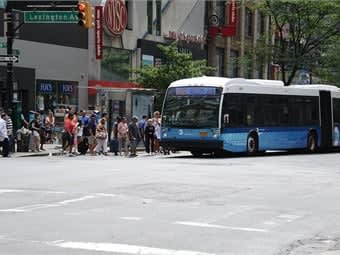
Under the new measure, offenders charged with aggravated harassment, including spitting on transportation workers, would be subject to a Class A misdemeanor punishable by up to one year in prison.
Marc A. Hermann
The head of New York MTA’s bus operations Craig Cipriano joined with senior officials from the Transport Workers Union Local 100 and bus operators who have recently been assaulted to condemn the rise in recent attacks on MTA bus operators and call for swift passage of legislation that would increase penalties for assaults on transit workers. The announcement came a week after a B15 bus operator was violently assaulted while driving, one of several disturbing attacks against bus operators in recent months.
At the event, the MTA and TWU Local 100 reiterated their shared commitment to improving worker safety and applauded Governor Cuomo for his leadership introducing important legislation to strengthen penalties for assaults against transit workers. Under the new measure, offenders charged with aggravated harassment, including spitting on transportation workers, would be subject to a Class A misdemeanor punishable by up to one year in prison. Spitting is currently only a violation punishable by fine.
The legislation would also expand the list of assaulted workers whose attackers may be punished with Class D felonies, which have a maximum sentence of seven years in prison. Class D felony protection currently covers train and bus operators, signalpersons, and terminal cleaners. The legislation would expand the coverage to customer assistance personnel, signal system repairers, track cleaners, and supervisors of such personnel, among other additional titles.
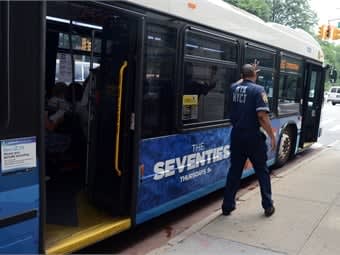
MTA and TWU leadership announced that a worker safety task force will help identify hot spots around the system where safety and law enforcement resources might best be leveraged moving forward.
Marc A. Hermann
Additionally, MTA and TWU leadership announced that a worker safety task force will help identify hot spots around the system where safety and law enforcement resources might best be leveraged moving forward. That task force will help inform how the MTA Police Department deploys some of the 500 new police officers that are set to begin work in the weeks and months ahead months ahead across the MTA, including NYC Transit, the Long Island Rail Road, and Metro-North Railroad.
Bus operators have experienced a surge in violent incidents over the last year, with New York Penal Law assaults up more than 10% and spitting incidents up 35% compared to 2018. To help combat these and other types of attacks, the MTA is continuing to ramp up its aggressive deployment of security cameras. Each bus of the system’s roughly 5,700-vehicle fleet is expected to be equipped with security cameras by the end of the 2020-2024 MTA Capital Plan.
Currently, nearly 4,200 buses — including nearly 90% of local buses — have security cameras onboard. Protective barriers to shield bus operators have also been part of the MTA’s broader strategy to reduce violence against bus operators.
More Security and Safety

Transit Agencies Highlight Safety Gains at National Summit
Leaders from 15 major transit systems shared crime-reduction results and safety initiatives while discussing the role of continued federal support.
Read More →
DART Launches Major Security, Fare Enforcement Initiative
The 90-day demonstration will deploy coordinated security teams at five light rail stations while testing controlled access and gathering data to guide future investments.
Read More →
RTD Launches NextRide App to Consolidate Trip Planning, Fares, Security Reporting
The app expands on RTD’s existing NextRide web application and allows customers to view real-time vehicle locations and service alerts, purchase and store digital fares, and access customer support.
Read More →

TAPTCO Updates OSHA Compliance Training for Transit Maintenance Operations
The revamped program addresses 26 OSHA standards for maintenance facilities, with TAPTCO pointing to training, documentation, and everyday shop hazards as continuing challenges for transit operations.
Read More →
Sponsored•August 18, 2026
How VaporVision Adds Value to Transit Door Systems
Wabtec engineers explain how the system improves doorway detection, strengthens diagnostics and gives transit agencies and OEMs greater operating flexibility.
Read More →
FRA Announces $5.3B in Rail Investments, Including $2B for Amtrak
Funding will support grade-crossing improvements, infrastructure upgrades, and new Amtrak equipment in 23 states.
Read More →
Chicago, Maryland Expand Non-Law-Enforcement Safety, Rider Support
The CTA and MTA are launching new programs aimed at de-escalation, crisis response, rider assistance, and greater transparency.
Read More →
LA Metro, City of West Hollywood, and Partners Advance Smarter Bus Lane Enforcement
The award-winning partnership combines AI-powered detection with human oversight to improve bus reliability, accessibility, and enforcement efficiency.
Read More →
LA Metro Reports 57% Decline in Homelessness on Transit System Since 2024
The agency's latest homelessness count offers new data on how care-based services and cross-sector partnerships can complement traditional transit security strategies.
Read More →
FTA Launches 'Transit Moves America' Dashboard to Highlight Agency Safety and Performance
The online dashboard transforms National Transit Database information into a public-facing resource that allows users to compare transit agencies on key operational and safety metrics.
Read More →