



NYCT to install 'Help Points' on subway
Created specifically for the subway environment, the unit is designed to be an easily recognizable communications tool for customers who need to either report an emergency or ask for travel directions.

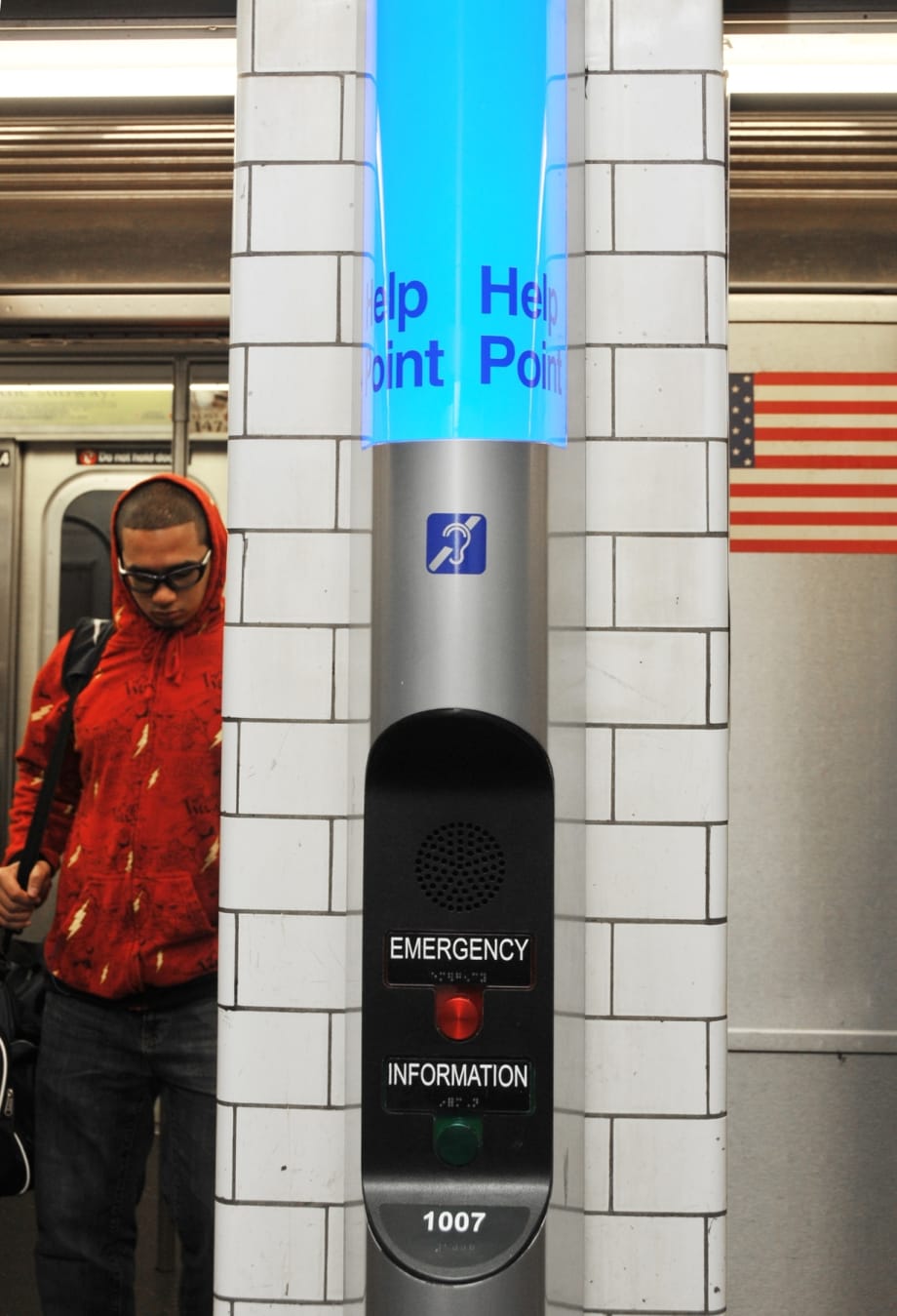
MTA New York City Transit will install Help Points, a digital communication tool for customers who need immediate assistance and information, to 102 stations.
For the first time, customers on the platform level of subway stations will have immediate access to the station booth and personnel at the Rail Control Center. Units will be positioned and spaced for easy access and high visibility. Created specifically for the subway environment, the Help Point is designed to be an easily recognizable communications tool for customers who need to either report an emergency or ask for travel directions.
The units will be easy to spot with a bright blue beacon light that will pulse when the unit is in action. This feature will help alert first responders in case there is an injured or sick customer at that location. When approaching the Help Points, customers will be greeted by two buttons, a green button which connects riders to the booth and a red button, linked directly to the Rail Control Center and to be used in the event of emergency.
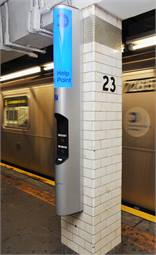
The eventual plan calls for the installation of the Help Points in all of the system’s 468 subway stations, replacing the Customer Assistance Intercoms units currently in use.
An initial pilot of the system was conducted at the 23rd Street and Brooklyn Bridge Stations on the Lexington Avenue Line and served to determine not only the usefulness of the units but also to evaluate the benefits of both hard-wired and wireless installations. Nine Help Points were installed at 23rd Street and another 10 at the Brooklyn Bridge Station. There is a second pilot currently underway at Rector Street on the Broadway Line and Burnside Avenue on the Jerome Line, in the Bronx.
Each Help Point is individually addressable, so that in the case of an emergency, personnel at the Rail Control Center will be able to pinpoint exactly where in the station the call originated. Not only will the new Help Point units improve response times, but the digital audio will provide much clearer sound than is available from the customer assistance intercoms used in subways now.
Along with the Help Points, the contract pending board approval next week, also includes the installation of the Passenger Station Local Area Network (PSLAN), the digital communications network which will provide connectivity for advanced-technology devices located within the station environment. Importantly, PSLAN will support the Help Points, the New Fare Payment System, On-The-Go screens and new security initiatives. Both projects are estimated to have a combined value of $100 million, with Help Points valued at approximately $40 million and PSLAN at $60 million.
More Rail
Amtrak, CN Reach Agreements to Strengthen Passenger Rail Service, Safety
The agreement resolves a more than decade-long proceeding before the Surface Transportation Board concerning the terms and conditions for Amtrak services, such as the City of New Orleans, Illini/Saluki, and Wolverine.
Read More →
New York MTA Advances Final Contract for Second Avenue Subway Expansion
Contract Four is the largest in the Second Avenue Subway Phase 2 project and includes construction of station infrastructure, tracks, and signals for the subway expansion, MTA officials said. Work on Contract Four will begin in 2027.
Read More →
San Diego MTS Breaks Monthly Trolley Ridership Record
Agency officials said July’s ridership indicates MTS’s continued recovery from the pandemic.
Read More →
Report Examines NJ TRANSIT Reliability, Funding Challenges
The Garden State Initiative analysis examines the roles of Amtrak infrastructure, fleet management, and agency operations while recommending a more performance-based approach to improving reliability.
Read More →
Stadler, CapMetro Sign Long-Term Rail Fleet Support Agreement
Beginning in 2027, Stadler will provide on-site technical expertise, spare parts support, training, and obsolescence management to help extend the reliability and longevity of CapMetro’s GTW fleet.
Read More →
Biz Briefs: Alstom Lands Canadian Contract, LYT to Supply California TSP, and More
In METRO's latest installment, we take a look at recent news from Complete Coach Works, Beep, FlixBus, and more partnerships making headlines across the transportation sector.
Read More →
CATS Gold Line Marks 5 Years of Service, 2.8M Passenger Trips
With a six-mile expansion planned, the Charlotte streetcar is positioned to connect more neighborhoods and major transit hubs across the region.
Read More →
Why Simulating Pedestrian Movement Has Become Essential for Modern Rail Stations
Pedestrian microsimulation is helping rail planners identify bottlenecks, test station designs, and prepare complex transit hubs for growing passenger volumes.
Read More →
Amtrak Begins Major Construction at New York’s Sunnyside Yard
The new maintenance facility will support Amtrak’s Airo trainsets while improving maintenance efficiency and turnaround times in New York.
Read More →
Chicago Leaders Unveil Plans for O’Hare Airport Express Train
The privately developed project would offer a 15-minute trip between downtown and O’Hare’s Terminal 2, with trains operating every 15 minutes on a dedicated track. The service would use battery-electric trains and three existing freight rail rights-of-way.
Read More →