



Renewable natural gas on-road fuel use reaches historic high
Over the last five years, RNG use as a transportation fuel has increased 577%, displacing over seven million tons of carbon dioxide equivalen.

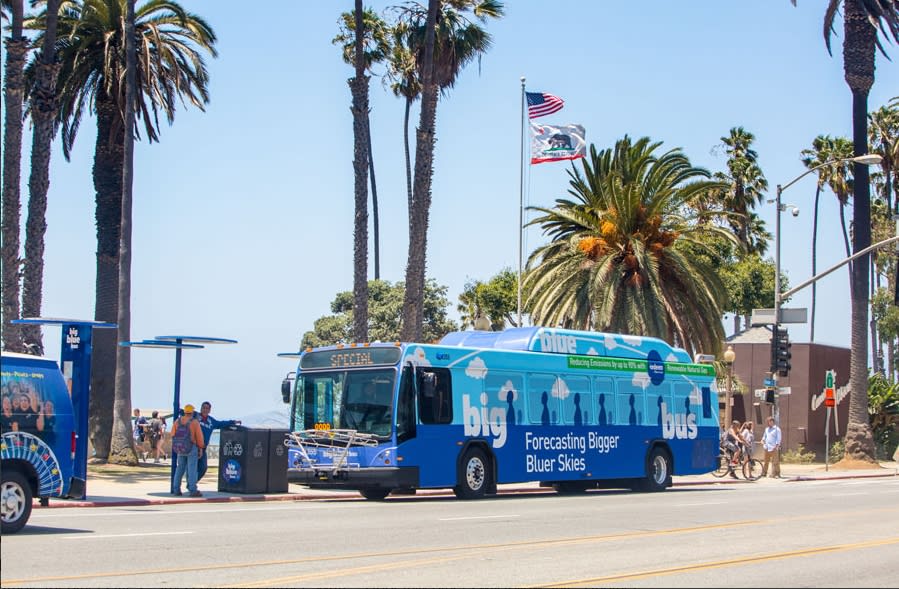
Over the last five years, RNG use as a transportation fuel has increased 577%, displacing over seven million tons of CO2e.
Clean Energy
Over the last five years, RNG use as a transportation fuel has increased 577%, displacing over seven million tons of CO2e.
Clean Energy
Natural Gas Vehicles for America (NGVAmerica) and the Coalition for Renewable Natural Gas (RNG Coalition) announced that 32% of all on-road fuel used in natural gas vehicles in calendar year 2018 was renewable natural gas (RNG).
Captured above ground from organic material in agricultural, wastewater, landfill, or food waste, RNG — or biomethane — produces net carbon-neutral and even net carbon-negative results when fueling on-road vehicles like short- and long-haul trucks, transit buses, and refuse and recycling collection vehicles. RNG fuel in 2018 had an EER-adjusted carbon intensity as low as -303.30, according to the California Air Resources Board. By comparison, California’s electricity grid rated between 25.0 and 38.95, according to the report.
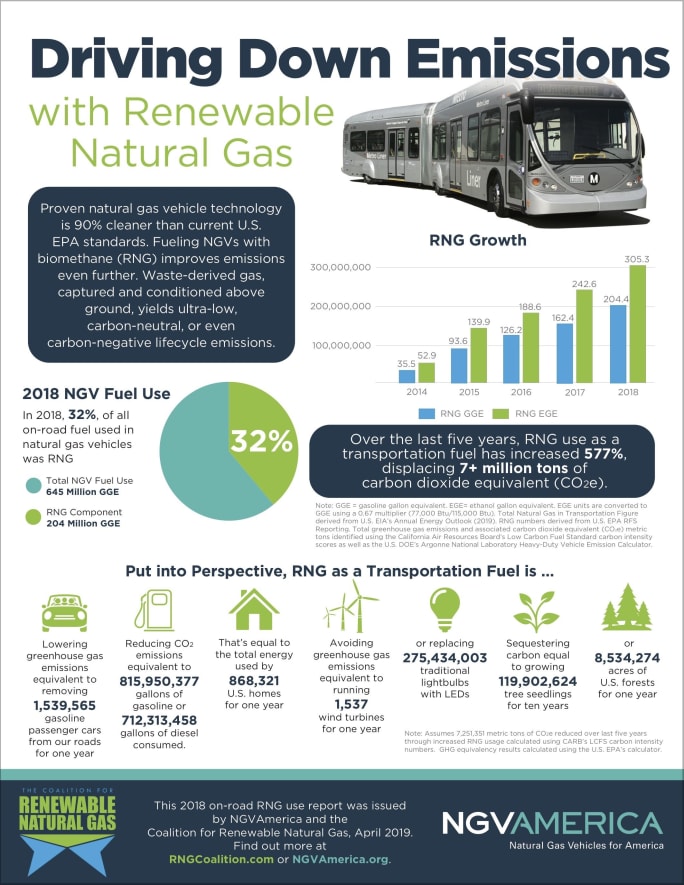
Over the last five years, RNG use as a transportation fuel has increased 577%, displacing over seven million tons of carbon dioxide equivalent (CO2e). NGVAmerica and the RNG Coalition report that in 2018 a total of 645 million gasoline gallon equivalent of natural gas was used as a motor fuel. Of that, more than 204 million gasoline gallon equivalent was renewable.
“The environmental advantages of using renewable natural gas to replace fossil fuels in on-road transportation have driven substantial growth in development and investment in new RNG production across the U.S.,” said Johannes Escudero, RNG Coalition CEO. “The number of North American RNG production facilities has multiplied more than two-and-a-half times in the past five years to almost 100 today, while RNG fuel use has increased nearly six-fold.”
RNG motor fuel use has eliminated 7,251,351 metric tons of CO2e over the last five years. Put into perspective, RNG motor fuel is:
Lowering greenhouse gas emissions equivalent to removing 1,539,565 gasoline passenger cars from our roads for one year.
Reducing CO2 emissions equivalent to 815,950,377 gallons of gasoline or 712,313,458 gallons of diesel consumed. That’s equal to the total energy used by 868,321 U.S. homes for one year.
Avoiding greenhouse gas emissions equivalent to running 1,537 wind turbines for one year, or replacing 275,434,003 traditional lightbulbs with LEDs.
Sequestering carbon equal to growing 119,902,624 tree seedlings for 10 years or 8,534,274 acres of U.S. forests for one year.
More Bus

New York MTA Plans Largest Bus Fleet Upgrade in More Than a Decade
The agency is seeking manufacturers for 650 new CNG buses to replace aging vehicles, improve reliability, and advance its broader fleet modernization strategy.
Read More →
Building a Flexible Path to Transit Electrification
John Hroncich discusses BAE Systems’ modular and scalable approach, lessons learned from decades of real-world operations, and how agencies can identify electrification strategies that fit their fleets.
Read More →
Bus Tech Talk: Keeping Transit Technicians Ahead of the Technology Curve
LA Metro’s Obed Mejia discusses technician training, evolving maintenance technology, fleet replacement, and strategies for getting the most out of today’s transit fleets.
Read More →
Biz Briefs: RIPTA Unveils New Frontrunners, Clevland RTA Adds New Siemens, and More
In METRO's latest installment, we take a look at recent news from Siemens, Prevost, Dodge, and more partnerships making headlines across the transportation sector.
Read More →
People Movement: Holly Arnold Joins Transdev and More
In this edition, we also cover recent appointments and announcements at Pace, CamTran, MCI, and more, showcasing the individuals helping to shape the future of transportation.
Read More →
The High Cost of Transit Buses: Industry Leaders Look to Procurement Reform
Transit leaders and policymakers examine how standardized bus designs, streamlined procurement, and predictable funding could help agencies stretch budgets and deliver better service.
Read More →
The Business Voice Behind Public Transportation
As chair of APTA’s Business Members Board of Governors, Ray Melleady explains how more than 850 business members are partnering with transit agencies to advance funding, innovation, and industry-wide collaboration.
Read More →
From Surviving to Thriving: Building Stronger Transportation Organizations
Bus Business Consultants founder Brian Dickson shares lessons on leadership, organizational health, and creating options for long-term success in a changing transportation industry.
Read More →
Finding the ‘Happy Medium’: Optimizing Maintenance Without Sacrificing Reliability
The key to maintenance optimization isn’t doing less work—it’s doing the right work at the right time on the right assets.
Read More →
LA Metro, City of West Hollywood, and Partners Advance Smarter Bus Lane Enforcement
The award-winning partnership combines AI-powered detection with human oversight to improve bus reliability, accessibility, and enforcement efficiency.
Read More →