



Reports Examine Transforming Workforce Development for the Transportation Industry
The Mineta Transportation Institute recently released several publications that explore important related issues and reveal new methods and pathways being developed and implemented to build the workforce pipeline.

The ongoing workforce crisis in transportation requires innovative solutions and strategic investments.
Photo: Canva
A 2022 survey revealed that 96% of transit agencies of all sizes are experiencing workforce challenges, and 84% said these shortages are impacting their ability to provide service.
With that, the Mineta Transportation Institute (MTI) recently released several publications that explore important related issues and reveal new methods and pathways being developed and implemented to build the workforce pipeline, including:
3) "Transforming Middle School Workforce Development for 21st-Century Education."
Looking at MTI’s New Reports
“The Indirect Benefits of a Transit Apprenticeship and its Potential Value as a Flexible Postsecondary Pathway” explores a success story of the transit sector embracing apprenticeships as a worthwhile training model.
Specifically, the Santa Clara Valley Transportation Authority Joint Workforce Initiative (JWI) is a model of apprenticeships that emphasize both technical and soft skills, thus offering employees the chance to develop “cross-cutting competencies” and advance their careers.
The report details the importance of affordability, portability, and articulation and outlines how these features could be further developed in the JWI and how this initiative could be used as a model for further workforce development.
The next report, “L&D On-ramps and Off-ramps for the Mobility Workforce: A Blueprint for Knowledge Ecosystem Formation in the Fourth Industrial Revolution,” introduces and discusses the proof-of-concept pilot program proposed in a previous report, “Trade and Transportation Talent Pipeline Blueprints: Building University-Industry Talent Pipelines in Colleges of Continuing and Professional Education.”
It presents a blueprint with implementation tools and strategies for California State University Long Beach (CSULB) and other CSU campuses to adopt the presented knowledge ecosystem model in higher education.
The study found near universal support for pursuing university-industry partnerships with 97% of CSULB faculty and staff and external stakeholders supporting the concept, demonstrating a viable new model for workforce development.
Finally, “Transforming Middle School Workforce Development for 21st-Century Education” summarizes the 2024 program of the Garrett Morgan Sustainable Transportation Competition for middle school students, one of MTI’s signature workforce development initiatives.
MTI has sponsored a competition every year since 2003 and over 1,300 students have participated. This year’s program was a success, fostering meaningful connections and practical learning.
Plans for future programs with further resources, improvements, and components to increase competition are already underway for 2025.
The Need for Innovation
The ongoing workforce crisis in transportation requires innovative solutions and strategic investments.
The reports and perspectives highlight several promising initiatives, from apprenticeships to university-industry partnerships and early-stage education programs, which are creating pathways to build a more diverse and resilient workforce.
The efforts offer valuable insights for addressing workforce shortages and equipping the next generation of professionals with the skills needed to meet the challenges of 21st century transportation.
More Management

From Surviving to Thriving: Building Stronger Transportation Organizations
Bus Business Consultants founder Brian Dickson shares lessons on leadership, organizational health, and creating options for long-term success in a changing transportation industry.
Read More →
Everett Transit, Community Transit Outline Consolidation Agreement
The proposed agreement calls for a 50% increase in bus service in Everett, a new microtransit zone, continued paratransit service, and the transfer of Everett Transit operations to Community Transit.
Read More →
Strada360’s Steve Lassey on Turning Transit Data Into Better Decisions
From breaking down data silos to preparing for AI, Strada360 CEO Steve Lassey discusses how transit agencies can use technology to improve operations, customer information, and long-term decision-making.
Read More →
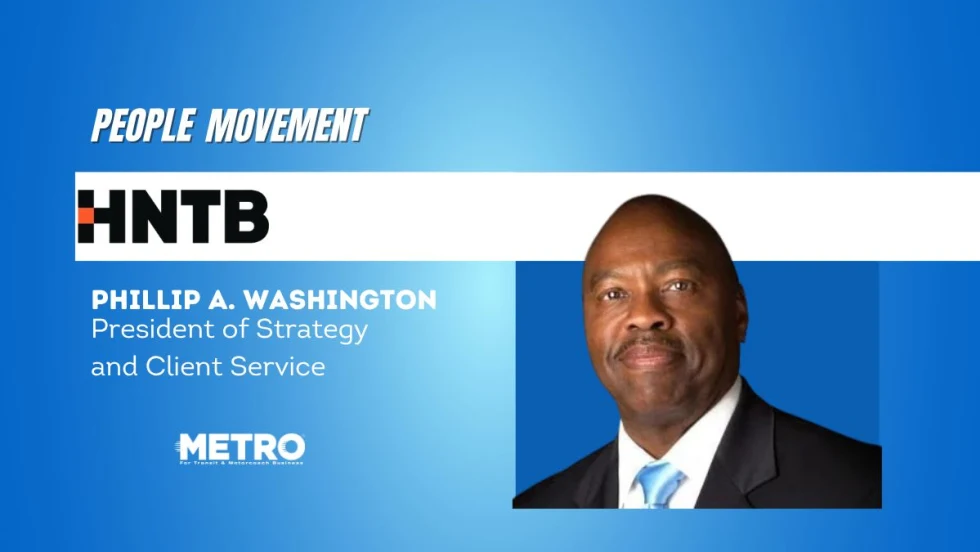
People Movement: Phil Washington Joins HNTB, Denver RTD Launches CEO Search, and More
In this edition, we also spotlight recent personnel moves at STV, the Eno Center for Transportation, and more, highlighting the people taking on new roles across the transportation industry.
Read More →
SEPTA Details Accelerate Vision for Transit System
The plan outlines investments in trolley modernization, new Metro and Regional Rail vehicles, accessible stations, and more frequent bus and rail service.
Read More →
FTA Ends Direct Oversight of MBTA Safety Actions
The federal agency closed its remaining special directive to the Massachusetts Department of Public Utilities following a safety review that began in 2022.
Read More →
Report: Transit Bus Manufacturing Supports 34,100 Jobs, $5.1B in GDP
The “Buses Mean Business” report examines the transit bus manufacturing industry’s economic footprint, supply chain, and rising demand for vehicle replacements.
Read More →
LIT Marks 10-Year Milestone at Annual Summit
Hosted by the COTA from September 10 to 13, the Summit carried the theme “Celebrating 10 Years of Excellence, Leadership, and Impact,” with every part of the program honoring the people, agencies, and partners who built LIT over its first decade.
Read More →
People Movement: Dan Dipert Coaches Adds Third-Generation Leader, Keolis Names New Valley Metro VP/GM, and More
In this edition, we also cover recent appointments and announcements at the Wabtec, SilverRide, HNTB, and more, showcasing the individuals helping to shape the future of transportation.
Read More →
METRO Opens Submissions for 2026 Motorcoach Awards
Nominations are now being accepted for METRO Magazine’s Operator of the Year and Innovative Operator of the Year awards.
Read More →