




RELATED: Sound Transit Taking Measured Approach to Quintuple Light Rail System
Sound Transit station achieves LEED Gold certification
The agency will pursue LEED Silver status for its future Operations and Maintenance Facility on the Eastside, and plans to pursue LEED certification for applicable stations and facilities that will serve future light rail extensions to West Seattle, Ballard and other cities.
July 14, 2017
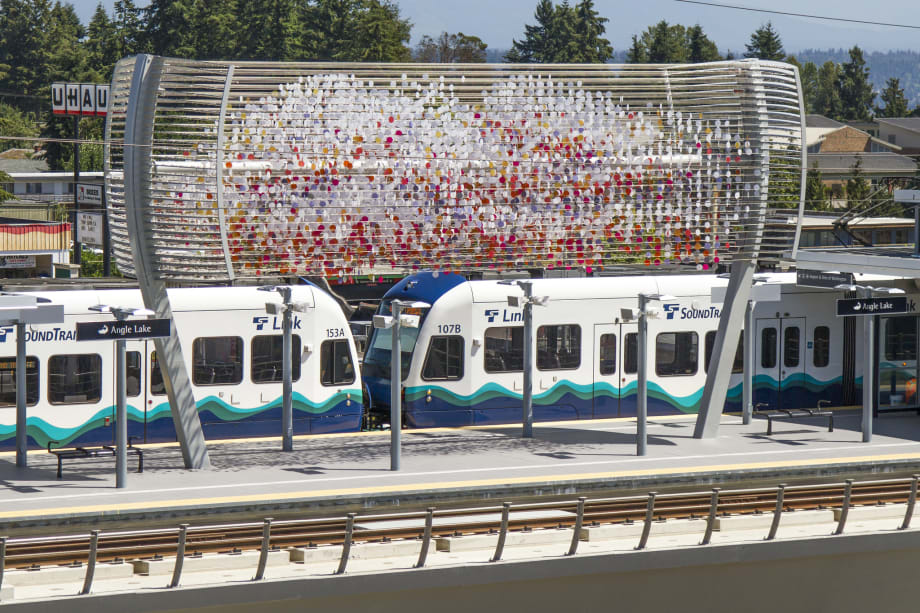
Artist Laura Haddad’s “Cloud” sculpture, made of 6,000 eco-resin disks that glimmer with variations in sunlight and wind, hangs above the train platform as a prominent visual element of the station.
Photos courtesy Sound Transit
3 min to read
Artist Laura Haddad’s “Cloud” sculpture, made of 6,000 eco-resin disks that glimmer with variations in sunlight and wind, hangs above the train platform as a prominent visual element of the station.
Photos courtesy Sound Transit
Seattle Sound Transit’s newest light rail facility earned Leadership Energy and Environmental Design (LEED) Gold certification from the U.S. Green Building Council for its use of sustainable practices in the design and construction of the Angle Lake Station, which opened in the city of SeaTac last fall. LEED Certification provides independent verification of a building’s sustainable design and is the most widely used sustainability rating system in the world.
“The Angle Lake Station exemplifies the creative ways in which transit facilities can function as sustainable resources in their communities,” said Sound Transit CEO Peter Rogoff. “Achieving LEED Gold status for our newest Link station is a testament to Sound Transit's commitment to use taxpayer dollars to design and build facilities that contribute to the health of our environment here in the Puget Sound region.”
Using the “Environment in Motion” theme, contractors who designed and built the transit facility incorporated several environmentally sustainable features in the station. A 60-panel, 14-kilowatt solar array on the platform canopy provides up to 18,000 kilowatt hours of power per year to the station. When not in use, escalators from the platform to a plaza area slow to a reduced speed to conserve energy. A pedestrian walkway covered by a 50-kilowatt solar array that also provides weather protection leads to a garage enfolded in a blue, wave-like façade of anodized aluminum that requires little maintenance. Four charging stations for electric vehicles are housed in the garage, and storage for 52 bicycles is available on site.
Station construction also incorporated regionally produced and recycled materials. Particular attention was paid to selecting materials that do not contain toxic chemicals, such as rock wool and cellular glass insulations. The station predominately uses LED lighting to reduce energy use.
Public art also reflects an environment in motion. Artist Laura Haddad’s “Cloud” sculpture, made of 6,000 eco-resin disks that glimmer with variations in sunlight and wind, hangs above the train platform as a prominent visual element of the station. The artwork illuminates in changing colors at night. Above the grand open staircase leading from the plaza to the garage, artist Jill Anholt’s “Immerse” sculpture appears to hang weightlessly in three delicate arcs that transfer and filter light into a parking area below. Unobstructed views of Puget Sound and the mountains from the station platform offer some of the best views along the Link light rail line.
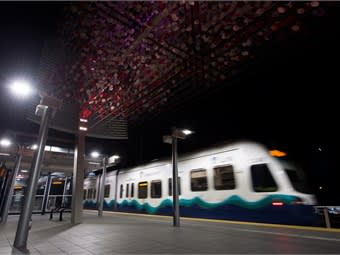
Artist Laura Haddad’s “Cloud” sculpture illuminates in changing colors at night.
The elevated station, which includes a guideway, garage and pedestrian plaza, was the first design-build project completed by Sound Transit. The team included PCL Civil Constructors Inc. with HDR Inc. and VIA Architecture to design and construct the aerial station and guideway; joint venture Harbor Pacific Graham, along with Berger ABAM and Brooks + Scarpa, to design and build the plaza and garage. WSP USA provided project management, and Huitt Zollers provided pre-design and design services. Johansen Excavating Inc. was awarded the public bid to construct roadway improvements.
Sound Transit will pursue LEED Silver status for its future Operations and Maintenance Facility on the Eastside, and plans to pursue LEED certification for applicable stations and facilities that will serve future light rail extensions to West Seattle, Ballard and other cities.
More Rail

New York MTA Advances Final Contract for Second Avenue Subway Expansion
Contract Four is the largest in the Second Avenue Subway Phase 2 project and includes construction of station infrastructure, tracks, and signals for the subway expansion, MTA officials said. Work on Contract Four will begin in 2027.
Read More →
San Diego MTS Breaks Monthly Trolley Ridership Record
Agency officials said July’s ridership indicates MTS’s continued recovery from the pandemic.
Read More →
Report Examines NJ TRANSIT Reliability, Funding Challenges
The Garden State Initiative analysis examines the roles of Amtrak infrastructure, fleet management, and agency operations while recommending a more performance-based approach to improving reliability.
Read More →
Stadler, CapMetro Sign Long-Term Rail Fleet Support Agreement
Beginning in 2027, Stadler will provide on-site technical expertise, spare parts support, training, and obsolescence management to help extend the reliability and longevity of CapMetro’s GTW fleet.
Read More →
Biz Briefs: Alstom Lands Canadian Contract, LYT to Supply California TSP, and More
In METRO's latest installment, we take a look at recent news from Complete Coach Works, Beep, FlixBus, and more partnerships making headlines across the transportation sector.
Read More →
CATS Gold Line Marks 5 Years of Service, 2.8M Passenger Trips
With a six-mile expansion planned, the Charlotte streetcar is positioned to connect more neighborhoods and major transit hubs across the region.
Read More →
Why Simulating Pedestrian Movement Has Become Essential for Modern Rail Stations
Pedestrian microsimulation is helping rail planners identify bottlenecks, test station designs, and prepare complex transit hubs for growing passenger volumes.
Read More →
Amtrak Begins Major Construction at New York’s Sunnyside Yard
The new maintenance facility will support Amtrak’s Airo trainsets while improving maintenance efficiency and turnaround times in New York.
Read More →
Chicago Leaders Unveil Plans for O’Hare Airport Express Train
The privately developed project would offer a 15-minute trip between downtown and O’Hare’s Terminal 2, with trains operating every 15 minutes on a dedicated track. The service would use battery-electric trains and three existing freight rail rights-of-way.
Read More →
OCTA Maps Out 30-Year Strategy to Protect Coastal Rail Corridor
The draft feasibility report identifies strategies to protect the coastal rail line for decades as the agency continues near-term stabilization and sand placement efforts.
Read More →