




People Movement: The Latest Moves at Valley Metro, OCTA, and More
South Central Extension Debuts, Transforming Transit and Community in South Phoenix
The 5.5-mile light rail extension connects South Phoenix to Valley Metro Rail’s new two-line system.
June 9, 2025
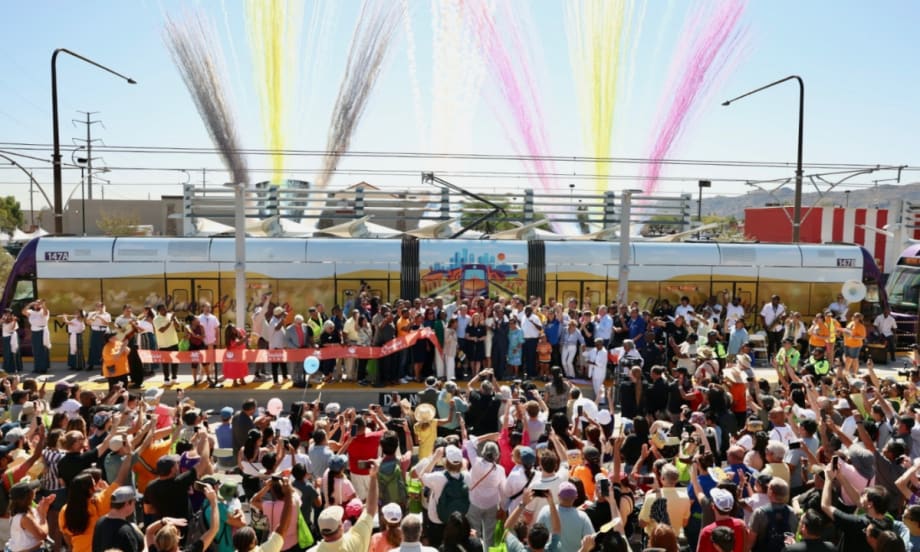
A community ribbon cutting for the South Central Extension/Downtown Hub light rail extension with federal, state, and local officials was held in Phoenix, Arizona.
Photo: Valley Metro
4 min to read
In Phoenix, Arizona, 5,000 community members and federal, state, and local officials gathered to celebrate the opening of the South Central Extension/Downtown Hub (SCE/DH) light rail expansion.
The extension represents a historic milestone for Valley Metro Rail, marking the system’s evolution to a 35-mile two-line rail system. The A line now travels east/west, and the B line travels north/south, with weekday service increased to 12 minutes before 7 p.m.
“The completion of this project marks an important new connection for residents and moves us closer to our goals as a sustainable and accessible city,” said Mayor Kate Gallego. “This historic extension introduces the region’s first two-line rail system, creates safer streets and new bike lanes, and adds shade and public art — all while connecting more residents to jobs, education, entertainment, and other amenities across the Valley. Equally important, it provides a whole new opportunity to showcase the unique offerings of this thriving corridor.”

(left to right) Phoenix Councilmembers Anna Hernandez and Kesha Hodge Washington; Petra Falcon, Community Advisory Board Chair; U.S. Cong. Greg Stanton; Mayor Kate Gallego; Myesha Harris, local business owner (behind Mayor Gallego); and Jessica Mefford-Miller, Valley Metro CEO.
Photo: Valley Metro
The $1.34 billion project was made possible through strong federal-local partnerships, with federal grants providing more than half the funding alongside Phoenix Transportation 2050 and regional Proposition 400 investments.
“Arizonans understand that these infrastructure investments make us more connected and more prosperous,” said U.S. Congressman Greg Stanton. “As we now look westward for future light rail expansion and anticipate the extensions of the streetcar line in the East Valley, we’re in a magical moment in Phoenix’s history, and we can only keep up this momentum if we keep investing in ourselves.”
The extension will add more than 8,000 daily riders to the light rail system, which currently serves an average of 32,000 daily boardings.
“I am excited for the opening of the South Central Extension! The residents of South Phoenix and District 7 have waited a long time for light rail, and I am excited about how this new extension will connect South Phoenix with the rest of the city,” said Phoenix District 7 Councilwoman Anna Hernandez. “A robust public transportation and light rail are the future of our city, and I am excited about how South Phoenix residents will benefit.”
Art, Heritage, and Transit Unite in South Central Extension Launch
Community-driven public art is prominently featured throughout the extension, with 18 installations created by artists who are predominantly local, reflecting the character and cultural richness of south Phoenix neighborhoods.
“This grand opening marks a transformative moment for South Phoenix. The South Central Extension represents direct access to local businesses and a community that has historically been disconnected and overlooked,” said Phoenix District 8 Councilwoman Kesha Hodge Washington. “South Phoenix deserves investment, inclusion, and infrastructure that lifts everyone around it, and that is the vision of the light rail extension.”
The recent celebration was held at three locations — the Baseline/Central Ave Park-and-Ride, Ed Pastor Transit Center, and Downtown Hub — and included a “Cruisin’ Central” community procession with over 250 community participants, a lowrider and classic car show, family-friendly activities, performances by local entertainers and over 60 local business pop-ups and food vendors. The festivities culminated with a ribbon-cutting ceremony and first rides at the Baseline/Central Ave Park-and-Ride.
“Today we are celebrating 5.5 new rail miles and the transformation of Valley Metro Rail into a multi-line operation, creating an important new connection to South Phoenix,” said Valley Metro CEO Jessica Mefford-Miller. “We built this project with the community to achieve their vision, and we will continue to advance the community’s vision to connect to the West and East Valleys and bring greater mobility and economic opportunity to more of metro Phoenix. I congratulate and thank the community and our teams for today’s successful opening!”
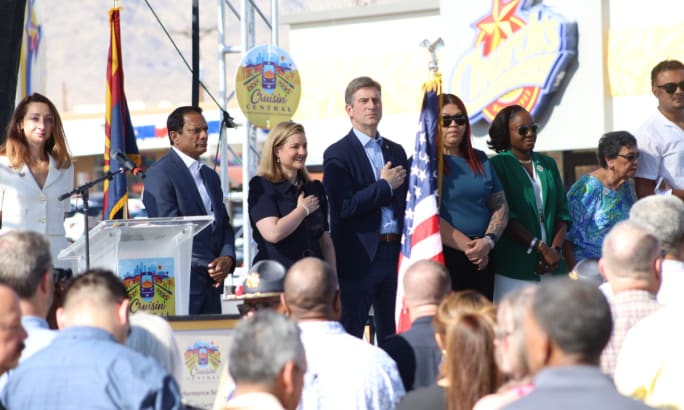
(left to right) Jessica Mefford-Miller, Valley Metro CEO; Ray Tellis, FTA Region IX Administrator; Phoenix Mayor Kate Gallego; U.S. Cong. Greg Stanton; Phoenix Councilmembers Anna Hernandez and Kesha Hodge Washington; Honorable Verma Pastor and Francisco Pastor-Rivera.
Photo: Valley Metro
New Rail, New Roots: Community Investment Along the Line
The project created over 5,000 local jobs, with over 600 workers hired directly from south Phoenix communities. There are eight new stations, a new park-and-ride facility at Baseline Road/Central Avenue, and a transit hub converging in downtown Phoenix.
The extension also includes several community upgrades, such as enhanced bike lanes, pedestrian pathways, over 550 new trees, desert-adapted landscaping, and comprehensive utility upgrades replacing more than 30 miles of underground infrastructure.
Valley Metro and the City of Phoenix prioritized supporting small, locally owned businesses throughout construction through a first-of-its-kind grant program. Through the Small Business Financial Assistance Program, over 270 grants, totaling over $1.6 million, were awarded to small businesses along the corridor.
More Rail

New York MTA Advances Final Contract for Second Avenue Subway Expansion
Contract Four is the largest in the Second Avenue Subway Phase 2 project and includes construction of station infrastructure, tracks, and signals for the subway expansion, MTA officials said. Work on Contract Four will begin in 2027.
Read More →
San Diego MTS Breaks Monthly Trolley Ridership Record
Agency officials said July’s ridership indicates MTS’s continued recovery from the pandemic.
Read More →
Report Examines NJ TRANSIT Reliability, Funding Challenges
The Garden State Initiative analysis examines the roles of Amtrak infrastructure, fleet management, and agency operations while recommending a more performance-based approach to improving reliability.
Read More →
Stadler, CapMetro Sign Long-Term Rail Fleet Support Agreement
Beginning in 2027, Stadler will provide on-site technical expertise, spare parts support, training, and obsolescence management to help extend the reliability and longevity of CapMetro’s GTW fleet.
Read More →
Biz Briefs: Alstom Lands Canadian Contract, LYT to Supply California TSP, and More
In METRO's latest installment, we take a look at recent news from Complete Coach Works, Beep, FlixBus, and more partnerships making headlines across the transportation sector.
Read More →
CATS Gold Line Marks 5 Years of Service, 2.8M Passenger Trips
With a six-mile expansion planned, the Charlotte streetcar is positioned to connect more neighborhoods and major transit hubs across the region.
Read More →
Why Simulating Pedestrian Movement Has Become Essential for Modern Rail Stations
Pedestrian microsimulation is helping rail planners identify bottlenecks, test station designs, and prepare complex transit hubs for growing passenger volumes.
Read More →
Amtrak Begins Major Construction at New York’s Sunnyside Yard
The new maintenance facility will support Amtrak’s Airo trainsets while improving maintenance efficiency and turnaround times in New York.
Read More →
Chicago Leaders Unveil Plans for O’Hare Airport Express Train
The privately developed project would offer a 15-minute trip between downtown and O’Hare’s Terminal 2, with trains operating every 15 minutes on a dedicated track. The service would use battery-electric trains and three existing freight rail rights-of-way.
Read More →
OCTA Maps Out 30-Year Strategy to Protect Coastal Rail Corridor
The draft feasibility report identifies strategies to protect the coastal rail line for decades as the agency continues near-term stabilization and sand placement efforts.
Read More →