Both People’s Transit and Prairie Hills Transit have accessed readily available funding streams to help support the purchase of the new buses.
Photo: ROUSH CleanTech
2 min to read
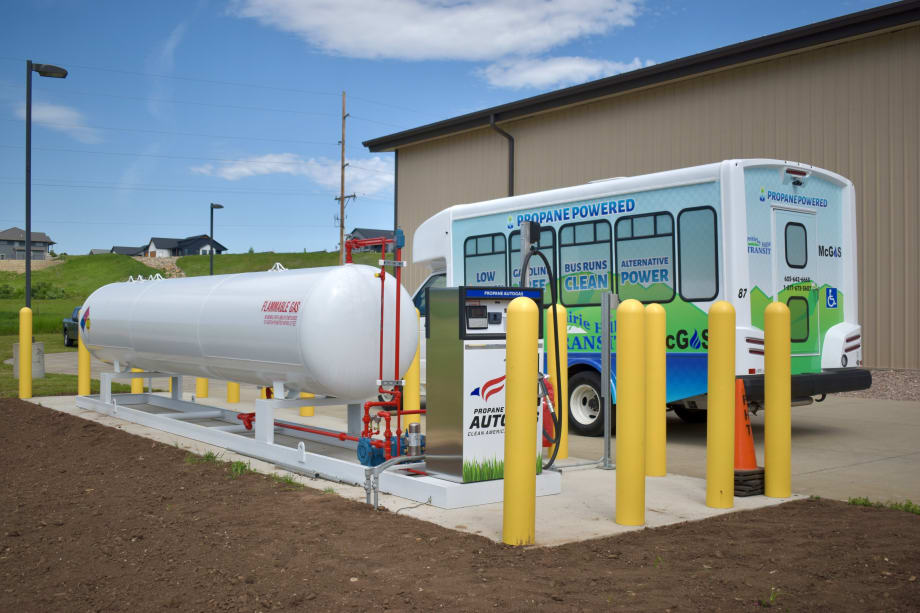
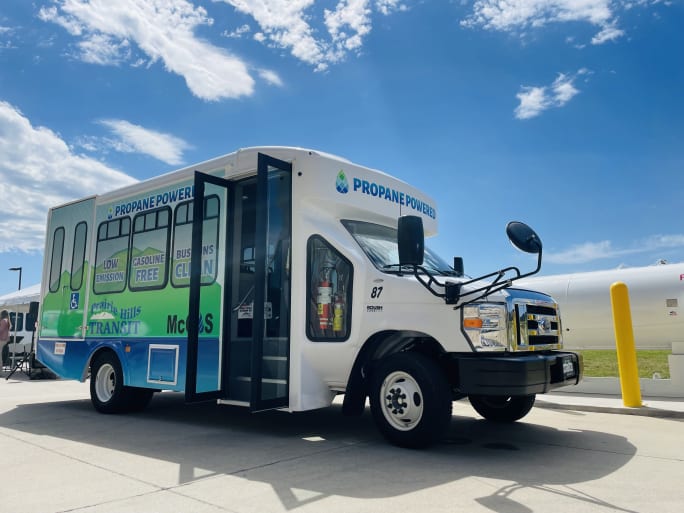
Two South Dakota transit agencies, People’s Transit in Huron and Prairie Hills Transit in Spearfish, unveiled their first orders of safe, environmentally friendly, and economical buses fueled with propane autogas.
“Prairie Hills Transit is on the cutting edge of public transit operation with these new propane buses and the first propane fueling infrastructure in the state. We’ve done extensive research and believe that the use of propane is an excellent way to reduce emissions,” said Barbara Cline, executive director of Prairie Hills Transit.
Ad Loading...
Prairie Hills Transit will operate six propane buses, which is 10% of its fleet.
“The new propane buses will have a positive impact on the environment because they reduce harmful emissions, especially when compared to our gasoline and diesel buses,” said Gayle Kludt, executive director of People’s Transit.
People’s Transit will operate six propane buses, transitioning 80% of its in-town fleet to propane this calendar year.
The ROUSH CleanTech Ford E-450 cutaway chassis is the only propane vehicle that has completed the Federal Transit Administration’s New Model Bus Testing Program (Altoona Testing), which allows transit fleet operators to access federal funds.
Photo: ROUSH CleanTech
New Propane Buses in South Dakota
Buses for both agencies are equipped with advanced propane engine systems designed and built by ROUSH CleanTech.
The ROUSH CleanTech Ford E-450 cutaway chassis is the only propane vehicle that has completed the Federal Transit Administration’s New Model Bus Testing Program (Altoona Testing), which allows transit fleet operators to access federal funds.
Ad Loading...
Both People’s Transit and Prairie Hills Transit have accessed readily available funding streams to help support the purchase of the new buses. “Funding for the buses will be primarily with Section 5339 federal funding,” said Kludt.
The propane buses also will reduce daily operating costs due to reduced fuel and maintenance expenses. On average, propane autogas costs about 40% less than gasoline and 50% less than diesel, according to ROUSH.
All of the new propane buses are certified to 0.02 grams per brake horsepower-hour and emit 90% less nitrogen oxide emissions than the EPA’s strictest standard. EPA and the California Air Resources Board measure NOx, particulate matter, non-methane hydrocarbons, carbon monoxide, carbon dioxide, methane, formaldehyde, and nitrous oxide. Propane vehicles equipped with a ROUSH CleanTech fuel system are lower in all eight measured outputs by an average of 64%.
Named APTA’s 2026 Outstanding Public Transportation System in its size category, Florida’s Indian River County transit system continues to grow ridership through fare-free service and a focus on evolving community needs.
Bus Business Consultants founder Brian Dickson shares lessons on leadership, organizational health, and creating options for long-term success in a changing transportation industry.
The proposed agreement calls for a 50% increase in bus service in Everett, a new microtransit zone, continued paratransit service, and the transfer of Everett Transit operations to Community Transit.
The plan outlines investments in trolley modernization, new Metro and Regional Rail vehicles, accessible stations, and more frequent bus and rail service.
The “Buses Mean Business” report examines the transit bus manufacturing industry’s economic footprint, supply chain, and rising demand for vehicle replacements.
In this edition, we also cover recent appointments and announcements at the Wabtec, SilverRide, HNTB, and more, showcasing the individuals helping to shape the future of transportation.
The agency is seeking manufacturers for 650 new CNG buses to replace aging vehicles, improve reliability, and advance its broader fleet modernization strategy.
John Hroncich discusses BAE Systems’ modular and scalable approach, lessons learned from decades of real-world operations, and how agencies can identify electrification strategies that fit their fleets.