



Southern California's Metrolink Debuts Contactless Fare Payment Pilot
Customers traveling between Redlands and Los Angeles can now tap their preferred payment method, including a credit or debit card, mobile wallet, or wearable device, at station validators before boarding and again while exiting.

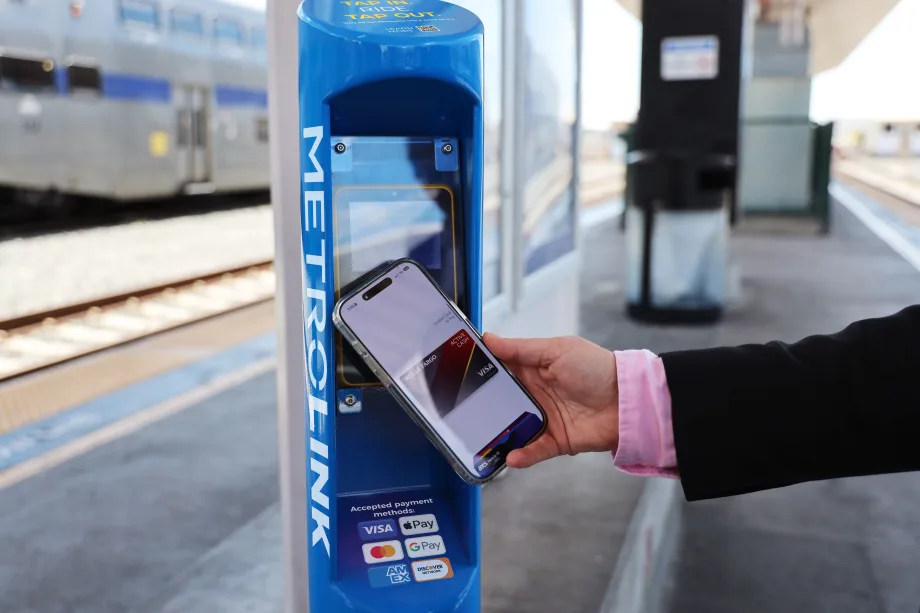
The six-month pilot program offers a convenient, pay-as-you-go option that eliminates the need to visit a ticket machine or download the Metrolink Mobile App to utilize the service.
Metrolink
- Southern California’s Metrolink has introduced contactless payments on the San Bernardino Line and Arrow service to streamline travel for users between Redlands and Los Angeles.
- The six-month pilot program enables riders to use credit/debit cards, mobile wallets, or wearable devices for boarding and exiting, bypassing the need for ticket machines or the mobile app.
- The new system supports integration with LA Metro’s transit, preparing for increased travel demand during FIFA World Cup 2026 events.
*Summarized by AI
Southern California’s Metrolink is making it easier for new, occasional, and visiting riders to use the system by launching contactless payments on the San Bernardino Line and Arrow service.
Customers traveling between Redlands and Los Angeles can now tap their preferred payment method, including a credit or debit card, mobile wallet, or wearable device, at station validators before boarding and again while exiting.
The six-month pilot program offers a convenient, pay-as-you-go option that eliminates the need to visit a ticket machine or download the Metrolink Mobile App to utilize the service.
The launch marks a significant step in modernizing fare payments and advancing a more seamless regional transportation experience ahead of increased travel demand during the FIFA World Cup 2026 matches and festivities, which run through July 19.
Contactless users will also have the option to tap into LA Metro’s transit system, including special bus service to the Los Angeles Stadium (SoFi Stadium) on game days. The county agency rolled out its own contactless payments system last month.
Metrolink’s Fare Payment
The pilot program was developed with support from the Southern California Association of Governments (SCAG) and the California State Transportation Agency (CalSTA) and is part of a broader strategy to make mass transit a more competitive choice for travelers, said officials.
Innovations like contactless payments, which have been shown to increase public transit use and meaningfully reduce vehicle miles traveled, are critical to meeting the state’s ambitious climate and mobility goals, and complement ongoing efforts to advance equity, efficiency, and sustainability at the state and local levels, said California Transportation Secretary Toks Omishakin.
“Contactless payments through the California Integrated Travel Project will simplify the rider experience and make transit an easier option, helping reduce congestion in heavily traveled regions like Southern California,” he said. “With millions of trips expected during FIFA World Cup 2026, making investments in regional systems like Metrolink is more important than ever.”
Distance-Based Fare Payments
During the pilot, contactless payments will operate on a distance-based, pay-as-you-go model.
Customers will be charged based on the stations where they tap on and off, rather than purchasing traditional fare products. Day Passes, Flex Passes, and Monthly Passes are not available through the contactless payment option. Discounts, free transfers, and loyalty points are also not currently supported during the pilot. Accepted payment methods include Visa, Mastercard, Discover, and American Express, as well as Apple Pay and Google Pay.
Metrolink fares are distance-based, with riders charged only for the distance they travel. To provide cost certainty, contactless payment users will never pay more than the price of a SoCal Day Pass in a single day, with daily fare caps set at $15 on weekdays and $10 on weekends. If riders forget to tap out, they will be charged $10.50, the maximum one-way fare for the San Bernardino Line.
Customers must also use the same credit card, debit card, mobile wallet, or wearable device at validators at both ends of their travel. For example, if a rider uses a physical credit card at boarding, they must close the loop by tapping out with that same physical card upon arrival. Combining different payment methods within a single journey will be recorded as two separate, unfinished trips, resulting in two charges at the one-way maximum of $10.50, said officials.
Metrolink officials said the agency will use customer feedback and operational data gathered throughout the pilot period to evaluate future enhancements, “supporting a better, more intuitive user experience.”
Quick Answers
Metrolink has introduced contactless payments for the San Bernardino Line, allowing users to pay via credit/debit card, mobile wallet, or wearable device.
*Summarized by AI
More Technology

From Hardware to Digital Partner: Luminator Charts Its Next Chapter
CEO Magnus Freiberg discusses Luminator’s shift toward becoming a digital partner, the growing importance of software and interoperability, and how AI can help agencies improve operations and passenger experience.
Read More →
Beyond the Checklist: A Structured Approach to Transit Maintenance
Reliability-Centered Maintenance helps transit agencies move beyond routine checklists to focus limited resources on the assets and failures that have the greatest impact on safety, reliability, and service.
Read More →
NJ TRANSIT Advances Bus Technology Upgrades Across Statewide Fleet
More than 1,500 buses now feature upgraded technology designed to improve arrival predictions and provide free Wi-Fi, with deployment expected to reach nearly 2,000 buses by the end of 2026.
Read More →

Building a Flexible Path to Transit Electrification
John Hroncich discusses BAE Systems’ modular and scalable approach, lessons learned from decades of real-world operations, and how agencies can identify electrification strategies that fit their fleets.
Read More →
Biz Briefs: Alstom Lands Canadian Contract, LYT to Supply California TSP, and More
In METRO's latest installment, we take a look at recent news from Complete Coach Works, Beep, FlixBus, and more partnerships making headlines across the transportation sector.
Read More →
From Legacy Silos to Conversational Intelligence
What if transit leaders could ask any operational question and get a trusted answer in seconds? Conversational AI is transforming how agencies use their data.
Read More →
USDOT Announces Rail Vehicle Replacement Grants, Chattanooga AV Shuttle Funding
More than $191 million in federal funding will help three transit agencies replace aging rail vehicles and support a new autonomous shuttle service in Chattanooga.
Read More →
Bus Tech Talk: Keeping Transit Technicians Ahead of the Technology Curve
LA Metro’s Obed Mejia discusses technician training, evolving maintenance technology, fleet replacement, and strategies for getting the most out of today’s transit fleets.
Read More →
Biz Briefs: RIPTA Unveils New Frontrunners, Clevland RTA Adds New Siemens, and More
In METRO's latest installment, we take a look at recent news from Siemens, Prevost, Dodge, and more partnerships making headlines across the transportation sector.
Read More →
Why Simulating Pedestrian Movement Has Become Essential for Modern Rail Stations
Pedestrian microsimulation is helping rail planners identify bottlenecks, test station designs, and prepare complex transit hubs for growing passenger volumes.
Read More →