




RELATED: Consultants address funding, trends
Support for raising Federal gas tax continues to rise, finds Mineta report
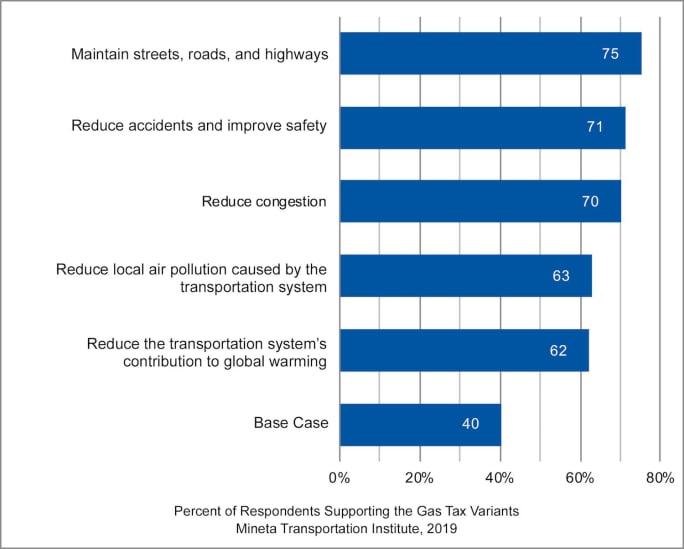
Seventy-five percent of respondents supported a 10¢ increase in the gas tax if the revenue raised is dedicated to maintenance projects.
June 24, 2019
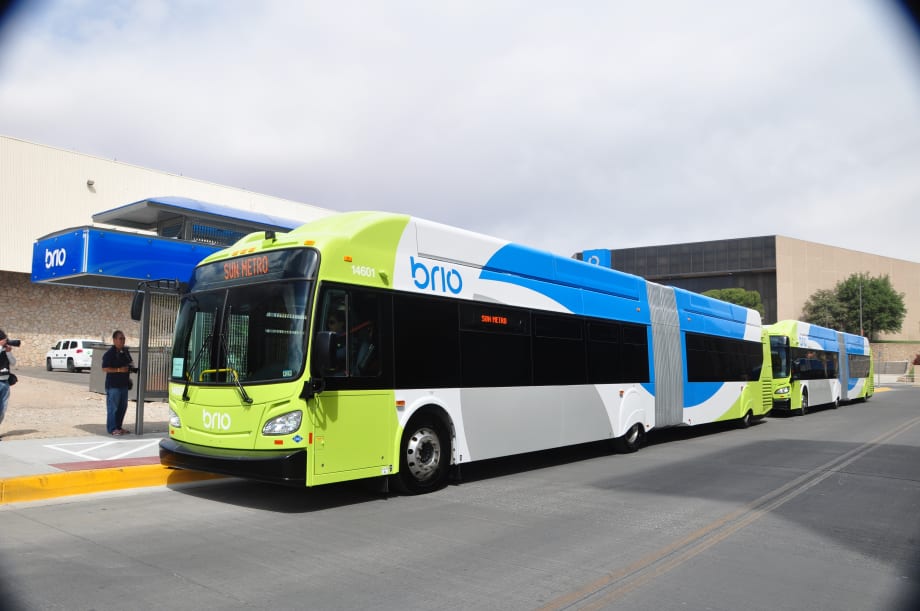
Large majorities value transportation improvements across transportation modes, including spending gas tax revenue for public transit-related projects.
Sun Metro
2 min to read
Large majorities value transportation improvements across transportation modes, including spending gas tax revenue for public transit-related projects.
Sun Metro
The Mineta Transportation Institute released its 10th annual survey exploring public support for raising federal transportation revenues through gas taxes of mileage fees: “What Do Americans Think about Federal Tax Options to Support Transportation? Results from Year Ten of a National Survey.”
“Support for raising the gas tax is largely dependent on how the revenue will be spent,” says Dr. Asha Weinstein Agrawal, one of the study’s authors and director of MTI’s National Transportation Finance Center. “Seventy-five percent of respondents supported a 10¢ increase in the gas tax if the revenue raised is dedicated to maintenance projects, but only 40% support the same increase if the money is used more generally to maintain and improve the transportation system.” (See Figure.)
Five of the same gas tax options have been tested each year to assess trends. Study co-author Dr. Hilary Nixon noted that in every case support has risen since 2010, with an increase for each of 13 percentage points or more.
Other key 2019 findings include:
Large majorities value transportation improvements across transportation modes, including spending gas tax revenue for road and public transit-related projects.
People do not have an accurate understanding of how much they pay in federal gas taxes. For example, 19% of respondents thought the federal gas tax rate is at least 76¢ per gallon, far higher than the current rate of 18.4¢ per gallon.
People would prefer to pay a mileage fee each time they buy fuel or charge an electric vehicle, rather than being billed monthly or annually.
People hold nuanced views on mileage fees with respect to equity and privacy
Linking transportation taxes to environmental objectives can increase support.
“We face growing needs across our transportation system, but funding hasn’t kept pace,” says Dr. Agrawal. “To solve this dilemma, we must either lower our goals for system maintenance and improvements, or raise new revenues.”
To view the full report, click here.
More Management

METRO Opens Submissions for 2026 Motorcoach Awards
Nominations are now being accepted for METRO Magazine’s Operator of the Year and Innovative Operator of the Year awards.
Read More →
New York MTA Advances Final Contract for Second Avenue Subway Expansion
Contract Four is the largest in the Second Avenue Subway Phase 2 project and includes construction of station infrastructure, tracks, and signals for the subway expansion, MTA officials said. Work on Contract Four will begin in 2027.
Read More →
Transit Agencies Highlight Safety Gains at National Summit
Leaders from 15 major transit systems shared crime-reduction results and safety initiatives while discussing the role of continued federal support.
Read More →

NITA Names New Leadership, Expands Reduced-Fare Program at First Board Meeting
The new regional transit authority appointed its first board chair and interim executive director while extending reduced fares across CTA, Metra, and Pace for eligible riders.
Read More →
Beyond the Checklist: A Structured Approach to Transit Maintenance
Reliability-Centered Maintenance helps transit agencies move beyond routine checklists to focus limited resources on the assets and failures that have the greatest impact on safety, reliability, and service.
Read More →
APTA 2026 Nominating Committee Selects Leadership Slate, Names Chair and Vice Chair Nominees
Leadership changes will help shape the association’s priorities and its representation of the transportation industry during the 2026–2027 term.
Read More →
DART Launches Major Security, Fare Enforcement Initiative
The 90-day demonstration will deploy coordinated security teams at five light rail stations while testing controlled access and gathering data to guide future investments.
Read More →
Sponsored•September 9, 2026
Advancing Fare Collection Through Technology and Innovation
Learn about delivering 1300 gates at 91 stations while managing fare evasion. Explore the large scale deployment, solution customization and real-world results that affect the region. Prepare for deployment in your region now.
Read More →
Game Day in Motion: Moving Millions During the 2026 World Cup
Between packed transit stations and team motorcoaches, see how agencies and operators across North America tackled the transportation demands of the 2026 FIFA World Cup.
Read More →
Surface Transportation Extension Averts Shutdown, Leaves Transit Funding Gap
The stopgap keeps federal transportation programs moving, but missing advance funding could complicate the transit and rail projects agencies are planning next.
Read More →