



Technology, shifts in behavior can improve urban transportation: report
Respondents around the globe chose "driving their own car" over other modes of transport for reasons including comfort (54%), ease of access (47%), and reliability (39%).

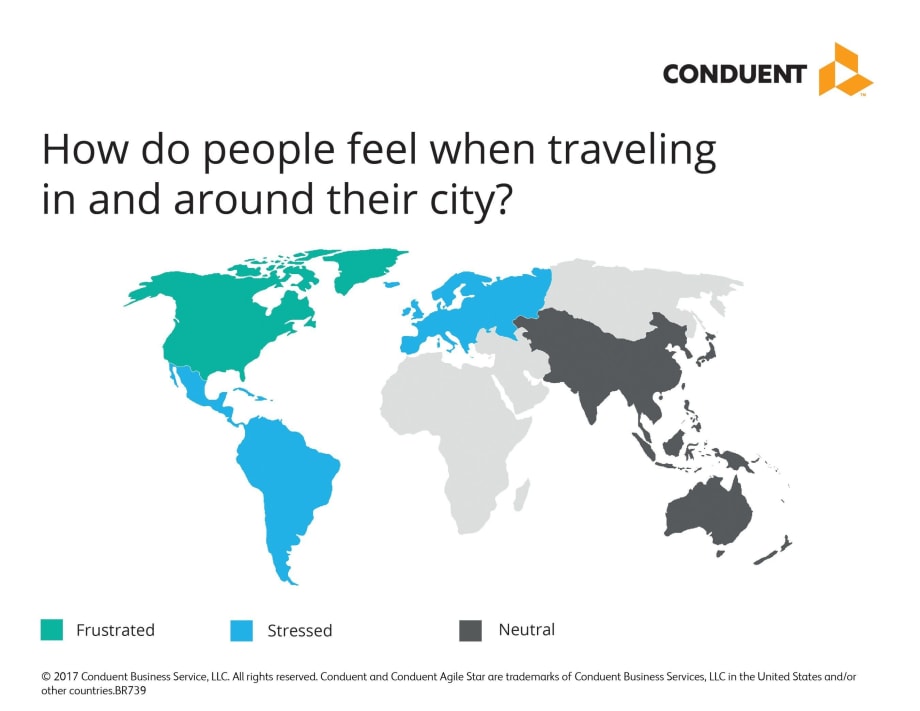
Nearly 40% of all respondents reported the negative emotions of 'stressed.'Graphic: Conduent
Nearly 40% of all respondents reported the negative emotions of 'stressed.'Graphic: Conduent
Traffic and congestion remain a major focus issue for cities worldwide. While new technologies, updated infrastructure, and expanded mobility choices are surfacing to ease the hassle of traveling within urban areas, the biggest factor in improving urban travel is changing human behavior. This is according to Conduent's Customer Experience of Urban Travel report — an extensive survey of mobility trends and preferences conducted in 23 cities across 15 countries.
"Transportation is an inherently personal decision. People primarily focus on their individual situation, factoring in speed, comfort, and cost when determining how they'd like to travel," said Don Hubicki, executive VP, Conduent, Public Sector, Transportation. "Providing more choices in line with our personal situations is key to changing behavior. For example, cities should introduce more options for getting around, incentivize people to choose alternatives, and provide innovative apps that enable people to think mode-agnostically, making better decisions for themselves and everyone else."
Transportation Choice Isn't Rational
Respondents around the globe chose "driving their own car" over other modes of transport for reasons including comfort (54%), ease of access (47%), and reliability (39%).
However, driving is the mode of transportation cited most as involving frequent delays when travelling in and around the city1. Respondents experiencing delays at least one day a week shared that delays cause them to miss out on time with their family and friends (61% sometimes/frequently) or arrive late to work (51% sometimes/frequently).
Furthermore, delays may be a large contributor to stress and frustration. Nearly 40% of all respondents reported the negative emotions of "stressed" (23%), or "frustrated" (16%) to describe how travel in and around their city makes them feel.
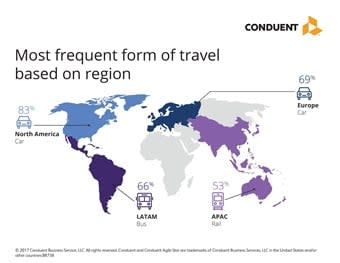
Respondents around the globe chose "driving their own car" over other modes of transport for reasons including comfort (54%), ease of access (47%) and reliability (39%). Graphic: Conduent
Despite this experience with delays, people still choose to drive, signaling that transportation decisions are influenced heavily by habits, convenience, and personal preferences influenced by factors such as infrastructure, culture, and demographics.
Enabling Multimodal Travel
"People's preferred travel choices aren't always best for their communities. It's time to think beyond transportation silos and present alternative options to create a better, more seamless travel experience," said Hubicki. "Despite an over-reliance on cars, our survey shows more than half of respondents find the proposition of a multimodal experience appealing."
Multimodal systems allow commuters to use more than one mode of transportation per journey. For example, someone might choose to ride a bus to the nearest train station, then take the train to their destination. This system provides greater travel flexibility and helps solve the "first-mile, last-mile" problem.
Making a multimodal system a reality requires urban planners to look for levers that can drive change, such as speed and reliability of services, education, and information. Respondents rated reliability of services (83%) and information (81 percent) as fairly or very important for future travel. In addition, nearly three-quarters of respondents (70%) said they'd likely be encouraged to ride public transit more frequently if the journey time was faster.
Transportation Innovation is Key
Another step cities can take to show progress toward delivering an innovative solution that eases travel woes is to roll out travel apps showing all available modes and routes for commuters to reach their destination.
Nearly half (49%) of all respondents believe they will have one app for their transportation needs by 2020. Conduent debuted its own unique mobility apps in 2016 integrated into the core of Transit and Parking Systems. Pilot program versions of these mobility apps are currently in use in Los Angeles, Denver, Centennial, Colo., and Bengaluru, India.
Additionally, Syndicat Mixte Intermodal Regional de Transports (SMIRT), a grouping of transport authorities in northern France, has become the first to deploy the Conduent Mobility Companion Platform to modernize the passenger experience with door-to-door multimodal trip planning.
"The future of transportation is a combination of what's possible and what's needed," said Hubicki. "People often don't know there's a better way, so when they imagine the future, they're limited by their current experiences and perceptions of travel. There is an opportunity to educate and show the way forward."
Conduent is a provider of public transportation and mobility solutions — including electronic toll collection, transit and public transport, parking and safety.
1 According to survey respondents, 10% of those who drive at least one day a week say they experience delays on six to seven days.
More New Mobility

From Hardware to Digital Partner: Luminator Charts Its Next Chapter
CEO Magnus Friberg discusses Luminator’s shift toward becoming a digital partner, the growing importance of software and interoperability, and how AI can help agencies improve operations and passenger experience.
Read More →
Biz Briefs: Alstom Lands Canadian Contract, LYT to Supply California TSP, and More
In METRO's latest installment, we take a look at recent news from Complete Coach Works, Beep, FlixBus, and more partnerships making headlines across the transportation sector.
Read More →
CharterUP’s Armir Harris on Technology, AI, and the Future of Group Mobility
In a recent episode of METROspectives, CharterUP Founder/CEO Armir Harris discussed the company’s evolution from an online charter bus marketplace into a technology platform supporting public- and private-sector mobility and much more.
Read More →
Jacksonville’s NAVI Project Charts a New Course for Autonomous Public Transportation
Through its NAVI program, JTA is showing how autonomous vehicles, intelligent infrastructure, and coordinated operations can work together to deliver everyday public transportation.
Read More →
Biz Briefs: Luminator Marks Milestone and More
From manufacturers and suppliers to transit agencies and motorcoach operators, these updates offer a snapshot of the projects, partnerships and business moves driving the industry forward.
Read More →
New Tricks for Old Bureaucracies: Joshua Schank on Making Transit Innovation Stick
Former LA Metro Chief Innovation Officer Joshua Schank discusses why good ideas aren't enough, how transit agencies can overcome resistance to change, and why today's challenges demand more innovation.
Read More →
How DART's GoPass Is Redefining Regional Mobility
Serving 14 transit agencies, GoPass simplifies multimodal travel by allowing riders to plan, pay for, and manage an entire trip through one app.
Read More →
Biz Briefs: OCTA Taps Clean Energy for Hydrogen Station, Stadler to Supply Via Rail Vehicles, and More
From manufacturers and suppliers to transit agencies and motorcoach operators, these updates offer a snapshot of the projects, partnerships and business moves driving the industry forward.
Read More →CharterUP Expands Into New Mobility and Autonomous Transportation
Vice President of New Mobility Stephen Joos discusses how CharterUP is leveraging its nationwide transportation network, technology platform, and autonomous vehicle partnerships to expand into workforce mobility, campus shuttles, and transit solutions.
Read More →
METRO Magazine Announces 2026 Innovative Solutions Awards Winners
Projects Recognized for Advancing Mobility Through Technology, Accessibility, Workforce Innovation, and Operational Excellence
Read More →