




RELATED: Calif. consortium to deploy 20 fuel-cell electric buses
Toyota delivers first fuel-cell bus to Tokyo
The company plans to introduce over 100 fuel cell buses mainly within the Tokyo area, ahead of the Tokyo 2020 Olympic and Paralympic Games.
February 27, 2017
Toyota
2 min to read
Toyota
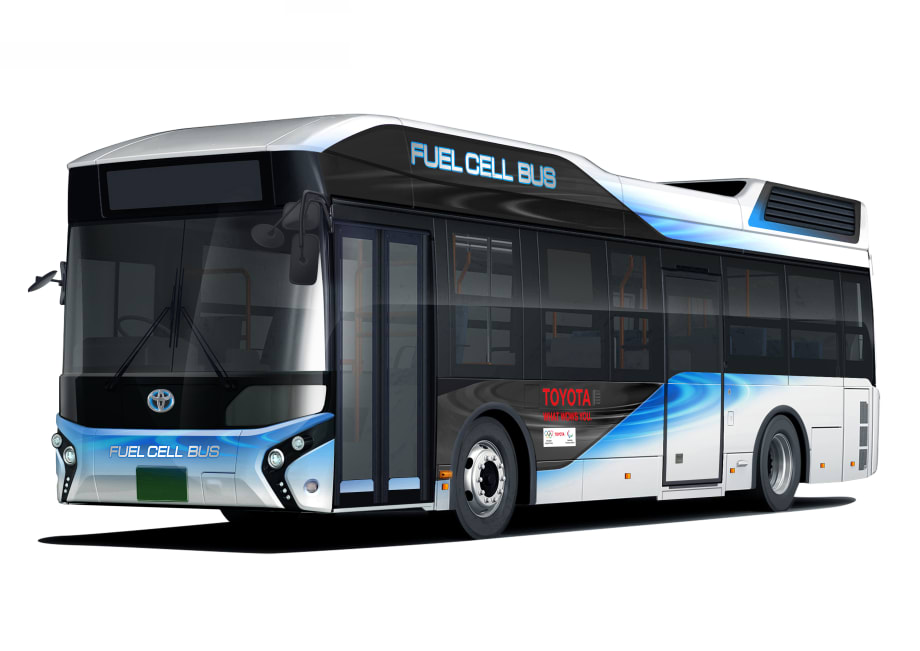
Toyota Motor Corp. delivered the first fuel cell bus (FC bus) sold under the Toyota brand to the Bureau of Transportation of the Tokyo Metropolitan Government. The Toyota FC Bus, as it is named, will be put into operation as a Toei route bus in March along with a second bus that is scheduled for delivery in the same month.
Toyota plans to introduce over 100 FC buses mainly within the Tokyo area, ahead of the Tokyo 2020 Olympic and Paralympic Games. The increased use of FC buses in urban areas is expected to help raise the level of understanding by the general public regarding the use of FC buses as a form of public transportation, according to the company.
The Toyota Fuel Cell System (TFCS)1, which was developed for the Mirai fuel cell vehicle (FCV), has been adopted to provide better energy efficiency in comparison with internal combustion engines, as well as to deliver superior environmental performance with no CO2 emissions or Substances of Concern (SoC) emitted when driving. In addition, the FC Bus is compliant with Non-Step Standards2, making for easy boarding and exiting by elderly people and young children.
The bus also uses a high-capacity external power supply system. With a power supply capable of a 9 kW3 maximum output, and a large capacity of electricity supply at 235 kWh4, the FC bus can be used as a power source in the event of disasters, such as at evacuation sites such as in school gymnasiums5 or, its electricity supply can also be harnessed for home electric appliance use.
1 A system combining hybrid technology with fuel cell technology composed of Toyota FC stacks and high pressure hydrogen tanks etc.
2 Barrier-free buses that satisfy the Standard Specification Non-Step Bus Certification Guidelines specified by the Ministry of Land, Infrastructure, Transport and Tourism.
3 Possible electric power varies depending on the performance of the power supply unit.
4 After DC/AC conversion by power supply unit. Power supply capacity varies according to power supply unit conversion efficiency, amount of remaining hydrogen and power consumption.
5 Requires wiring work at the facilities.
More Technology

From Hardware to Digital Partner: Luminator Charts Its Next Chapter
CEO Magnus Friberg discusses Luminator’s shift toward becoming a digital partner, the growing importance of software and interoperability, and how AI can help agencies improve operations and passenger experience.
Read More →
Beyond the Checklist: A Structured Approach to Transit Maintenance
Reliability-Centered Maintenance helps transit agencies move beyond routine checklists to focus limited resources on the assets and failures that have the greatest impact on safety, reliability, and service.
Read More →
NJ TRANSIT Advances Bus Technology Upgrades Across Statewide Fleet
More than 1,500 buses now feature upgraded technology designed to improve arrival predictions and provide free Wi-Fi, with deployment expected to reach nearly 2,000 buses by the end of 2026.
Read More →

Building a Flexible Path to Transit Electrification
John Hroncich discusses BAE Systems’ modular and scalable approach, lessons learned from decades of real-world operations, and how agencies can identify electrification strategies that fit their fleets.
Read More →
Biz Briefs: Alstom Lands Canadian Contract, LYT to Supply California TSP, and More
In METRO's latest installment, we take a look at recent news from Complete Coach Works, Beep, FlixBus, and more partnerships making headlines across the transportation sector.
Read More →
Sponsored•September 8, 2026
From Legacy Silos to Conversational Intelligence
What if transit leaders could ask any operational question and get a trusted answer in seconds? Conversational AI is transforming how agencies use their data.
Read More →
USDOT Announces Rail Vehicle Replacement Grants, Chattanooga AV Shuttle Funding
More than $191 million in federal funding will help three transit agencies replace aging rail vehicles and support a new autonomous shuttle service in Chattanooga.
Read More →
Bus Tech Talk: Keeping Transit Technicians Ahead of the Technology Curve
LA Metro’s Obed Mejia discusses technician training, evolving maintenance technology, fleet replacement, and strategies for getting the most out of today’s transit fleets.
Read More →
Biz Briefs: RIPTA Unveils New Frontrunners, Clevland RTA Adds New Siemens, and More
In METRO's latest installment, we take a look at recent news from Siemens, Prevost, Dodge, and more partnerships making headlines across the transportation sector.
Read More →
Why Simulating Pedestrian Movement Has Become Essential for Modern Rail Stations
Pedestrian microsimulation is helping rail planners identify bottlenecks, test station designs, and prepare complex transit hubs for growing passenger volumes.
Read More →