



U.S. DOT makes $199M available for PTC implementation
The grants, which will be selected by the FRA and awarded and administered by the FTA, will help commuter railroads implement PTC, which prevents accidents and saves lives.

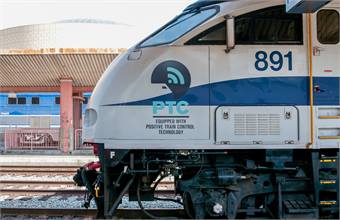
The U.S. Department of Transportation announced it will accept applications for $199 million in competitive grant funding for Positive Train Control (PTC) implementation.
The grants, which will be selected by the Federal Railroad Administration (FRA) and awarded and administered by the Federal Transit Administration (FTA), will help commuter railroads implement PTC, which prevents accidents and saves lives.
“With more passengers depending on rail for transportation, Positive Train Control is needed more than ever,” said U.S. Transportation Secretary Anthony Foxx. “I encourage all commuter railroads to take full advantage of this opportunity to invest in the most important rail safety technology in more than a century.”
Congress authorized the funding in the Fixing America’s Surface Transportation (FAST) Act, and the funding is available for Fiscal Year (FY) 2017. PTC technology can prevent certain train-to-train collisions, overspeed derailments, incursions into established work zones and trains routed to the wrong tracks because a switch was left in the wrong position.
“This funding will get us a bit closer to activating Positive Train Control on some of the most important railroads in the country that transport millions of passengers to their jobs each morning and to their families each night,” said FRA Administrator Sarah E. Feinberg. “We urge railroads to submit strong applications that make these dollars go as far as possible, and we remain hopeful that Congress will act on the President’s request for more funding to make PTC a reality as quickly as possible.”
In 2008, Congress mandated PTC implementation on certain railroad main lines where railroads transport poisonous-by-inhalation (PIH), or toxic-by-inhalation (TIH), hazardous materials, or any line where a railroad provides regularly scheduled passenger service. Last October, Congress extended the original deadline from December 31, 2015, to at least December 31, 2018.
The President has consistently made funding and assistance for commuter railroads to implement PTC a priority. In his FY 2017 budget request, the President requested $1.25 billion. This follows requests of $825 million in both FY 2015 and FY 2016.
To view a list of when railroads predict that they will achieve full PTC implementation, click here.
More Rail

New York MTA Advances Final Contract for Second Avenue Subway Expansion
Contract Four is the largest in the Second Avenue Subway Phase 2 project and includes construction of station infrastructure, tracks, and signals for the subway expansion, MTA officials said. Work on Contract Four will begin in 2027.
Read More →
San Diego MTS Breaks Monthly Trolley Ridership Record
Agency officials said July’s ridership indicates MTS’s continued recovery from the pandemic.
Read More →
Report Examines NJ TRANSIT Reliability, Funding Challenges
The Garden State Initiative analysis examines the roles of Amtrak infrastructure, fleet management, and agency operations while recommending a more performance-based approach to improving reliability.
Read More →
Stadler, CapMetro Sign Long-Term Rail Fleet Support Agreement
Beginning in 2027, Stadler will provide on-site technical expertise, spare parts support, training, and obsolescence management to help extend the reliability and longevity of CapMetro’s GTW fleet.
Read More →
Biz Briefs: Alstom Lands Canadian Contract, LYT to Supply California TSP, and More
In METRO's latest installment, we take a look at recent news from Complete Coach Works, Beep, FlixBus, and more partnerships making headlines across the transportation sector.
Read More →
CATS Gold Line Marks 5 Years of Service, 2.8M Passenger Trips
With a six-mile expansion planned, the Charlotte streetcar is positioned to connect more neighborhoods and major transit hubs across the region.
Read More →
Why Simulating Pedestrian Movement Has Become Essential for Modern Rail Stations
Pedestrian microsimulation is helping rail planners identify bottlenecks, test station designs, and prepare complex transit hubs for growing passenger volumes.
Read More →
Amtrak Begins Major Construction at New York’s Sunnyside Yard
The new maintenance facility will support Amtrak’s Airo trainsets while improving maintenance efficiency and turnaround times in New York.
Read More →
Chicago Leaders Unveil Plans for O’Hare Airport Express Train
The privately developed project would offer a 15-minute trip between downtown and O’Hare’s Terminal 2, with trains operating every 15 minutes on a dedicated track. The service would use battery-electric trains and three existing freight rail rights-of-way.
Read More →
OCTA Maps Out 30-Year Strategy to Protect Coastal Rail Corridor
The draft feasibility report identifies strategies to protect the coastal rail line for decades as the agency continues near-term stabilization and sand placement efforts.
Read More →