



UT Profile: Princeton's Tiger Transit key to sustainability efforts
The transportation system operates on a fixed-route schedule. The university contracted with First Transit to provide safe, convenient and reliable transportation throughout the Princeton campus and surrounding community.

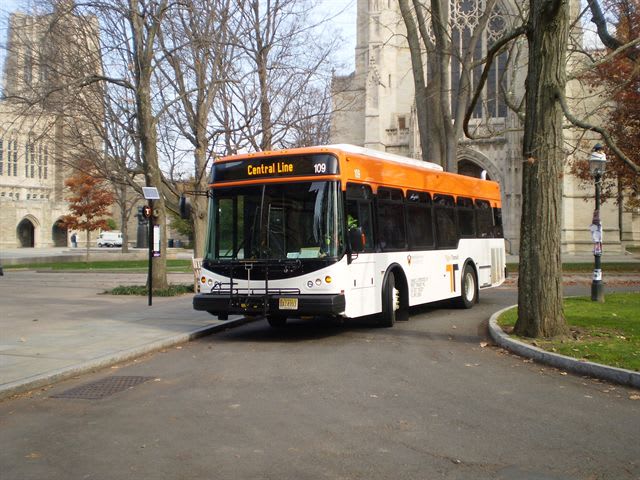
The Tiger Transit fleet consists 10, 30-foot El Dorado National EZ Rider IIs, four Starcraft Allstar XLs and four Champion Bus Challengers. The buses run on B20 biodiesel fuel.
[IMAGE]Princeton-2.jpg[/IMAGE]In 2006, Princeton University recognized that its campus shuttle system would not be sufficient to meet the growing mobility needs and long-term sustainability goals of the university's community. The shuttle system, which consisted of three routes developed incrementally over a five year period, marked its conclusion in 2008 and, on Jan. 5, 2009, Princeton launched TigerTransit, a new integrated campus transit system, featuring new routes, new environmentally friendly buses and a new service provider.
Princeton University's TigerTransit transportation system operates on a fixed-route schedule. The university contracted with First Transit to provide safe, convenient and reliable transportation throughout the Princeton campus and surrounding community.
"The TigerTransit transportation system offers improved service levels, including connections to the main campus' academic and administrative buildings from faculty, staff and graduate students housing locations; useful service to undergraduates; and service to off-campus locations including the Forrestal Campus, Princeton Plasma Physics Lab, and Millstone Apartments in support of the university's campus and sustainability plans," explained Kim Jackson, director, Transportation and Parking Services, for Princeton.
The TigerTransit system also integrated a route previously run by and for the independent Princeton Theological Seminary. The route transports seminary students, faculty and staff from their apartment complex in West Windsor, N.J. to the campus in Princeton. Inclusion of the seminary route reduces redundancy and fosters a greater partnership between the university and the seminary, allowing students of both institutions to better co-mingle, added Jackson.
The Tiger Transit fleet consists 10, 30-foot El Dorado National EZ Rider IIs, four Starcraft Allstar XLs and four Champion Bus Challengers. The buses run on B20 biodiesel fuel, demonstrating the university's commitment to sustainability by reducing carbon dioxide emissions.
"TigerTransit is a core component of Transportation and Parking Services' multiple Transportation Demand Management (TDM) programs that offers alternative transportation options for staff and faculty who commute to and from campus," Jackson said. "The system supports employees' participation in a mass transit subsidy program, car and van pools, and those who walk or bike to campus."
The new buses also feature increased seating capacity from the previous fleet, low floors with full accessibility and a rear access wheelchair ramp with capacity on the vehicle for two wheelchairs.
Each bus also has a front rack for two bicycles, light-emitting diode (LED) signage on the front and sides for better visibility at night, and all buses are equipped with a Web-based GPS tracking system "TigerTracker," providing riders real-time notification of bus location and service disruptions.
"The ability to communicate weather emergency changes to the system or traffic patterns disruptions/adjustments affecting the routes is invaluable," said Jackson.
[IMAGE]Princeton2-2.jpg[/IMAGE]Since graduate student housing complexes are not as centralized on the main campus as undergraduate dormitories, TigerTransit's largest ridership is the graduate student population, said Jackson, with the service providing transportation to those students from their university housing locations to academic buildings.
Meanwhile, faculty and staff are transported from parking facilities located outside of campus core to administrative and academic locations.
Tiger Transit's routes, which were designed to provide transit service to areas previously underserved, help eliminate the need for students to have vehicles and faculty and staff to drive to meeting locations on campus. Other TigerTransit services include stops with connections to New Jersey Transit and the Princeton Borough FreeB shuttle, service to local shopping centers, an on-demand service and extended hours. Multi-line TigerTransit stops also provide transfers from one line to another.
Tiger Transit is part of Princeton's Sustainability Plan, adopted in February 2008 to help the university continue to make significant progress toward its goals in the areas of greenhouse gas emissions reduction; resource conservation; and research, education and civic engagement.
In the fall of 2009, the Transportation and Parking Services produced a brochure titled, "Going Places: A Car Free Guide to Princeton University." The brochure, mailed to all incoming freshmen and new graduate students, distributed to various campus offices as well as during orientations, provides information on alternative modes of transportation on campus and surrounding areas and supports the university's sustainability efforts and promotes TigerTransit as the main campus transportation system, explained Jackson.
"The university has committed to reducing its carbon dioxide emissions to 1990 levels by 2020 through direct local reductions with no purchase of market 'offsets,'" she said. "Transportation initiatives are an important part of the university's overall goals to reduce greenhouse gas emissions."
METRO Editor: This is the first in a series of University Transit profiles (UT Profile), that will be featured on our website and in our University Transit E-Newsletter. If you would like to see a profile of your university transit system here, send your information to info@metro-magazine.com.
More Bus

New York MTA Plans Largest Bus Fleet Upgrade in More Than a Decade
The agency is seeking manufacturers for 650 new CNG buses to replace aging vehicles, improve reliability, and advance its broader fleet modernization strategy.
Read More →
Building a Flexible Path to Transit Electrification
John Hroncich discusses BAE Systems’ modular and scalable approach, lessons learned from decades of real-world operations, and how agencies can identify electrification strategies that fit their fleets.
Read More →
Bus Tech Talk: Keeping Transit Technicians Ahead of the Technology Curve
LA Metro’s Obed Mejia discusses technician training, evolving maintenance technology, fleet replacement, and strategies for getting the most out of today’s transit fleets.
Read More →
Biz Briefs: RIPTA Unveils New Frontrunners, Clevland RTA Adds New Siemens, and More
In METRO's latest installment, we take a look at recent news from Siemens, Prevost, Dodge, and more partnerships making headlines across the transportation sector.
Read More →
People Movement: Holly Arnold Joins Transdev and More
In this edition, we also cover recent appointments and announcements at Pace, CamTran, MCI, and more, showcasing the individuals helping to shape the future of transportation.
Read More →
The High Cost of Transit Buses: Industry Leaders Look to Procurement Reform
Transit leaders and policymakers examine how standardized bus designs, streamlined procurement, and predictable funding could help agencies stretch budgets and deliver better service.
Read More →
The Business Voice Behind Public Transportation
As chair of APTA’s Business Members Board of Governors, Ray Melleady explains how more than 850 business members are partnering with transit agencies to advance funding, innovation, and industry-wide collaboration.
Read More →
From Surviving to Thriving: Building Stronger Transportation Organizations
Bus Business Consultants founder Brian Dickson shares lessons on leadership, organizational health, and creating options for long-term success in a changing transportation industry.
Read More →
Finding the ‘Happy Medium’: Optimizing Maintenance Without Sacrificing Reliability
The key to maintenance optimization isn’t doing less work—it’s doing the right work at the right time on the right assets.
Read More →
LA Metro, City of West Hollywood, and Partners Advance Smarter Bus Lane Enforcement
The award-winning partnership combines AI-powered detection with human oversight to improve bus reliability, accessibility, and enforcement efficiency.
Read More →