



Virgin Hyperloop, AECOM, CDOT advances feasibility study
The study has developed an initial design concept for first hyperloop portal (station) located near the Denver International Airport at 72nd and Himalaya.


Hyperloop will complement existing forms of transportation and will integrate seamlessly with the transport ecosystem.
Photos courtesy Virgin Hyperloop One

Hyperloop will complement existing forms of transportation and will integrate seamlessly with the transport ecosystem.
Photos courtesy Virgin Hyperloop One
Virgin Hyperloop One, the Colorado Department of Transportation (CDOT), and AECOM are advancing to the second half of the Rocky Mountain Hyperloop feasibility study. Late last year, CDOT and Virgin Hyperloop One, working with AECOM, kicked off the hyperloop study, which will examine the technological and economic feasibility of a hyperloop transportation system in Colorado, based on an initial concept presented to Virgin Hyperloop One by CDOT and AECOM in 2016.
"The partnership between Virgin Hyperloop One and CDOT is an exciting one" said Amy Ford, chief of advanced mobility for CDOT. "We have received some very positive feedback from interested Colorado stakeholders during and following our outreach event. To me it's apparent that Colorado citizens are interested in the safety and mobility benefits a hyperloop system could bring to Colorado."
The study has developed an initial design concept for first hyperloop portal (station) located near the Denver International Airport at 72nd and Himalaya. The study will analyze multiple potential alignments to link this central point of connectivity across the Front Range, as well as the mountain resorts.
“Colorado has it all, from booming sectors in aerospace, technology and renewable energy to the Rockies’ natural splendor,” said Rob Lloyd, CEO of Virgin Hyperloop One. “With so many drawn to the state, hyperloop will enable efficient, fast, effortless connections that link Coloradans across city limits to work, live, and play.”
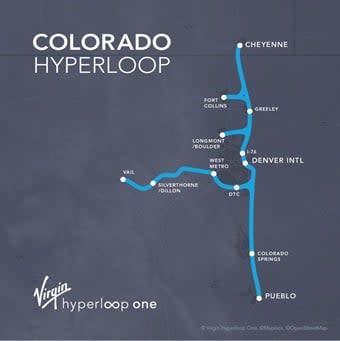
Hyperloop is a new ultra-high-speed mode of transportation that moves freight and people quickly, safely, on-demand and direct from origin to destination. Hyperloop will complement existing forms of transportation and will integrate seamlessly with the transport ecosystem. In a hyperloop, passengers or cargo pods accelerate gradually via electric propulsion through a low-pressure tube. The pod quickly lifts above the track using magnetic levitation and glides at airline speeds for long distances due to ultra-low aerodynamic drag. Last year, Virgin Hyperloop One set a historic test speed record of nearly 240 miles per hour during its third phase of testing at DevLoop, the world’s first full-system hyperloop test site located in North Las Vegas.
The hyperloop will differ from other fixed guideway modes of transportation by offering on-demand solutions and no fixed schedule. Passengers will be able to depart as soon as they arrive. The system will be dynamic with the ability to deploy pods based on up-to-the-second data points that continually optimize departures and arrivals. The hyperloop portal will also integrate seamlessly with existing transportation modes like the RTD A line.
Virgin Hyperloop One, in partnership with AECOM, released an architectural rendering of the portal, located at the Denver International Airport, which features a public gathering plaza as well as subterranean, green-roof infrastructure that integrates into the landscape, and emerging smart city developments.
“Through our partnership with Virgin Hyperloop One and the Colorado Department of Transportation, we are defining the next generation of infrastructure and transportation systems to addresses the shifting way people and freight need to move,” said Travis Boone, an executive VP at AECOM. “The Rocky Mountain Hyperloop showcases how we imagine, partner, and innovate to help define mobility of the future.”
In addition to technical and economic aspects, the study will offer multiple opportunities for additional partners and stakeholders, such as local governments, businesses, and community groups to become part of this venture and to help make hyperloop a reality in Colorado.
More Technology

From Hardware to Digital Partner: Luminator Charts Its Next Chapter
CEO Magnus Friberg discusses Luminator’s shift toward becoming a digital partner, the growing importance of software and interoperability, and how AI can help agencies improve operations and passenger experience.
Read More →
Beyond the Checklist: A Structured Approach to Transit Maintenance
Reliability-Centered Maintenance helps transit agencies move beyond routine checklists to focus limited resources on the assets and failures that have the greatest impact on safety, reliability, and service.
Read More →
NJ TRANSIT Advances Bus Technology Upgrades Across Statewide Fleet
More than 1,500 buses now feature upgraded technology designed to improve arrival predictions and provide free Wi-Fi, with deployment expected to reach nearly 2,000 buses by the end of 2026.
Read More →

Building a Flexible Path to Transit Electrification
John Hroncich discusses BAE Systems’ modular and scalable approach, lessons learned from decades of real-world operations, and how agencies can identify electrification strategies that fit their fleets.
Read More →
Biz Briefs: Alstom Lands Canadian Contract, LYT to Supply California TSP, and More
In METRO's latest installment, we take a look at recent news from Complete Coach Works, Beep, FlixBus, and more partnerships making headlines across the transportation sector.
Read More →
From Legacy Silos to Conversational Intelligence
What if transit leaders could ask any operational question and get a trusted answer in seconds? Conversational AI is transforming how agencies use their data.
Read More →
USDOT Announces Rail Vehicle Replacement Grants, Chattanooga AV Shuttle Funding
More than $191 million in federal funding will help three transit agencies replace aging rail vehicles and support a new autonomous shuttle service in Chattanooga.
Read More →
Bus Tech Talk: Keeping Transit Technicians Ahead of the Technology Curve
LA Metro’s Obed Mejia discusses technician training, evolving maintenance technology, fleet replacement, and strategies for getting the most out of today’s transit fleets.
Read More →
Biz Briefs: RIPTA Unveils New Frontrunners, Clevland RTA Adds New Siemens, and More
In METRO's latest installment, we take a look at recent news from Siemens, Prevost, Dodge, and more partnerships making headlines across the transportation sector.
Read More →
Why Simulating Pedestrian Movement Has Become Essential for Modern Rail Stations
Pedestrian microsimulation is helping rail planners identify bottlenecks, test station designs, and prepare complex transit hubs for growing passenger volumes.
Read More →