



Web Extra: Sound Transit commences Univ. of Washington tunneling project
University Link will extend the region's first modern light rail system by about three miles and serve an estimated 70,000 additional daily riders in one of the most densely populated areas of the university and the nation.

Courtesy of Sound Transit
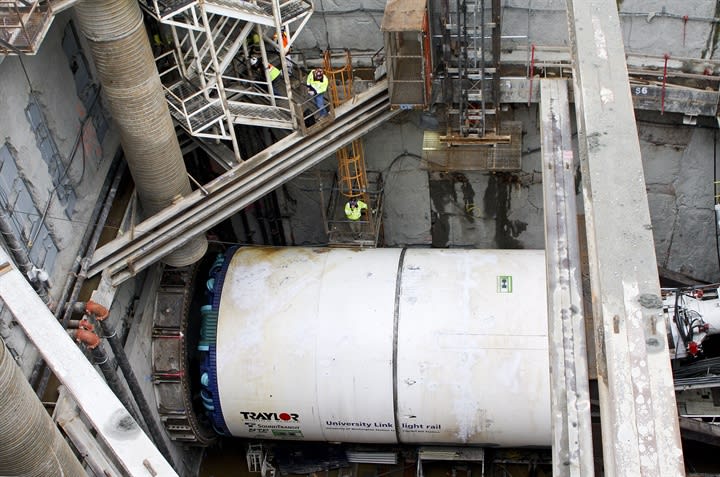
[IMAGE]UWS-TBMLaunch-TBM-5-11-2.jpg[/IMAGE]Last week, Sound Transit dedicated the first of the three tunnel boring machines that will dig twin tunnels from the University of Washington (UW) to downtown Seattle as part of the transit system's University Link light rail extension.
"We're a couple of years into construction, but this marks a huge milestone of getting the tunnel boring machines in place and ready to go," said Bruce Gray spokesman for Sound Transit.
University Link will extend the region's first modern light rail system by about three miles and serve an estimated 70,000 additional daily riders in one of the most densely populated areas of the university and the nation.
"The station will be right next to Husky Stadium and the university's medical center," explained Bob Roseth, director, news and information, at UW. "Half of the university's activity is concentrated on what is called south campus, so it's a key destination point for lots and lots of people, not just students."
Roseth added that on any given day, UW can have up to 75,000 people on campus including students, faculty, staff and visitors. He also said that the University Link will be beneficial for those going to Husky Stadium for football games.
When complete, it will take six minutes to get from Husky Stadium to downtown Seattle via Link. Riders can also transfer downtown to reach Sea-Tac Airport.
University Link will provide a reliable option for drivers and transit users who are stuck on Interstate 5, a facility that operates over capacity for up to eight hours a day, with vehicle speeds running between 15 mph and 35 mph, according to Sound Transit.
With UW focused on lowering its economic footprint and use of single occupancy vehicles, it has been a long-time supporter of public transit to campus and worked in tandem with Sound Transit to help the project become a success, explained Roseth.
"The issue for us has been sighting of the stations," he added. "We also have a lot of high-end research going on here that uses very sensitive equipment, so we had extensive discussions, and productive ones, that were ultimately satisfying in terms of the sighting of the station, routing of the lines and digging of the tunnels."
[IMAGE]UWS-TBM-Launch-diplomats-banner-2.jpg[/IMAGE]The population of the corridor served by University Link is expected to increase by a projected 56 percent by 2030, further increasing congestion and the need for fast, reliable light rail service. Based on its benefits, the University Link project received the highest possible FTA ranking in the extremely competitive federal funding process, Gray explained.
The University Link extension is expected to be completed in 2016. An additional light rail project that will provide transportation to the north side of campus, which voters approved in 2008, is in the works with UW and Sound Transit continuing to work together to achieve the proper alignment. That extension is expected to open by 2021.
More Rail

New York MTA Advances Final Contract for Second Avenue Subway Expansion
Contract Four is the largest in the Second Avenue Subway Phase 2 project and includes construction of station infrastructure, tracks, and signals for the subway expansion, MTA officials said. Work on Contract Four will begin in 2027.
Read More →
San Diego MTS Breaks Monthly Trolley Ridership Record
Agency officials said July’s ridership indicates MTS’s continued recovery from the pandemic.
Read More →
Report Examines NJ TRANSIT Reliability, Funding Challenges
The Garden State Initiative analysis examines the roles of Amtrak infrastructure, fleet management, and agency operations while recommending a more performance-based approach to improving reliability.
Read More →
Stadler, CapMetro Sign Long-Term Rail Fleet Support Agreement
Beginning in 2027, Stadler will provide on-site technical expertise, spare parts support, training, and obsolescence management to help extend the reliability and longevity of CapMetro’s GTW fleet.
Read More →
Biz Briefs: Alstom Lands Canadian Contract, LYT to Supply California TSP, and More
In METRO's latest installment, we take a look at recent news from Complete Coach Works, Beep, FlixBus, and more partnerships making headlines across the transportation sector.
Read More →
CATS Gold Line Marks 5 Years of Service, 2.8M Passenger Trips
With a six-mile expansion planned, the Charlotte streetcar is positioned to connect more neighborhoods and major transit hubs across the region.
Read More →
Why Simulating Pedestrian Movement Has Become Essential for Modern Rail Stations
Pedestrian microsimulation is helping rail planners identify bottlenecks, test station designs, and prepare complex transit hubs for growing passenger volumes.
Read More →
Amtrak Begins Major Construction at New York’s Sunnyside Yard
The new maintenance facility will support Amtrak’s Airo trainsets while improving maintenance efficiency and turnaround times in New York.
Read More →
Chicago Leaders Unveil Plans for O’Hare Airport Express Train
The privately developed project would offer a 15-minute trip between downtown and O’Hare’s Terminal 2, with trains operating every 15 minutes on a dedicated track. The service would use battery-electric trains and three existing freight rail rights-of-way.
Read More →
OCTA Maps Out 30-Year Strategy to Protect Coastal Rail Corridor
The draft feasibility report identifies strategies to protect the coastal rail line for decades as the agency continues near-term stabilization and sand placement efforts.
Read More →