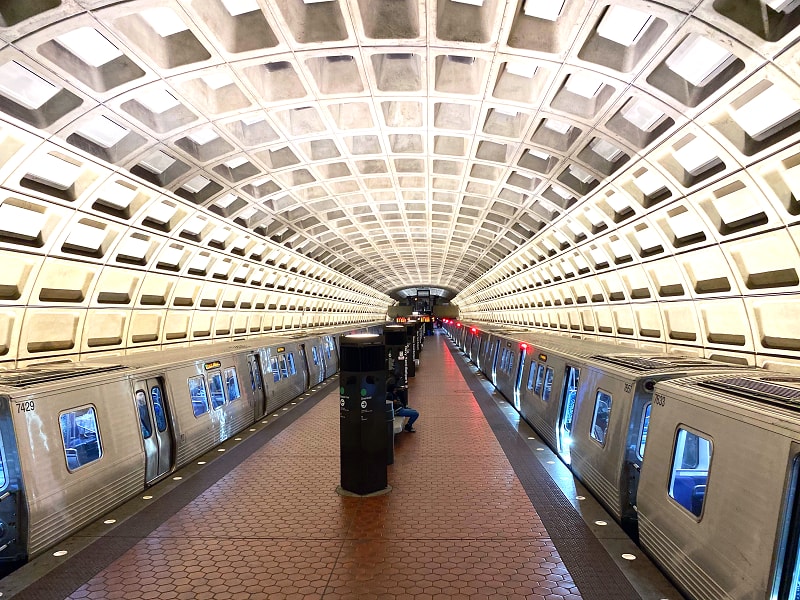
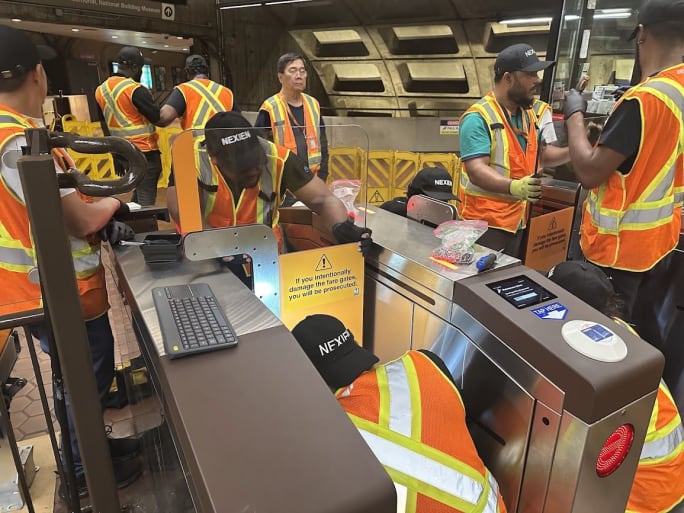
More than 1,200 five-foot-tall gates and taller fences have been installed across all stations. The agency also improved its fare boxes across its bus fleet.
Fare evasion increased to record levels during the pandemic, leading to a loss of $40 million of fare revenue a year. WMATA relies on those fares to help keep buses, trains, and MetroAccess services running.
The improvements have led to an 82% drop in fare evasion in the Metrorail system.
Ad Loading...
Completion of the Fare Gate Project
More than 1,200 five-foot-tall gates and taller fences have been installed across all stations. The project began in July 2023.
“We have seen incredible results from the taller faregates,” said WMATA GM/CEO Randy Clarke. “We are never going to completely stop fare evasion, but these go a long way in addressing the problem.”
WMATA also recently completed the installation of new fareboxes across all 1,500 of its buses.
Customers often could not pay on buses because of farebox malfunctions. Metro Transit Police regularly patrol bus loops and individual bus routes to enforce payment.
Preventing Fare Evasion
Fare evasion is one of customers’ biggest concerns, according to WMATA surveys. Customers said it made them feel unsafe and that it was unfair to those who paid fares.
Ad Loading...
“Tackling fare evasion has been one of the board of directors top priorities,” said WMATA Board Finance and Capital Committee Chair Matt Letourneau. “Not only does fare evasion cost us badly needed revenue, but it is also fundamentally unfair to all our customers who pay their hard-earned money.”
Metro Transit Police continue to patrol stations for fare evasion and have written more than 10,000 fare evasion citations so far this year. That’s nearly three times the number of tickets written through the same period last year and 2,000 more citations than all of 2019.
Revenue from the tickets goes to the local governments.
Fare evasion is one of customers’ biggest concerns, according to WMATA surveys. Customers said it made them feel unsafe and that it was unfair to those who paid fares.
Photo: WMATA
Fare Enforcement Success, Help for Those Who Need It
So far this year, MTPD has arrested more than 250 individuals stopped for fare evading and found to have open warrants. Police have also recovered 16 guns.
Fare evasion increased to record levels during the pandemic, leading to a loss of $40 million of fare revenue a year. Metro relies on those fares to help keep buses, trains, and MetroAccess services running.
Ad Loading...
For those who need help paying, WMATA has several fare discount programs.
Nearly 8,500 people have signed up for Metro Lift, a half-off fare program launched in June 2023 for low-income individuals enrolled in SNAP. Those over age 65 are eligible for half-off fares with a Senior SmarTrip card. D.C. students are eligible for the Kids Ride Free program.
From breaking down data silos to preparing for AI, Strada360 CEO Steve Lassey discusses how transit agencies can use technology to improve operations, customer information, and long-term decision-making.
Eric Reese discusses how interoperability, open architecture, and modular design can help transit agencies control costs, reduce vendor lock-in, and upgrade technology without starting over.
John Hanlon shares how AlphaRoute is leveraging AI-powered technology to help paratransit providers optimize operations, support frontline staff, and enhance the rider experience.
CEO Magnus Friberg discusses Luminator’s shift toward becoming a digital partner, the growing importance of software and interoperability, and how AI can help agencies improve operations and passenger experience.
Reliability-Centered Maintenance helps transit agencies move beyond routine checklists to focus limited resources on the assets and failures that have the greatest impact on safety, reliability, and service.
More than 1,500 buses now feature upgraded technology designed to improve arrival predictions and provide free Wi-Fi, with deployment expected to reach nearly 2,000 buses by the end of 2026.
John Hroncich discusses BAE Systems’ modular and scalable approach, lessons learned from decades of real-world operations, and how agencies can identify electrification strategies that fit their fleets.
In METRO's latest installment, we take a look at recent news from Complete Coach Works, Beep, FlixBus, and more partnerships making headlines across the transportation sector.
What if transit leaders could ask any operational question and get a trusted answer in seconds? Conversational AI is transforming how agencies use their data.