



WMATA extends, improves 'Rush Hour Promise' to riders
The service guarantee has credited back approximately $1 million for more than 277,000 trips with delays greater than 15 minutes.

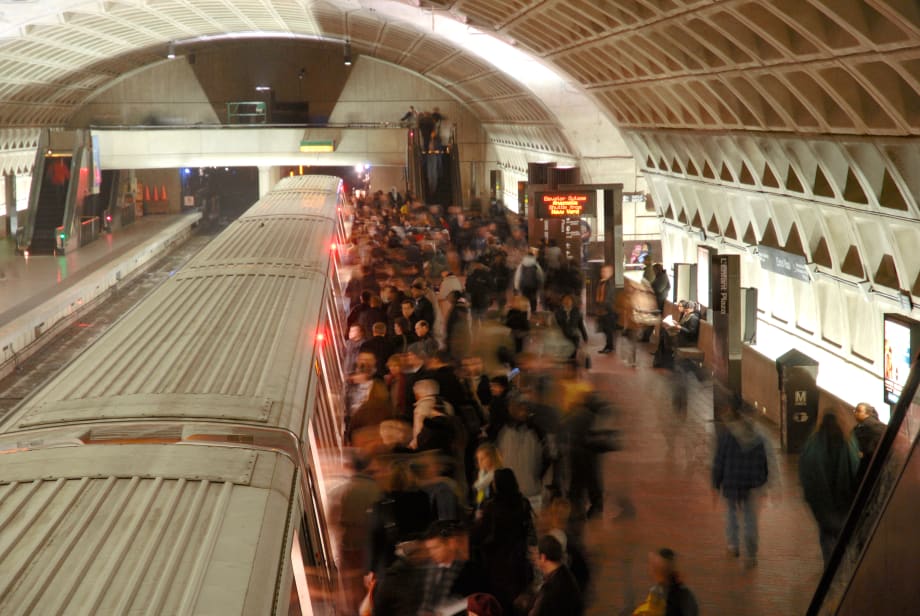
In September, WMATA achieved its highest on-time performance in more than seven years when 90% of 13.1 million passenger trips arrived within the expected travel time.
Larry Levine
In September, WMATA achieved its highest on-time performance in more than seven years when 90% of 13.1 million passenger trips arrived within the expected travel time.
Larry Levine
The Washington Metropolitan Area Transit Authority’s (WMATA) board of directors voted to expand its first-of-its-kind Rush Hour Promise program through June 2019, and to improve it to include unscheduled delays of 10 minutes or more, rather than 15 minutes today.
Beginning January 1, Metrorail or Metrobus customers using a registered SmarTrip card who experiences a rush-hour delay of 10-minutes or more will receive a Metro credit for future travel.
“Metro service continues to be more reliable, thanks to new preventive maintenance programs and new railcars,” said WMATA GM/CEO Paul J. Wiedefeld. “We understand our customers' time is valuable and we are holding ourselves accountable to deliver reliable, on-time service.”
The service guarantee, first launched in January, has credited back approximately $1 million for more than 277,000 trips with delays greater than 15 minutes. This represents .3% of all rush hour trips during that period and 50% of lower than original projections, while also helping to maintain current ridership.
In September, WMATA achieved its highest on-time performance in more than seven years when 90% of 13.1 million passenger trips arrived within the expected travel time.
Customer research suggests Rush Hour Promise has restored confidence in reliability, a key measure to attract new riders and encourage existing riders to continue using WMATA. Over the past 10 months, most customers (93%) who received Rush Hour Promise credits returned, reversing past trends when unreliable service drove customers away.
The expanded service guarantee is recognition of WMATA’s continued improvement and investment in new trains, robust preventive maintenance, and capital improvements. Railcar performance is now the best in eight years, traveling 50% more miles before experiencing delays, according to the agency. Fire incidents also declined nearly 40% in the past year and track problems decreased by 83% in the first quarter of FY2019.
Customers who wish to take advantage of the Rush Hour Promise program can simply register their SmarTrip card anytime. The program is fully automated for rail riders. The system measures when a customer “taps into” the system and when they “tap out.” If the trip takes 10 minutes or longer than the expected travel range, a credit will be provided to cover the full value of the delayed trip for customers paying with stored value or using SmartBenefits.
WMATA will consider whether to extend the program beyond June as part of the FY2020 budget.
More Rail

New York MTA Advances Final Contract for Second Avenue Subway Expansion
Contract Four is the largest in the Second Avenue Subway Phase 2 project and includes construction of station infrastructure, tracks, and signals for the subway expansion, MTA officials said. Work on Contract Four will begin in 2027.
Read More →
San Diego MTS Breaks Monthly Trolley Ridership Record
Agency officials said July’s ridership indicates MTS’s continued recovery from the pandemic.
Read More →
Report Examines NJ TRANSIT Reliability, Funding Challenges
The Garden State Initiative analysis examines the roles of Amtrak infrastructure, fleet management, and agency operations while recommending a more performance-based approach to improving reliability.
Read More →
Stadler, CapMetro Sign Long-Term Rail Fleet Support Agreement
Beginning in 2027, Stadler will provide on-site technical expertise, spare parts support, training, and obsolescence management to help extend the reliability and longevity of CapMetro’s GTW fleet.
Read More →
Biz Briefs: Alstom Lands Canadian Contract, LYT to Supply California TSP, and More
In METRO's latest installment, we take a look at recent news from Complete Coach Works, Beep, FlixBus, and more partnerships making headlines across the transportation sector.
Read More →
CATS Gold Line Marks 5 Years of Service, 2.8M Passenger Trips
With a six-mile expansion planned, the Charlotte streetcar is positioned to connect more neighborhoods and major transit hubs across the region.
Read More →
Why Simulating Pedestrian Movement Has Become Essential for Modern Rail Stations
Pedestrian microsimulation is helping rail planners identify bottlenecks, test station designs, and prepare complex transit hubs for growing passenger volumes.
Read More →
Amtrak Begins Major Construction at New York’s Sunnyside Yard
The new maintenance facility will support Amtrak’s Airo trainsets while improving maintenance efficiency and turnaround times in New York.
Read More →
Chicago Leaders Unveil Plans for O’Hare Airport Express Train
The privately developed project would offer a 15-minute trip between downtown and O’Hare’s Terminal 2, with trains operating every 15 minutes on a dedicated track. The service would use battery-electric trains and three existing freight rail rights-of-way.
Read More →
OCTA Maps Out 30-Year Strategy to Protect Coastal Rail Corridor
The draft feasibility report identifies strategies to protect the coastal rail line for decades as the agency continues near-term stabilization and sand placement efforts.
Read More →