



WMATA to allow bicycles on trains during rush hour
Policy change expected to make Metrorail a more attractive travel option for reverse commuters who use bikes to travel between rail station and jobs.

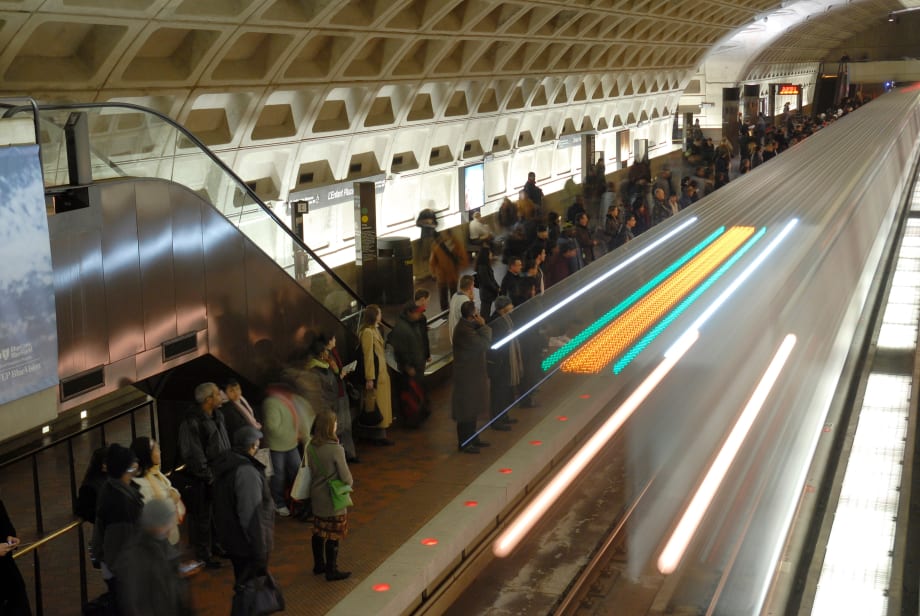
WMATA will monitor implementation of the new policy to determine whether any modifications are necessary.
Larry Levine
WMATA will monitor implementation of the new policy to determine whether any modifications are necessary.
Larry Levine
Beginning next week, Washington Metropolitan Area Transit Authority (WMATA) customers will be able to bring their bikes with them on the train — at any time — as the agency is ending a long-standing restriction that prohibited bicycles during rush hours.
The policy change, which takes effect Monday, is expected to make Metrorail a more attractive travel option for reverse commuters who want to take their bike to travel between the rail station and their workplace.
WMATA reviewed its policy and determined that it could respond to requests from the bicycling community by ending the rush-hour bike restriction without significant negative effects. The review took into account that the majority of rush-hour trains are eight cars in length (the longest possible), and that new 7000-series trains provide more open space.
“We received requests from Washington Area Bicyclist Association (WABA) and others in the bicycle community asking us to take a fresh look at our policy,” said WMATA COO Joe Leader. “We believe this change supports ridership growth by Metro a commuting option for those who want to have a bike with them.”
When Metrorail first opened, bikes were not allowed in the system at all. Since then, WMATA has incrementally loosened restrictions without significant problems. Bikes were first allowed in 1982, with a paid permit on weekends and holidays only. The days and hours when bikes were allowed gradually expanded over time. Permits were eliminated in 1998, and the current policy was established in 2001, allowing bikes at all hours except weekdays from 7 a.m. to 10 a.m. and 4 p.m. to 7 p.m.
WMATA will monitor implementation of the new policy to determine whether any modifications are necessary. In addition, the agency reserves the ability to restrict bicycles on the rail system during major events drawing high ridership, such as July 4 fireworks and Inauguration Day.
Customers can also bring their bikes with them on Metrobus. All 1,500 Metrobuses are equipped with a rack on the front that can accommodate up to two full-size bikes at a time.
Roughly 0.8% of WMATA customers arrived at their rail station by bike in 2016. The WMATA Board has set a goal of increasing that percentage to 2.1% by 2020.
More Rail

New York MTA Advances Final Contract for Second Avenue Subway Expansion
Contract Four is the largest in the Second Avenue Subway Phase 2 project and includes construction of station infrastructure, tracks, and signals for the subway expansion, MTA officials said. Work on Contract Four will begin in 2027.
Read More →
San Diego MTS Breaks Monthly Trolley Ridership Record
Agency officials said July’s ridership indicates MTS’s continued recovery from the pandemic.
Read More →
Report Examines NJ TRANSIT Reliability, Funding Challenges
The Garden State Initiative analysis examines the roles of Amtrak infrastructure, fleet management, and agency operations while recommending a more performance-based approach to improving reliability.
Read More →
Stadler, CapMetro Sign Long-Term Rail Fleet Support Agreement
Beginning in 2027, Stadler will provide on-site technical expertise, spare parts support, training, and obsolescence management to help extend the reliability and longevity of CapMetro’s GTW fleet.
Read More →
Biz Briefs: Alstom Lands Canadian Contract, LYT to Supply California TSP, and More
In METRO's latest installment, we take a look at recent news from Complete Coach Works, Beep, FlixBus, and more partnerships making headlines across the transportation sector.
Read More →
CATS Gold Line Marks 5 Years of Service, 2.8M Passenger Trips
With a six-mile expansion planned, the Charlotte streetcar is positioned to connect more neighborhoods and major transit hubs across the region.
Read More →
Why Simulating Pedestrian Movement Has Become Essential for Modern Rail Stations
Pedestrian microsimulation is helping rail planners identify bottlenecks, test station designs, and prepare complex transit hubs for growing passenger volumes.
Read More →
Amtrak Begins Major Construction at New York’s Sunnyside Yard
The new maintenance facility will support Amtrak’s Airo trainsets while improving maintenance efficiency and turnaround times in New York.
Read More →
Chicago Leaders Unveil Plans for O’Hare Airport Express Train
The privately developed project would offer a 15-minute trip between downtown and O’Hare’s Terminal 2, with trains operating every 15 minutes on a dedicated track. The service would use battery-electric trains and three existing freight rail rights-of-way.
Read More →
OCTA Maps Out 30-Year Strategy to Protect Coastal Rail Corridor
The draft feasibility report identifies strategies to protect the coastal rail line for decades as the agency continues near-term stabilization and sand placement efforts.
Read More →