



BART replacing old third rail for a smoother and more reliable ride
The new rail is half the weight of the old and conducts electricity better.
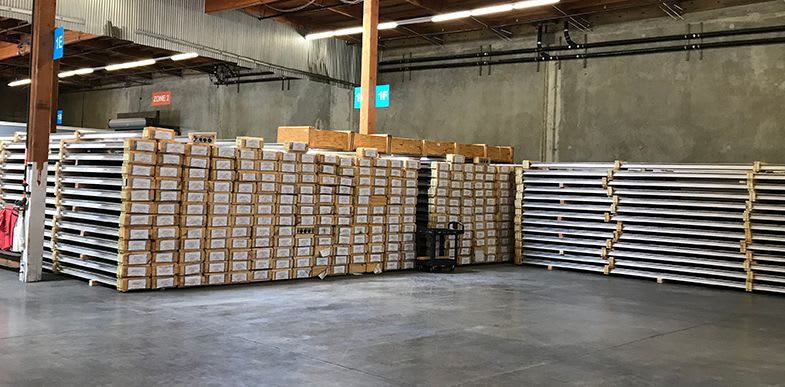
New, stainless steel-capped aluminum third rail segments stacked in a warehouse.
BART
New, stainless steel-capped aluminum third rail segments stacked in a warehouse.
BART
A key part of BART’s Measure RR rebuilding work is renewing power infrastructure, a major upgrade that will improve the rider experience through greater reliability and less down time for repairs.
Along with cable and traction power substation replacement, part of the job is replacing sections of third rail, the electrified rail that powers BART trains.
Stacked high in a chock-full storage warehouse are stainless steel-capped, aluminum third rail segments that will be more efficient and economical. The new rail is half the weight of the old and conducts electricity better.
That means easier and faster installation, because the old rail weighed in at 27 pounds per foot or 810 pounds for a typical 30-foot segment or “stick,” more than twice the weight of the new rail. It takes many workers to handle such a heavy load, and the old rail is also six times stiffer than the new, making it tough to position just right. With the new rail, BART can do repairs more quickly, requiring less down time and inconvenience.
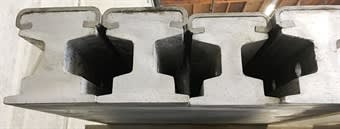
Close-up detail of the new third rail that is stacked in a warehouse waiting to be used.
BART
The warehouse holds some 2,400 sticks of new rail, at 12 pounds per foot, or 360 pounds per stick. That’s light enough to require far fewer workers to handle. There’s a thick aluminum bar to conduct electricity, covered by a tough stainless steel cap for resistance to the countless iron paddles from train cars that slide across its top, transferring power to the train.
“Third rail is an important asset for reliability of the power system and continuous train operation,” said Myat San, BART’s Group Manager for Power and Mechanical Engineering. “The useful life of these third rail segments is about 20 years. As they age, efficiency and performance will be impacted.”
RELATED: Powers takes over as 10th BART GM
Back in the 1960s and 1970s, Kaiser Aluminum (no longer in business) supplied all of BART’s third rail for the core system.
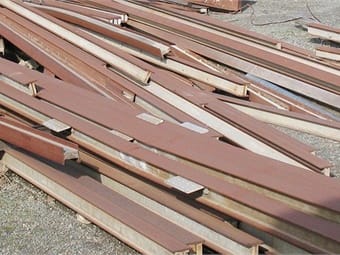
Old Kaiser Aluminum rail, past its useful life, is put into a scrap pile for removal.
BART
There were two styles, a regular one at 4 micro-ohms per foot (an ohm is a standard measure of electrical resistance) and a more conductive version known colloquially as “double-stuff Oreo” at 2 micro-ohms per foot. The more conductive one was considerably more expensive and used in areas with long distances between traction power substations.
The original third rail was made by standing 30-foot steel I-beams vertically in molds, and pouring in molten aluminum for a strong bond. It was symmetrical top and bottom, so when the tops wore out after about 20 years of use, BART electricians simply flipped them to use the other side. Eventually both sides would wear out and require third rail replacement.
By around 1990, with much of the third rail in high-wear areas at the end of its useful life and with no more Kaiser Aluminum to provide new rail, another manufacturer provided for core system replacements, as well as for new extensions to the BART system such as to San Francisco International Airport. This rail is the heavier, less conductive rail in much of the system today.
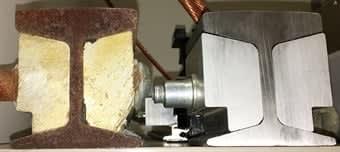
A corroded, weather-exposed rail cross-section, left, and a pristine sample.
BART
BART also decided to make all new third rail the thicker aluminum 2 micro-ohm/ft. version—the double-stuff Oreo kind -- to reduce voltage drops and improve train performance between substations. Third rail voltage has direct impact on train performance, and thus it is important to maintain it at acceptable levels.
RELATED: BART team wins APTA Rail Rodeo
Several years ago BART tested a new, stainless-capped aluminum third rail product that offered many advantages, and test sections were installed south of Bay Fair Station to see how it performed. After successful tests, BART is moving forward to install it systemwide, replacing legacy 4 micro-ohm rail with the more economical, more conductive, lighter and more flexible new rail. That’s good news for passengers, who can expect a smoother, more reliable ride from the new third rail, the backbone of power for the whole BART system.
“The Measure RR work we are doing to replace substations, transformers, third rail and more, is about reliability and a better experience for BART’s riders,” San said.
BART District voters in 2016 approved the Measure RR infrastructure bond for rebuilding the system. For more information, visit our Measure RR rebuilding website.
More Rail

New York MTA Advances Final Contract for Second Avenue Subway Expansion
Contract Four is the largest in the Second Avenue Subway Phase 2 project and includes construction of station infrastructure, tracks, and signals for the subway expansion, MTA officials said. Work on Contract Four will begin in 2027.
Read More →
San Diego MTS Breaks Monthly Trolley Ridership Record
Agency officials said July’s ridership indicates MTS’s continued recovery from the pandemic.
Read More →
Report Examines NJ TRANSIT Reliability, Funding Challenges
The Garden State Initiative analysis examines the roles of Amtrak infrastructure, fleet management, and agency operations while recommending a more performance-based approach to improving reliability.
Read More →
Stadler, CapMetro Sign Long-Term Rail Fleet Support Agreement
Beginning in 2027, Stadler will provide on-site technical expertise, spare parts support, training, and obsolescence management to help extend the reliability and longevity of CapMetro’s GTW fleet.
Read More →
Biz Briefs: Alstom Lands Canadian Contract, LYT to Supply California TSP, and More
In METRO's latest installment, we take a look at recent news from Complete Coach Works, Beep, FlixBus, and more partnerships making headlines across the transportation sector.
Read More →
CATS Gold Line Marks 5 Years of Service, 2.8M Passenger Trips
With a six-mile expansion planned, the Charlotte streetcar is positioned to connect more neighborhoods and major transit hubs across the region.
Read More →
Why Simulating Pedestrian Movement Has Become Essential for Modern Rail Stations
Pedestrian microsimulation is helping rail planners identify bottlenecks, test station designs, and prepare complex transit hubs for growing passenger volumes.
Read More →
Amtrak Begins Major Construction at New York’s Sunnyside Yard
The new maintenance facility will support Amtrak’s Airo trainsets while improving maintenance efficiency and turnaround times in New York.
Read More →
Chicago Leaders Unveil Plans for O’Hare Airport Express Train
The privately developed project would offer a 15-minute trip between downtown and O’Hare’s Terminal 2, with trains operating every 15 minutes on a dedicated track. The service would use battery-electric trains and three existing freight rail rights-of-way.
Read More →
OCTA Maps Out 30-Year Strategy to Protect Coastal Rail Corridor
The draft feasibility report identifies strategies to protect the coastal rail line for decades as the agency continues near-term stabilization and sand placement efforts.
Read More →